The English translation is not very accurate.
I'm interested in the X1 Carbon, so I looked into this article.
-----------
You may remember visiting the Lenovo booth at IFA in Berlin earlier this year and getting a sneak peek at some upcoming ThinkPad and Yoga laptops.
One of those models, the ThinkPad Carbon X1 Aura Edition, has been launched in China, and
one reason why this laptop stands out among many other laptops and 2-in-1 devices is that it's the first mobile product to feature a PCI Express 5.0 solid-state drive (SSD).
If you missed our previous coverage, we introduced an experience report on Lenovo's laptops unveiled at IFA in Berlin,
especially the ThinkPad models equipped with cutting-edge SSDs.
PCIe 5.0 SSDs already exist to some extent, but they haven't gained a strong foothold in the desktop space and didn't exist in laptops until now.
One reason why it took so long for this technology to appear in laptops is likely related to issues with heat management and dissipation.
While thermal output management is much easier in desktop environments, it's not as straightforward in laptops.
The PCIe 5 SSD brings performance improvements while also introducing additional challenges.
We can see how Lenovo is addressing this in a photo posted on Weibo.
The photo compares the older ThinkPad X1 Carbon with the new model equipped with a PCIe 5 SSD.
In the new model, the drive is covered by a metal heatsink, and the poster concludes that "energy consumption and heat generation are significantly higher than in the older model."
While we can't say for sure until we test it ourselves, this seems like a reasonable assumption. Then the question arises: where is the limit of diminishing returns?
On paper, PCIe 5 SSDs are up to twice as fast as PCIe 4 SSDs. In reality, there are only specific scenarios where this benefit will be noticeable.
To this end, the laptop is optimized for AI. It's based on Intel's Core Ultra 7 258V processor,
which is an 8-core Luna Lake processor clocking up to 4.8GHz, featuring 12MB of L3 cache and an onboard NPU capable of handling 47 TOPS.
It also boasts 32GB of LPDDR5X-8533 memory, 1TB or 2TB of storage, a battery with up to 18 hours of usage time (57Whr),
and fairly robust I/O connectivity (1x HDMI 2.1, 5Gbps's 2x USB-A, 1x Thunderbolt 4/USB-C, 3.5mm audio jack, SIM card slot).
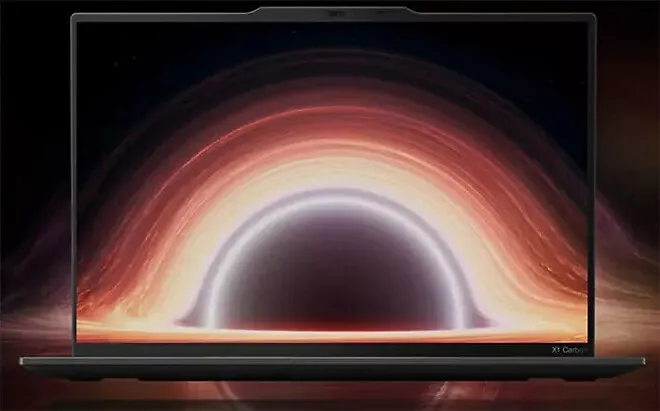
The display is also highly rated. It features a 14-inch OLED screen with a resolution of 2880x1800, a refresh rate of 120Hz,
a maximum brightness of 500 nits (HDR), and covers 100% of the DCI-P3 color gamut.
According to ITHome, Lenovo's ThinkPad X1 Carbon Aura Edition will be priced at 15,999 yuan for the 1TB PCIe 5 SSD model and 17,999 yuan for the 2TB variant. Typically, companies don't follow a simple currency exchange rate from one region to another, but
these prices translate to approximately $2,200 (1TB) and $2,475 (2TB) in US dollars.