
Since this is a translation of an overseas article, there may be mistranslations.
https://www.flatpanelshd.com/news.php?subaction=showfull&id=1785302409
TV manufacturers are betting their future on 98-inch and 100-inch TVs.
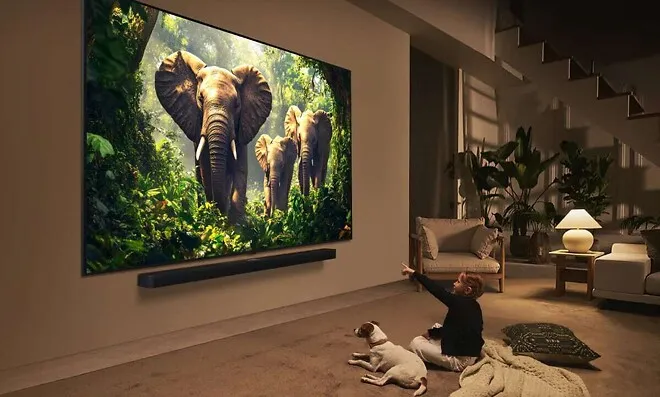
TCL opened the door and Hisense quickly followed suit. Now, all major TV brands are jumping into the 98-inch and 100-inch segment, which is contributing to price reductions.
It took several years for 55-inch and 65-inch TVs to reach reasonable price points, but the leap from 75 inches to 85 inches and then to 98 inches and 100 inches has been remarkably fast in recent years.
The first affordable 98-inch TV was launched by TCL in 2022. This happened after the pandemic boom in TV sales had subsided. TCL CSOT, which utilizes its remaining production capacity to cut panels, began a full-fledged offensive into the large-screen TV market with 98 inches and 85 inches.
Later that year, it was reported that large TV sales had grown significantly across various markets. In the same year, Hisense launched the first affordable 100-inch TV. The dream of a home cinema is rapidly becoming a reality.
Other brands followed suit.
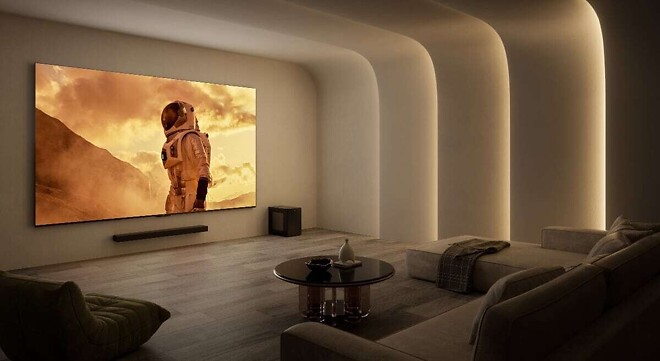
Things progressed quickly from there. Samsung and Sony entered the market with affordable 98-inch TVs in 2023. The following year saw even cheaper options emerge, particularly TCL expanding its 98-inch portfolio significantly from budget to premium models.
In 2024, LG joined the trend with its first 98-inch LCD TV available only in select regions. The following year, it launched its first 100-inch LCD TV with wider availability.
In 2025, a surge of 98-inch and 100-inch TVs from various smaller brands flooded the market.
This year, Philips launched its first 100-inch TV as part of The One series, its line of essential feature TVs. This demonstrates how mature this market has become.
At least in 4K. It's worth noting that most 98-inch and larger TVs still use 4K panels, not 8K, even though this screen size is where a higher resolution starts to make a real difference.
The proliferation of large TVs has been accompanied by a rapid decline in prices. Large TVs have become popular items during Black Friday sales. For example, one of TCL's 98-inch models hit $1000 during last year's Black Friday. A 98-inch TV is almost four times the screen area of a 50-inch TV. Photo TCL
China leads the market
This launch ultimately leaves Panasonic as the only traditional TV brand without a large screen model. Since Panasonic's TV business was recently acquired by China Skyworth, changes are expected there soon. In any case, large panels are sourced from China.
In all cases, these products are LCD TVs that do not necessarily use MiniLED or RGB LED. Picture quality varies significantly from the cheapest models to the most expensive ones. LG offers a 97-inch OLED TV, but it is still unrealistically expensive even though the first generation was launched four years ago.
TCL CSOT produces all 98-inch LCD panels for all brands. 100-inch panels are also produced by Chinese companies BOE and HKC.
You can check the TV database for filtering by size to see the options of major TV manufacturers.
How much bigger can TVs get?
The accelerating trend towards larger TVs is partly due to a strategic push by LCD TV manufacturers who are losing market share to OLED in the 55-inch, 65-inch and increasingly 75-inch and 77-inch segments. Increasing the size is a countermeasure in areas where OLED still lacks price competitiveness.
This trend is also shifting a larger share of display panel production from Korea and Taiwan to China. Japan has already been pushed out of price competition.
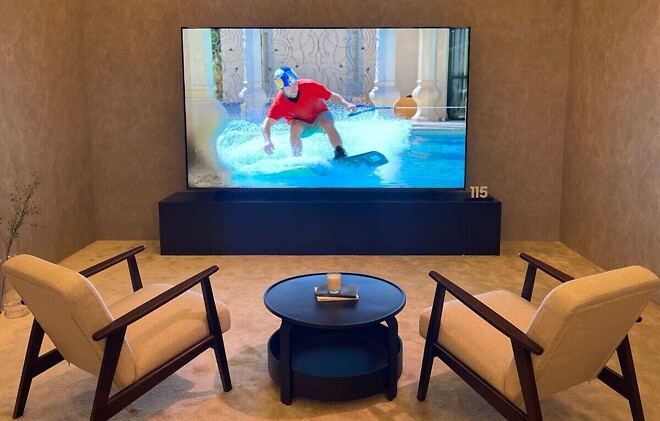
This is also having an impact on the beamer projector market. TVs are offering significantly better picture quality overall, including HDR content. After the 115-inch photo model, a 130-inch LCD TV is expected to follow.
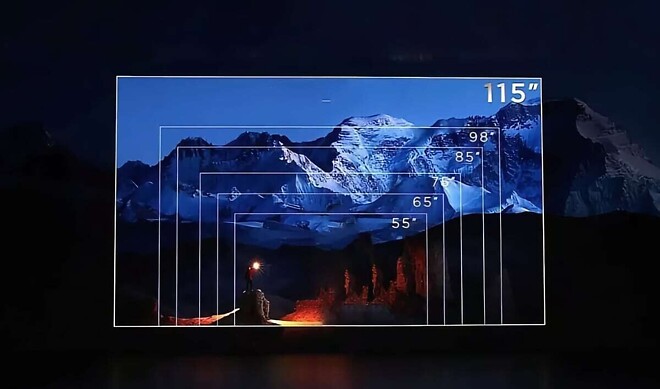
The question is where this will end. What comes after 100 inches? Some TV manufacturers have already launched 115-inch LCD TVs and a 130-inch model is expected to follow in the second half of 2026. But at some point, the limits of physics will catch up. There are practical limits to how big a TV can be before people can no longer fit it through doorways or into living rooms or basements.
Unless the industry starts thinking about alternatives, TVs exceeding 130 inches may hit a wall. Rollable TVs didn't initially get much traction, but that doesn't mean the idea is completely scrapped.
The industry is also experimenting with modular LED displays like those used in cinemas, but these are still very expensive and not easy to install. Perhaps all of this will lead in a completely different direction, such as VR headsets that can create virtual displays far exceeding 1000 inches.
▶ Source: https://www.flatpanelshd.com/news.php?subaction=showfull&id=1785302409