This is a translation of a foreign article, so there may be mistranslations.
https://www.avpasion.com/tcl-proyecto-t8-china-televisores-oled-lg-samsung/
TCL, Completing T8 Factory Faster Than Expected: Threatening LG and Samsung's OLED TV Monopoly.
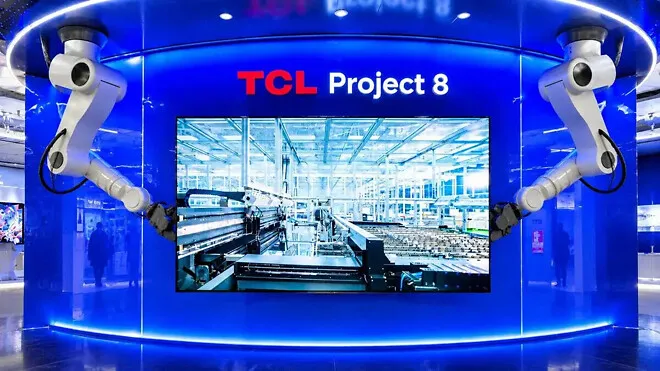
Finally, the world's first printing OLED panel factory has begun operations. TCL's 'Project T8' is not a new Terminator series, but a massive factory built and dedicated to a single concrete goal.
That goal is to arm China and enter the OLED TV field, which until now has been the exclusive domain of Korean brands LG and Samsung. Until now, the only large-scale OLED panel manufacturers in the world were these two, but as just mentioned, that is a matter of the 'past'.
As confirmed two years ago, TCL has already broken ground on the new T8 factory. Just two months ago, we heard news that construction was underway and the factory was expected to be completed around Q3 or Q4 of 2026. However, as of May 11, 2026, according to CNMO Technology, the brand announced that it has already completed factory construction and will immediately begin OLED panel production. What is the purpose? It is to fill the market with much cheaper printing OLED panels and capture a share of this market.
Project T8: TCL's Massive Factory for Manufacturing Printing OLED Panels for TVs
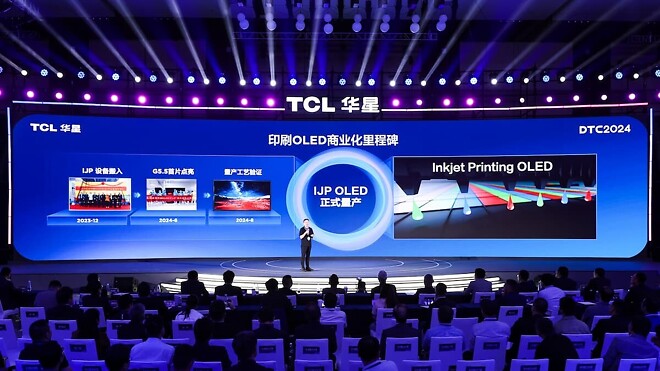
In any case, as seen in news from two months ago, TCL's intention is to enter the OLED TV field and dramatically lower prices, thereby capturing the throne in the segment currently monopolized by Korea. To do this, it will use 'inkjet printing OLED' technology. The total investment in this project is approximately 29.5 billion yuan (approximately 5.3 trillion won in Korean currency / 3.6 billion euros), with monthly processing capacity of approximately 22,500 glass substrates.
Since beginning main construction on November 30, 2025, this project has continuously accelerated construction efficiency thanks to support from an integrated construction service system. As a result, the entire process from groundbreaking of the main construction to completion of the structure was completed in just 151 days.
As a result, this massive facility will be able to begin mass production of G8.6 generation OLED panels through an inkjet system. TCL's concept is to manufacture 2290 × 2620 mm sized 8.6 generation OLED glass substrates through an on-demand deposition method. Compared to the conventional vacuum deposition method, this method has significant advantages: high material utilization, potentially superior yield rates, and the possibility of more environmentally friendly and efficient production.
Inkjet Printing OLED Panels: The 'Budget' OLED TV Revolution Begins
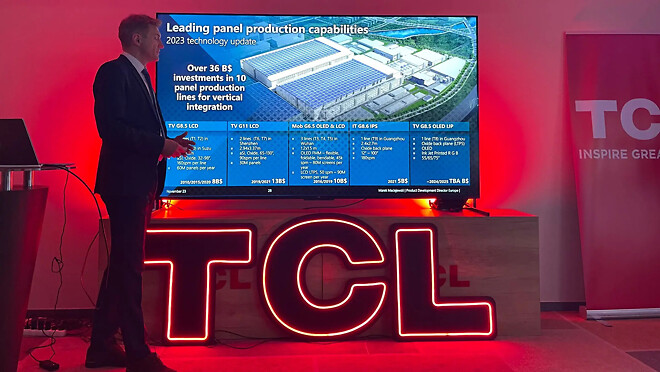
This year, in particular, LG announced in a big way that it would create a more affordable OLED model line. It makes sense. They see the wolf that is China approaching. OLED is currently the world's best smart TV, but it is very expensive compared to mid-range mini-LED models that form a price point impossible with OLED. This is precisely what TCL is aiming for through inkjet printing TVs.
According to Chinese sources, the inkjet printing system is very efficient. For this, a large printer that prints panels will be used. Unlike conventional manufacturing methods, the inkjet method precisely deposits the substrate without needing to use a mask, reducing the number of lost particles, increasing yield, and dramatically lowering costs. Furthermore, using this method allows for the production of higher resolution models without significantly affecting the price.
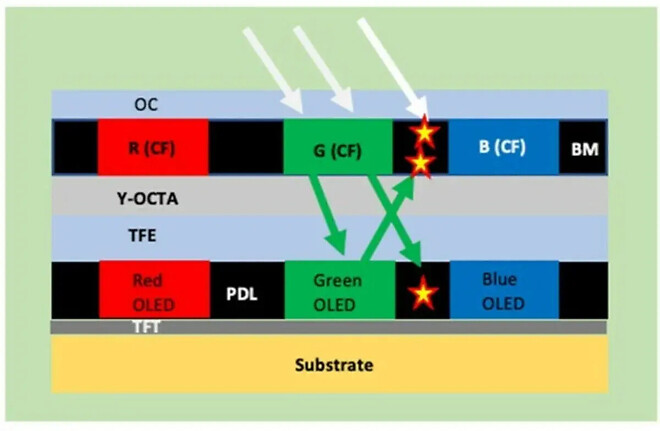
In the end, until now TCL could only produce a small number of prototypes to verify technical feasibility. After confirming the possibility, they accelerated the construction of the massive 'Project T8' factory to supply the large production volumes the market demands. Moreover, building the factory in just 151 days is truly a maniacal pace. Based on their speed, we will likely see results from this inkjet printing OLED panel sooner than expected—much sooner than most might think.
https://www.hdtvtest.co.uk/news/omdia-forecasts-inkjet-printed-oled-panels-to-cost-a-whole-lot-less
Omdia's Groundbreaking Cost Reduction Forecast for Inkjet-Printed OLED Panels
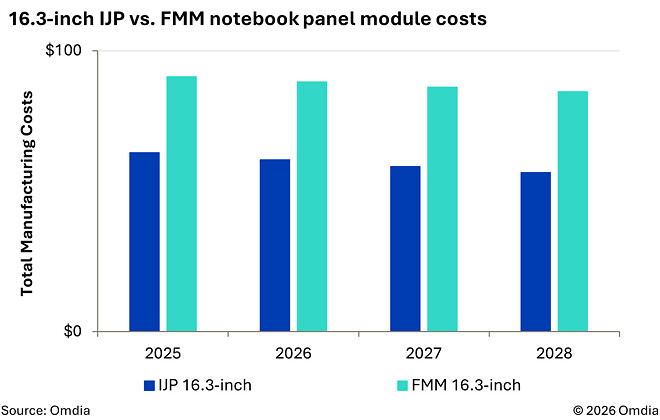
According to Omdia's report this week, OLED display prices are expected to become significantly cheaper in the coming years thanks to the emergence of inkjet-printed panel manufacturing technology that dramatically reduces production costs.
The report mentioned that as a result of these technological advances, the price accessibility of OLED display panels for notebooks, tablets, and ultimately TVs could improve significantly.
Currently, most OLED displays worldwide are produced by LG Display and Samsung Display, and both companies use "Fine Metal Mask (FMM)" technology in panel manufacturing. Omdia analyzed that while FMM costs are declining year-over-year, they still have significantly lower efficiency compared to inkjet printing technology, which Chinese companies such as TCL CSOT and BOE Technology Group are scaling up. As a result, inkjet-printed panels are expected to cost approximately 30% to 35% less than FMM panels.
This difference stems from how OLED pixel material is attached to the panel. The FMM method uses a kind of stencil to spray material onto the panel, resulting in significant waste. In contrast, inkjet printing is much more precise, resulting in much less material waste.
Given that OLED displays currently cost much more than LCD panels and most OLED TVs and monitors are considered premium products, this lower cost is welcome news. However, inkjet printing is still a very new technology, and neither TCL CSOT nor BOE has yet manufactured OLED displays at the scale required for commercial mass production.
However, TCL CSOT hopes to change this, and it is known that its new 8.6-generation OLED factory, which began operations last year, is progressing smoothly. Originally, this facility was expected to be able to start mass production of OLED displays at the earliest by the end of 2027, but according to a report from last March, the company's schedule has been moved up significantly ahead of schedule.
Their first OLED display is expected to be a new 27-inch 120Hz 4K resolution panel based on an RGB stripe pixel structure. The report stated that this panel, designed for monitors, is expected to enter mass production by the end of July.
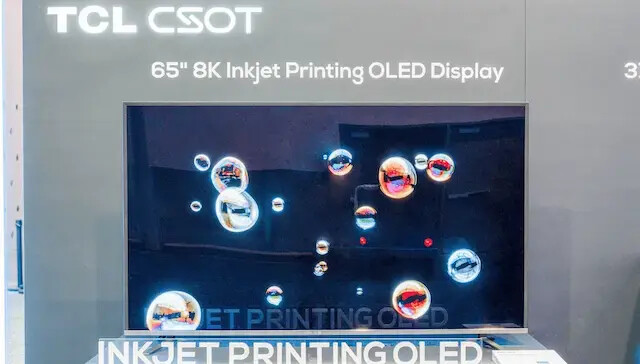
This means that by around next year, affordable OLED panels for monitors and notebooks will definitely emerge, but we may need to wait a bit longer to see affordable OLED TVs. TCL CSOT has released several concepts of inkjet-printed OLED panels for TVs, including a 65-inch display unveiled this week at SID Display Week, but it has no plans to mass-produce them at this stage.
However, the prototype panels suggest that the company is clearly considering such moves, and given the rapid progress so far, it seems reasonable to expect that mass production will be possible before the end of the 2020s.
▶ Original Source: https://www.avpasion.com/tcl-proyecto-t8-china-televisores-oled-lg-samsung/
▶ Original Source: https://www.hdtvtest.co.uk/news/omdia-forecasts-inkjet-printed-oled-panels-to-cost-a-whole-lot-less