This is a translation of a foreign article, so there may be errors in translation.
https://www.flatpanelshd.com/news.php?subaction=showfull&id=1781589632
First HDMI 2.2 Devices Expected to Launch in 2027 — Will TVs Be Included?
The HDMI Forum expects the first devices featuring HDMI 2.2 — which offers up to double the bandwidth — to launch next year, as testing and certification are already underway.
It took two years from the announcement of HDMI 2.1 to the unveiling of the first device, LG's 2019 OLED TV.
HDMI 2.2 appears to be following a very similar pattern. According to coverage by Charbax of ARMdevices.com at Computex 2026, citing an announcement from the HDMI Licensing Administrator, the specification was announced in January 2025, finalized in June 2025, and the first devices are expected to appear in 2027.
Rob Tobias, CEO and Chairman of the HDMI Licensing Administrator, stated that he has heard chip manufacturers will begin sampling FRL2 chips this year, and therefore we can expect to see HDMI 2.2 products supporting 96Gbps — or up to 96Gbps — next year.
Will TVs Also Get HDMI 2.2?
Rob Tobias added that the very first HDMI 2.2 products could actually appear as early as late 2026 — including the first Ultra96 cables expected to receive certification by the end of this quarter or the next, as well as products certified under the new LIP (Latency Indication Protocol), which addresses video and audio latency issues.
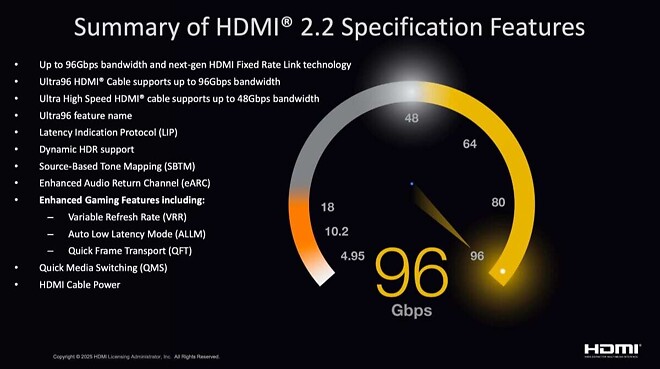
However, when consumers talk about HDMI 2.2 devices, most will think of TVs, AV receivers, game consoles, and media players with increased HDMI bandwidth — and the 2027 timeline mentioned by Rob Tobias refers precisely to these. In such devices, HDMI 2.2 enables up to 96Gbps of bandwidth, double that of HDMI 2.1.
He did not specify which type of HDMI 2.2 device would come to market first, but there is a good chance that premium, high-performance TVs will once again lead the way.
In theory, the adoption of HDMI 2.2 should be easier than the transition from HDMI 2.0 to HDMI 2.1, which required a complete shift to an entirely new signaling system — from TMDS to FRL. HDMI 2.2 is FRL2-based, meaning it continues to build on the existing FRL approach. Hopefully, this will result in fewer defects and issues in other device categories such as AV receivers as well.
The Many Forms of HDMI 2.2.
As with HDMI 2.1, the expanded bandwidth of HDMI 2.2 is optional, not mandatory. As a result, in the coming years we will likely see TVs and AV devices advertised as featuring HDMI 2.2 even if they do not support bandwidth beyond HDMI 2.1's 48Gbps. Once again, HDMI 2.2 will effectively replace HDMI 2.1 as a catch-all marketing term, so buyers should exercise caution when purchasing products.
It is also worth noting that HDMI 2.2 bandwidth actually comes in three tiers: 64, 80, and 96Gbps.
In future articles and its TV database, FlatpanelsHD will only indicate HDMI 2.2 support for devices that support one of the high-bandwidth tiers.
What HDMI 2.2 Makes Possible.
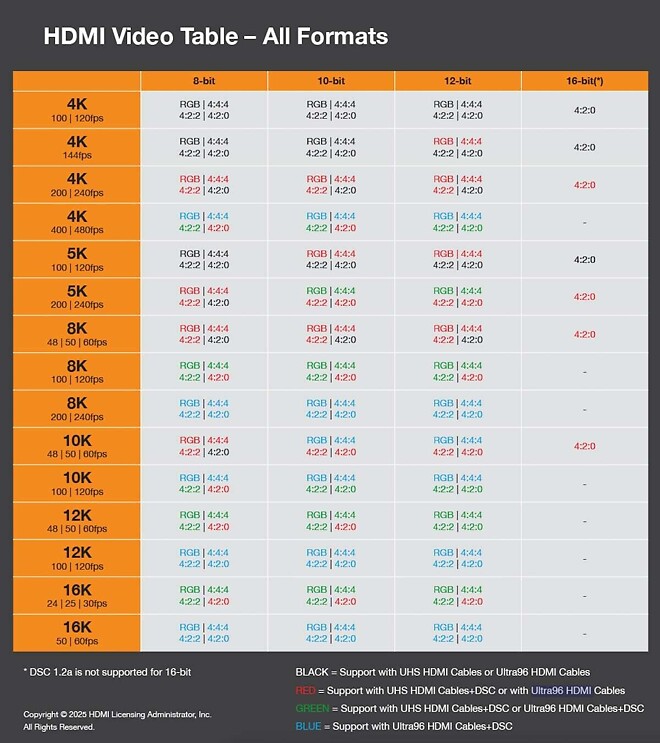
With up to double the bandwidth of HDMI 2.1, HDMI 2.2 enables uncompressed 4K 240Hz even at the 80Gbps tier, uncompressed 4K 480Hz under chroma subsampling 4:2:0 conditions, and — for the first time — uncompressed 8K 60Hz RGB. This can be seen as the first HDMI specification with native 8K support.
Using DSC, a lossless signal compression technology, support can extend well beyond 4K 480Hz, reaching up to 8K 240Hz. It will also allow monitors to drive 1440p resolution at over 1000Hz. Please also refer to the previous article: HDMI 2.2 Launch — Supporting 4K 480Hz, 8K 240Hz, and Even 16K.
In other words, HDMI 2.2 primarily enables resolution, refresh rate, and bit depth in the TV space to be pushed beyond current limits. In the PC market, DisplayPort 2.1 already provides up to 80Gbps of bandwidth, so constraints there are relatively fewer.
The HDMI Forum has already mentioned that TVs supporting 4K 240Hz are in the testing phase.
Looking Back at How HDMI 2.1 Rolled Out.
For reference, here is how HDMI 2.1 was adopted over time:
• In spring 2019, LG's 2019 OLED TV was unveiled as the first HDMI 2.1 device, and Samsung launched the 8K Q950R the same year.
• In 2020, more brands introduced 4K TVs equipped with HDMI 2.1.
• In summer 2020, the first AV receivers featuring HDMI 2.1 were released, though HDMI 2.1 implementation in those products was flawed at the time.
• In September and November 2020 respectively, the first HDMI 2.1 graphics cards launched — the Nvidia RTX 30 series and AMD Radeon RX 6000 series.
• In November 2020, both the PlayStation 5 and Xbox Series X launched with HDMI 2.1 support.
• From 2021, the first HDMI 2.1 monitors became available from various brands.