
This is a translation of a foreign article, so there may be translation errors.
https://wccftech.com/samsung-bets-on-unmanned-fabs-by-2030-to-break-its-unions-leverage-after-a-costly-bonus-war/
Samsung focuses on unmanned fabs by 2030 to break away from unions' influence after costly bonus war
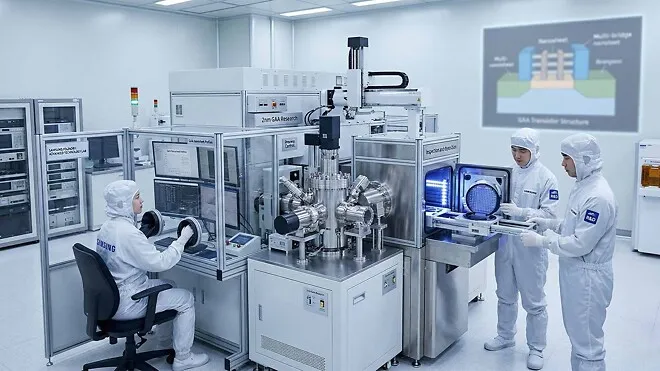
Samsung's semiconductor workers may have won the battle over bonuses, but now it appears they are heading towards losing the war itself. This is particularly because Samsung is accelerating automation to escape the influence of unions.
Samsung's Data Sharing Eco Platform (DSEP), opening a viable path towards fully unmanned semiconductor fabs by 2030
Samsung has established a data-sharing protocol called 'Data Sharing Eco Platform (DSEP)'. The core idea of this platform is to share real-time semiconductor process data with selected partners while inputting this data into an AI-based factory operation system to achieve complete automation by 2030.
According to Korean media ET News (Electronics Times), as many as 60 partner companies, mainly consisting of equipment suppliers, have already joined Samsung's DSEP, and this number is expected to grow over time.
The platform operates in a multimodal fashion. That is, it not only shares relevant data pieces with Samsung's partners, but also collects and analyzes this comprehensive data and inputs it into customized AI models. Through this, it derives practical insights such as yield stabilization, improved defect detection capabilities, and securing accessibility to new processes that were previously judged to have data security risks.
One practical advantage of DSEP is that it can speed up the diagnosis and repair of equipment that previously had to be visited by engineers from related companies because it was considered too sensitive to export outside the fab. Now, through real-time data, suppliers can quickly diagnose problems and take remedial measures without disrupting the entire production rhythm.
To further accelerate the goal of achieving complete automation by 2030, Samsung's semiconductor division is also building a high-performance computing (HPC) platform to provide formidable computing power capable of processing the large-scale data that DSEP is designed to collect, distribute, and analyze.
From the opposite perspective, as Samsung's automation efforts gain momentum, unionized workers and engineers find themselves in a position to lose their influence. This is especially true after they recently threatened destructive strikes if their bonus-related demands were not met, holding the entire group hostage and shaking it for several weeks.
As reported in May, according to an agreement between Samsung and the union, workers will receive a special performance bonus equivalent to 10.5% of the tech giant's annual operating profit if annual operating profit exceeds 200 trillion won from 2026 to 2028, and exceeds 100 trillion won from 2029 to 2035.
In fact, based on current expectations that Samsung will earn approximately 300 trillion won in operating profit this year, memory division employees can receive bonuses of approximately 600 million won (approximately 400,000 dollars) per person this year alone. However, if Samsung's accelerating automation plans are hinting at something, this golden age may not last very long.