
This is a translation of a foreign article, so there may be translation errors.
https://hothardware.com/news/nvidia-ai-robots-install-graphics-cards
NVIDIA AI Robots Learn to Install Graphics Cards Without Human Help
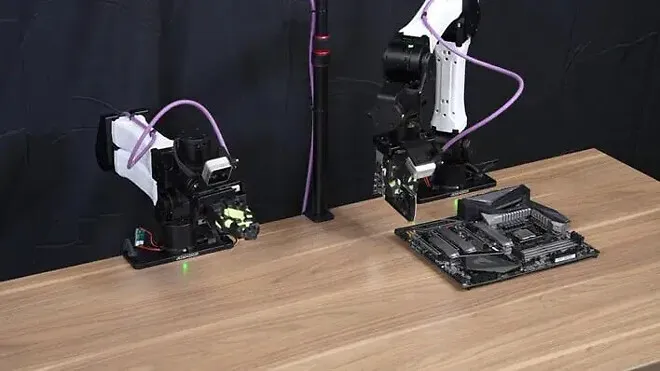
Teaching robots new skills has always been a labor-intensive and challenging task that requires human involvement. Someone had to reset the scene, monitor the hardware, and judge whether the robot performed correctly every time it failed.
NVIDIA now wants that someone to disappear. NVIDIA has been pushing physical AI strongly over the past year, and this latest project takes that concept one step further. Together with Carnegie Mellon University and UC Berkeley, NVIDIA's General Embodied Agent Research Lab has unveiled EnPAIRe, a framework that entrusts the entire training loop to an AI coding agent, allowing robots to learn new skills on real hardware without human supervisors.
This system is a closed-loop feedback system composed of four parts. The environment module resets the scene, performs safety checks, and validates each result. The policy improvement module learns from reward signals, camera footage, execution time tracking logs, and errors that occur to write and modify control code.
The rollout module often runs real tests simultaneously on multiple robots and records everything. The evolution module then compares agent branches, keeping code that works and discarding code that fails. This is similar to how software teams rely on continuous testing, but the difference is that the tests are run on actual robot arms.
To find the best-performing model, researchers deployed three coding agents: Codex based on GPT 5.5, Claude Code Opus 4.7, and Kimi Code based on Kimi K2.6. Each agent proposed ideas, tested them on hardware, and kept only what improved. The results were remarkable. Robots trained on challenging and precise tasks achieved a 99 percent success rate on the pass@8 metric, which allows up to 8 attempts per sub-task and where each retry is corrected based on the previous failure. This is a metric that measures true resilience, not luck.
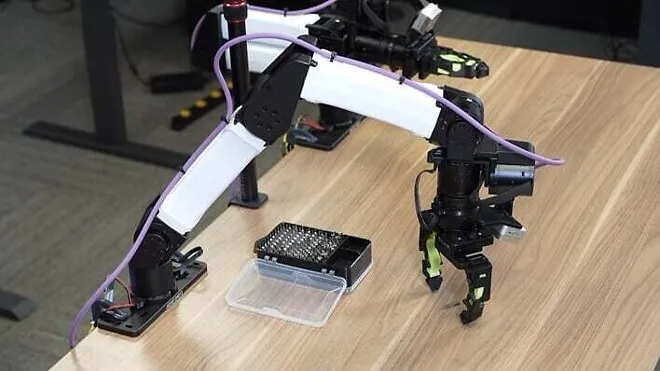
These tasks were by no means easy. The robots sorted small pins into boxes, cut cable ties using actual cutters, and installed expansion cards and graphics cards directly into motherboard slots. Anyone who has struggled to fit a stiff card into a PCIe slot will acknowledge that the last task is a remarkable achievement.
Results vary depending on the size of the agent fleet. The research team tested by running groups of 1, 4, and 8 agents in parallel. A single agent took close to 5 hours to solve the task. 8 agents reduced this to about 2 hours. To measure the pros and cons, NVIDIA introduced two metrics: average robot utilization and average token utilization.
There are trade-offs here. Larger teams reach a working policy much faster, but token usage spikes because more agents spend more time reading logs, summarizing colleagues' branches, and coordinating. Also, when models are slowed by debugging or waiting for inference, expensive hardware sits idle, reducing robot utilization. You gain speed at the cost of consuming tokens.
Jim Fan, who co-leads the GEAR Lab, evaluated this project as enabling automated research for the first time in the physical world. NVIDIA plans to open-source it, which will allow universities, startups, and hobbyists to build their own self-improving robot labs.
This aligns with NVIDIA's push to strongly advance physical AI over the past year, including the robotics agenda announced ahead of GTC 2026. According to NVIDIA's research, the bottleneck was never the robots. It was us humans, made of flesh and blood.