
This is a translation of a foreign article, so there may be translation errors.
https://www.ecoustics.com/news/tcl-ijp-oled-monitors/
TCL to Launch IJP OLED Monitors and Notebook Panels. Will Consumer OLED TVs Be Next?
As Sony BRAVIA TV manufacturing through TCL and Sony's joint venture is just around the corner, it's becoming interesting to wonder whether TCL's move to launch InkJet Printed OLED monitors to the market could be a precursor to the future consumer TV market.
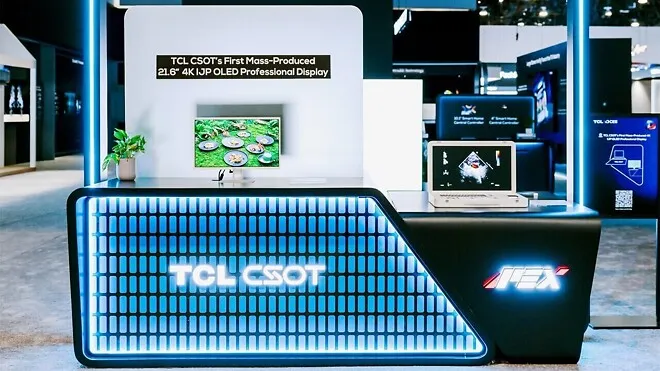
According to TrendForce, a Taiwan-based Taipei headquarters global market research and intelligence agency, TCL CSOT, the display manufacturing division of tech giant TCL, is actively promoting its IJP (InkJet Printing) OLED display technology as a means to enter the OLED monitor and notebook panel supply chain.
The company's existing 5.5-generation IJP OLED production line has already entered mass production and successfully commercialized medical OLED display panels, and validation programs for branded monitor and notebook products are currently underway. The company's progress could be a potential challenge to the long-standing dominance of Korean panel manufacturers LG Display and Samsung Display in the OLED industry.
TCL previously invested in Japanese company JOLED, and then acquired IJP OLED patents and actual manufacturing equipment from the company in 2023. TCL CSOT transferred equipment to China to build a 5.5-generation IJP OLED factory that began operations at the end of 2024.
TrendForce reported that TCL CSOT is first testing market demand with 27-inch UHD (ultra-high-definition) IJP OLED monitors produced on the 5.5-generation line, targeting the professional monitor segment.
According to TrendForce, IJP OLED is becoming an increasingly attractive alternative to brand suppliers because it offers superior power efficiency in high-end business and creator-focused displays compared to existing QD-OLED and WOLED technologies. The IJP method of manufacturing OLED screens can dramatically reduce manufacturing costs, enabling TCL to set lower prices than competitors and quickly capture market share.
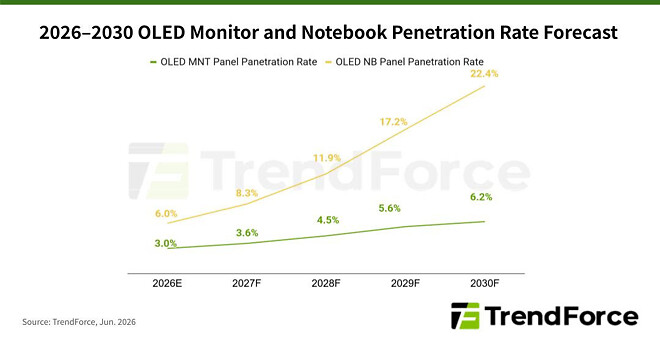
TrendForce predicts that due to TCL CSOT's recent IJP OLED initiative, OLED market share in monitors and notebook/laptop screens will increase significantly. (Chart copyright TrendForce – all rights reserved. Used with permission.)
Monitor brands from China, Taiwan, and South Korea are known to be evaluating IJP OLED panels for use in computer monitors, and TCL CSOT is expected to begin mass production of IJP OLED monitor panels in the third quarter of 2026.
The OLED monitor panel market is currently dominated by Samsung Display and LG Display. Due to current costs associated with OLED screen manufacturing compared to more common LCD-based panels, OLED penetration in the computer monitor market in 2026 has been limited to about 3%. However, according to TrendForce, as TCL CSOT makes major investments in upcoming 8.6-generation OLED manufacturing facilities, TrendForce expects OLED monitor penetration to double to 6.2% by 2030, the end of this period, and continue to expand beyond.
Meanwhile, according to TrendForce, OLED screen manufacturing for notebooks/laptops is becoming increasingly diversified. In addition to Samsung Display, TCL CSOT, BOE, and Visionox have all committed resources to 8.6-generation OLED notebook panel production. As a result, OLED screen adoption in laptops and notebook computers appears to be accelerating rapidly, and penetration is projected to reach 22.4% by 2030.
InkJet Printing vs. Vacuum Evaporation – Which Is Better?
IJP OLED uses large-format inkjet printers to directly print soluble organic materials onto substrates or "mother glass" as red, green, and blue subpixels. This promises lower production costs and significantly less material waste compared to the traditional vacuum deposition method used in W-OLED and QD-OLED panel manufacturing.
Additionally, because IJP creates independent red, green, and blue subpixels, this process can avoid the need for color filters used in W-OLED displays and the quantum dot layer required for QD-OLED displays. However, current IJP OLED manufacturing facilities are limited in panel size, and the IJP panels currently being produced themselves have limitations in overall brightness, so this technology is currently unable to enter the consumer television business.
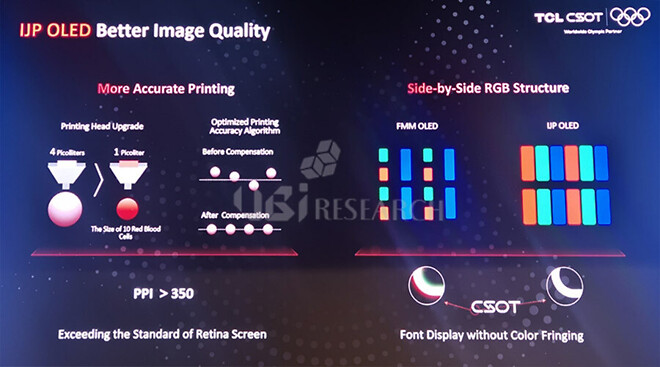
TCL promotes the advantages of IJP OLED compared to traditional OLED displays.
The wildcard in this entire market is TCL CSOT's 8.6-generation OLED factory located in Guangzhou, China, which is scheduled to begin producing IJP OLED panels in Q3 or Q4 2026. The new factory is expected to have the capacity to manufacture IJP OLED screens with much larger screen sizes than the current 5.5-generation production line.
The initial production of the new factory will focus on smaller IJP OLED screens for the notebook and monitor market, but the company has the potential to start mass-producing consumer TV-size OLED screens in 65-inch and 77-inch screen sizes as early as next year (2027). Whether they actually pursue this path depends on how the smaller screen business progresses and whether they can raise production volume and yield fast enough to reach competitive prices for these larger screens after recovering the substantial R&D investment required to build the factory.
TV enthusiasts (like myself) love OLED TVs because of their perfect black levels and excellent contrast. However, the latest flagship TVs from major TV brands (except LG) all feature LCD display panels, and create bright and bold images with wide color gamut reproduction through improved backlight units that use mini-LED or RGB backlighting.
While Samsung, LG, and Sony continue to offer OLED TV models, major manufacturers like Samsung and TCL are pouring billions of dollars into LCD display research, marketing, and manufacturing, so the performance gap between LCD and OLED is certainly narrowing with each new model year. And given the inefficiencies inherent in current OLED panel manufacturing, with OLED manufacturing costs remaining high compared to LCD TV manufacturing, it is uncertain how long this technology will be supported.
The promise of cheaper OLED panels is a factor that could extend the lifespan of this technology and allow OLED TVs to compete with LCD TVs even at budget-friendly price points.
As TCL and Sony establish a joint venture for TV manufacturing called BRAVIA, Inc., which is scheduled to begin operations in April 2027, and as the new 8.6-generation IJP OLED factory begins full-scale panel production around the same time, we must watch to see whether this leads to positive results for the future of OLED TV technology overall, particularly for Sony/BRAVIA OLED TVs.
Can we look forward to a Bravia 10?
The full report on TCL CSOT's entry into the notebook and monitor screen market with IJP OLED screens can be found directly on TrendForce's report page.
https://www.trendforce.com/research/wv
▶ Original source: https://www.ecoustics.com/news/tcl-ijp-oled-monitors/