4/20 Weekly Analysis - AI & Fintech Rally Reignited
April 20 2026 Weekly Market Analysis
## Key Theme This Week: "AI & Fintech Rally Reignited, Energy Takes a Breather"
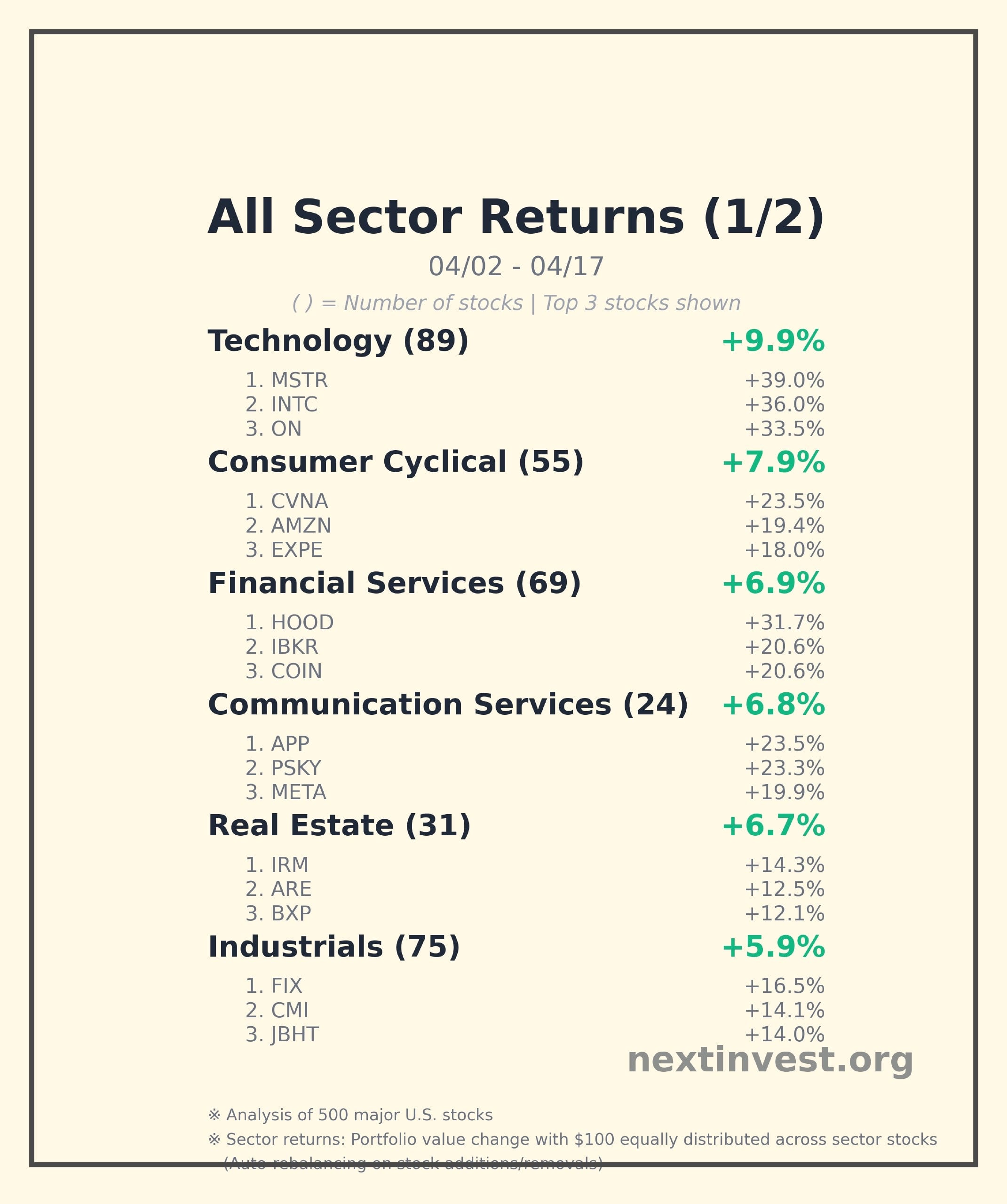
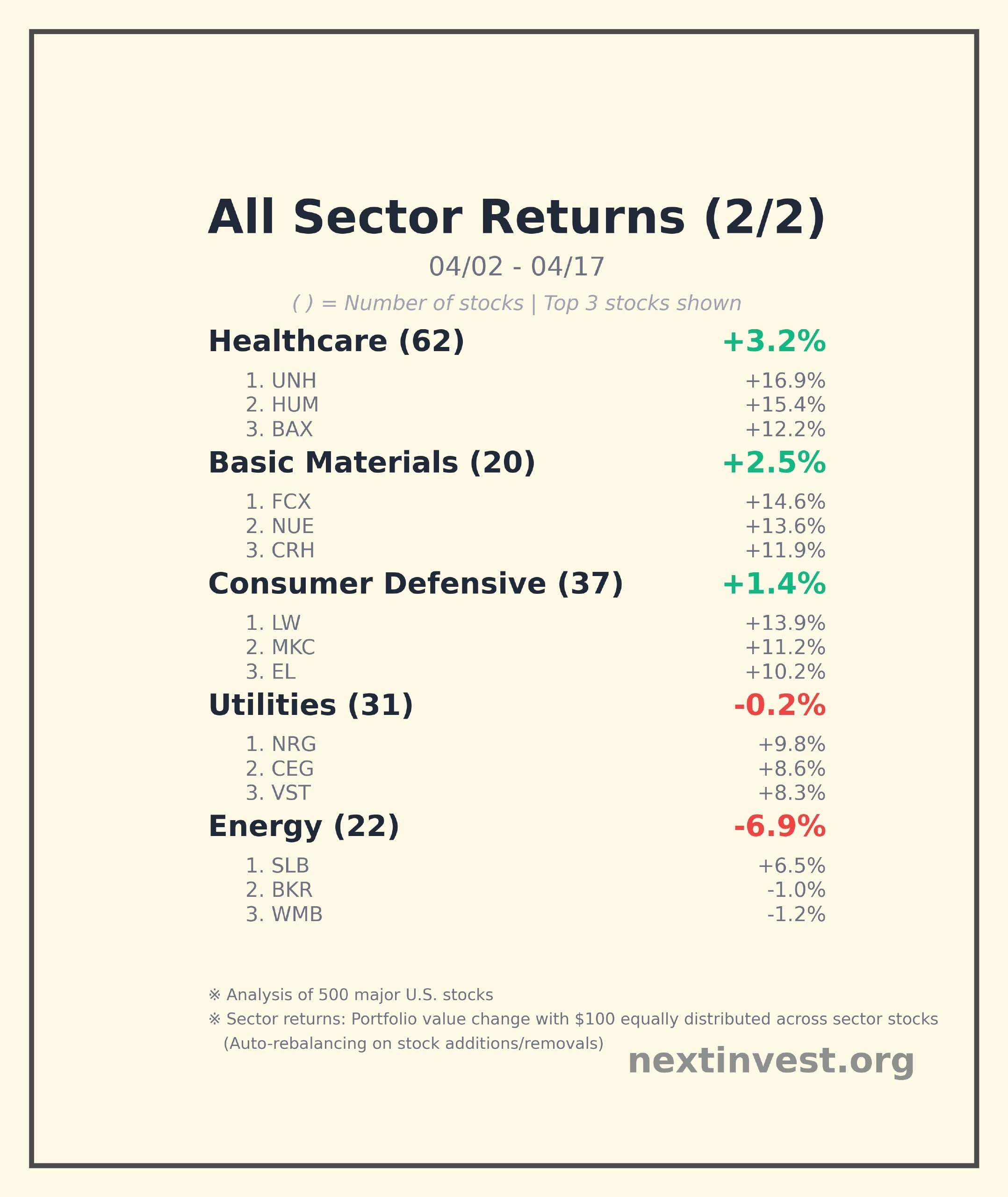
This week (April 13–17, U.S. Eastern Time), the U.S. stock market saw technology and growth stocks lead the market once again. As of the 10-day mark, 9 out of 11 sectors were in positive territory, with technology (+9.88%) clearly in the lead, while energy (-6.86%) was the only sector to drop significantly.
To sum it up in one line:
- AI infrastructure & semiconductor investment expectations + fintech & crypto recovery → growth stock revaluation
- Energy stocks, which had surged for months, pulled back as profit-taking and volatility concerns set in with a "that's enough for now" sentiment
Let's start with why this trend matters. If the two pillars driving the market from the second half of last year through early this year were "energy" and "high-dividend & defensive stocks," money has been shifting back toward "AI, tech, and fintech" over the past one to two months. Simply put,
> "From oil and dividends back to AI and apps" — the center of gravity is quietly shifting again
This is a change that could have a direct impact on investment themes over the next one to two years.
---
## Sector Performance: Who Moved, and Why?
### 1) Technology +9.88% — Intel, ON Semi, and Others: "The AI Infrastructure Rally Arrives"
The reason the technology sector was the hottest this week can be summed up in one phrase: "Real money for AI infrastructure is starting to become visible."
- Intel (INTC, +35.97%)
Over the past few weeks, Intel's stock has become the poster child for a "late-blooming semiconductor turnaround," as news about factory (foundry) investments, stake transactions, and AI alliance announcements rolled out one after another. From early April onward, news about factory stake buybacks and AI infrastructure collaboration with Google and Musk's side spread the perception that "Intel is now seriously trying to become an AI factory company," and that expectation carried over into this week. (m.economictimes.com)
- Simply put: Even though it's still running at a loss, once it started to look like Intel could properly operate factories that would be churning out AI chips for years to come, investors moved in to "stake their claim early."
- ON Semiconductor (ON, +33.48%)
ON Semi has strengths in power semiconductors (chips that efficiently control electricity) for electric vehicles, industrial use, and data centers. With the recent surge in data center power consumption and expectations for EV-related demand converging, it has been drawing attention as the essential "electrical plumbing" of the AI and EV era. It surged this week as money poured into the technology sector.
- MicroStrategy (MSTR, +38.96%)
This company is a software firm that simultaneously holds a large amount of Bitcoin, making it a kind of "Bitcoin leverage play." As Bitcoin has been oscillating near its highs and expectations for cryptocurrency have come back to life, it moved sharply as an indirect crypto theme beneficiary.
Trend perspective:
- 30-day (30D): The technology sector was already up +7.13% in an uptrend, and it added another +9.88% over this 10-day period, accelerating the upward momentum.
- 120-day (120D): +11.21%, suggesting that the "tech resurgence" trend is continuing on both a short- and medium-term basis.
> Why does this matter to me?
> Many people have been wondering "isn't it too late to invest in AI?" but the market is still sending a signal that new money is flowing into "AI infrastructure (factories, power, servers)." Even if you don't buy individual stocks, this could mean it's worth paying attention to related ETFs or funds focused on semiconductor and cloud infrastructure. However, it's important to keep in mind that the pace of the recent rally has been very steep, which means short-term volatility (the magnitude of ups and downs) could increase.
---
### 2) Consumer Cyclical +7.92% — Amazon, Online Travel: Expectations That "Wallets Are Opening Again"
Consumer cyclical stocks are sectors where consumption rises and falls with the economy — automobiles, online shopping, travel, and entertainment all fall into this category.
- Amazon (AMZN, +19.45%)
Amazon is not just a shopping platform — it's a comprehensive platform that spans cloud (AWS), advertising, and streaming video.
- With improving profitability in advertising and cloud, and growing expectations for AI-powered cloud services, it has been evaluated as "not just a distribution company, but an essential infrastructure platform for the AI era."
- Carvana (CVNA, +23.45%)
Online used car dealer Carvana has been making a comeback, as expectations converged around the idea that "if an interest rate-cutting cycle is approaching, used car demand could revive," combined with expectations for improved debt structure and an earnings turnaround. It's a highly volatile stock, but this week it played the role of a symbol for "soft landing + consumer recovery" bets.
- Expedia (EXPE, +17.99%)
Travel platform Expedia showed strength on the back of still-solid travel demand and expectations for summer peak season bookings. Despite economic uncertainty, the signal is that people are still spending money on travel.
Trend perspective:
- 30D: It had been virtually flat at +0.53%, but added +7.92% over this 10-day period, showing a clear short-term rebound.
- 120D: Only +1.81%, so it will take a few more weeks to determine whether this week's rally is the "start of a reversal" or just a temporary spike.
> Why does this matter to me?
> It's a signal that the market is giving more credit to the "economy holds up better than expected" scenario rather than the "economy falls apart" one. If recovery expectations grow in tangible areas like online consumption, travel, and automobiles, it means my everyday spending and my investment portfolio are moving in a similar direction.
---
### 3) Financial Services +6.88% — Robinhood & Coinbase: Crypto and Retail Investor Enthusiasm Making a Comeback
The standouts in the financial sector this week were not traditional banks, but fintech, brokerage, and crypto-related names.
- Robinhood (HOOD, +31.72%)
This is the mobile brokerage platform widely used by retail investors in the U.S. There were two main drivers behind this week's surge.
1) The SEC's moves to relax the "pattern day trader" rule — allowing accounts below $25,000 to trade short-term more freely — came into the spotlight, raising expectations for increased retail trading volume. (benzinga.com)
2) As the Bitcoin and cryptocurrency market showed renewed strength, expectations for Robinhood's new businesses — including crypto trading and prediction markets — were also priced in. (coincentral.com)
Simply put, regulatory easing + crypto tailwinds combined, and it was a week when expectations exploded around the idea that "retail investors could come flooding back into the market."
- Coinbase (COIN, +20.60%)
The leading U.S. cryptocurrency exchange Coinbase showed strength as Bitcoin held near its highs and expectations grew that the regulatory environment might be less hostile than feared. As long as Bitcoin doesn't fall sharply, the point that "more trading just means more money" was highlighted once again. (coincentral.com)
- Interactive Brokers (IBKR, +20.62%)
A global brokerage platform with a high proportion of derivatives, international stocks, and professional investors. With trading volume recovering and interest income (interest revenue from customer deposits) remaining stable, it drew attention as a "platform that benefits when trading gets active again."
Trend perspective:
- 30D: +3.40%, 120D: +4.12% — a gentle uptrend, onto which this week's crypto and trading theme added further acceleration.
> Why does this matter to me?
> The revival of retail investor enthusiasm also means that market volatility could increase. More opportunities arise, but it could also become a period where sharp short-term surges and drops are common. Fintech and crypto-related stocks are an area where you should first assess "whether I can handle the volatility" before getting involved.
---
### 4) Communication Services +6.77% — Meta, AppLovin: Advertising & Gaming Demand Revalued
- Meta (META, +19.86%)
Meta continued to rise this week on the dual theme of "advertising recovery + AI platform," driven by expectations of continued advertising revenue recovery, cost control, and AI-powered recommendation algorithm improvements.
- AppLovin (APP, +23.51%)
Mobile gaming and advertising platform AppLovin surged sharply as mobile gaming demand and ad tech expectations came back to life. It's a classic high-growth, high-momentum stock — big upside potential, but big swings in price.
- Paramount Skydance (PSKY, +23.32%)
Post-merger, it has been drawing attention as a beneficiary of the media industry's restructuring, with expectations for content IP revaluation and cost structure improvements converging.
Trend perspective:
- The 120D return was barely +0.87% — essentially flat — but it gained +6.77% in this 10-day period, suggesting it may be "at the very beginning of turning off the bottom."
> Why does this matter to me?
> A recovery in advertising and entertainment means consumer sentiment and corporate marketing budgets are bouncing back. This is an area where the connection between my sense of the economy and stock prices is relatively clear.
---
### 5) REITs / Real Estate +6.67% — Room to Breathe on Peak Interest Rate Expectations
The real estate and REIT (listed companies that distribute rental income from real estate) sector also showed strength, rising 6.67%.
- Alexandria Real Estate (ARE), BXP, Iron Mountain (IRM), and other office, data center, and storage facility REITs all rebounded in unison.
The reason is relatively straightforward.
- When the perception spreads through the market that "it's hard for rates to rise much further,"
- expectations grow that the burden on the real estate sector, which relies on large-scale borrowing, will ease,
- and those expectations were reflected in stock prices this week.
Trend perspective:
- 30D: +2.23%, 120D: +3.52% — after a gradual recovery over the past one to four months, this week saw an additional step higher.
> Why does this matter to me?
> Real estate and REITs are asset classes where many investors hold for the long term, focused on dividends. This week's move can be read as the market's signal that "the risk of a sharp rate hike is largely in the rearview mirror," and it could be a point where investors targeting rental income and dividend yields find renewed interest.
---
### 6) Healthcare, Consumer Staples, Utilities — Defensive Sectors Post "Quiet Gains"
- Healthcare (+3.23%): UnitedHealth (UNH, +16.87%), Humana (HUM, +15.36%), and other health insurers showed strength. Since healthcare spending goes out steadily regardless of the economic cycle, it continues to serve as a "portfolio safety belt" in an environment where economic uncertainty remains.
- Consumer Staples (+1.44%): McCormick (MKC), Estée Lauder (EL), and others rose, but on a 30D basis they are still at -4.97%, so it's too early to call this week's rebound a major trend reversal.
- Utilities (-0.25%): Public utilities such as electricity and gas providers barely declined, given their nature as interest rate-sensitive dividend stocks, but posted a slight underperformance as their relative attractiveness faded compared to growth stocks.
> Why does this matter to me?
> Defensive stocks won't suddenly make you rich, but they play the role of preventing your portfolio from collapsing all at once. This week serves as a reminder that even when the overall index looks good, cutting defensive exposure too much can mean a bigger shock when a short-term correction hits.
---
### 7) Energy -6.86% — The 120D Leader Takes a Breather on Profit-Taking and Demand Concerns
The only sector to fall sharply this week was energy (-6.86%).
The interesting point is that its 120-day (four-month) performance stands at +26.88% — first place among all 11 sectors. In other words, the sector that had been performing the best over the past few months took a notably large pause this week.
Breaking down the background:
1. Oil prices, which had surged on geopolitical and war-related risks, are now in a period of turbulence due to strategic reserve releases and demand slowdown concerns. In early March, fears over war with Iran and a possible closure of the Strait of Hormuz pushed oil prices above $100 a barrel at one point, but subsequent strategic reserve releases by the International Energy Agency (IEA) and ceasefire expectations combined to reverse some of those gains. (en.wikipedia.org)
2. When oil prices rise too fast, the concern emerges that over the long run, "high oil prices could weaken the economy and crush demand." In that case, a short-term spike in oil prices does not necessarily translate into sustained gains in energy stocks.
3. With the sector already up more than 20% on a 120D basis, profit-taking selling of "that's enough" also poured in.
> Why does this matter to me?
> If you have been heavily increasing your energy allocation over the past few months, you need to consider this week's correction as a "warning signal." With oil prices and war-related news capable of sending stocks swinging sharply, it's become more important than ever to diversify rather than concentrate in a single sector.
---
## Key Stock Movements: Intel, Robinhood, AI, and Crypto Keywords
Summarizing the most noteworthy stocks this week:
- Intel (INTC, Technology):
- 10D: +35.97%
- Background: AI factory investment, stake buybacks, and big tech partnerships converged, making it the spotlight beneficiary of the "late-arriving AI foundry theme." (m.economictimes.com)
- ON Semiconductor (ON, Technology):
- 10D: +33.48%
- Background: Expectations for data center and EV power semiconductor demand positioned it as something like "the plumbing company supplying electricity to AI servers."
- MicroStrategy (MSTR, Technology):
- 10D: +38.96%
- Background: A Bitcoin leverage play that surged alongside the crypto rally.
- Robinhood (HOOD, Financial):
- 10D: +31.72%
- Background: SEC regulatory easing + crypto and prediction market expectations combined into a bet on increasing retail trading volume. (benzinga.com)
- Coinbase (COIN, Financial):
- 10D: +20.60%
- Background: Bitcoin holding near highs + trading volume expectations recast it as "the representative infrastructure stock of crypto trading."
> In summary, the individual stock stories this week can largely be grouped around two axes: "AI infrastructure" and "the revival of crypto and retail investing."
---
## This Week Through a 30-Day and 120-Day Lens: Trend Acceleration vs. Reversal
Translating the tabulated data into a narrative flow:
- Technology & Energy:
- 120D: Both are up double digits (Technology +11.21%, Energy +26.88%)
- However, the most recent 10D diverges: Technology up, Energy down
→ An early signal that the "energy dominance + tech underperformance" dynamic is shifting to "energy resting, technology picking up the baton"
- Consumer Cyclical & Communication Services:
- 120D returns are low or nearly flat, but strong rebounds in the most recent 10D
→ "Moving from pure economic pessimism to quietly beginning to price in the possibility of consumer, advertising, and content recovery"
- Defensive stocks (Healthcare, Consumer Staples, Utilities):
- On a 120D basis, slightly positive or flat
- In the most recent 10D, quiet gains or slight underperformance
→ "Not completely ignored, but not emerging as market leaders either" — maintaining their role as a portfolio stabilizer
---
## Last Session (24H) One-Line Comment
In the most recent session, 8 out of 11 sectors were in positive territory, with Consumer Cyclical (+3.02%) the strongest and Energy (-2.75%) the weakest.
→ The weekly trend (technology and consumer strength, energy correction) carried through to the final trading day and wrapped up without change.
---
## Points to Watch Next Week: What Should You Be Looking At?
1. Intel and Big Tech's Additional AI-Related News and Earnings Guidance
- Whether this week's rally was "overheating" or a "legitimate revaluation" will be told by actual orders, bookings, and profitability guidance.
- If AI factory and server investments are confirmed in the numbers, the semiconductor and cloud infrastructure rally could extend further; conversely, if results disappoint expectations, there is also a risk of a sharp short-term decline.
2. SEC and Regulatory Issues and Retail Trading Volume
- Robinhood, Coinbase, and crypto-related stocks are in territory where a single regulatory headline can move them 10–20%.
- Keep in mind that if related comments, hearings, or rule details emerge next week, volatility could increase further.
3. Oil Price and Middle East/Iran-Related News and the Energy Sector's Response
- There are still many factors that can move oil prices — war, ceasefire, strategic reserve releases, and demand indicators.
- Whether oil prices surge again or find stability below $90 will determine whether energy stocks see renewed strength or continue their pause. (en.wikipedia.org)
4. U.S. Economic and Consumer Data
- If indicators such as retail sales, consumer sentiment, and employment support the "soft landing" narrative, they could provide tailwinds for the consumer and communication sectors that rebounded this week.
- Conversely, if the data comes in far too weak, money could rotate back into defensive stocks and bonds in a "reversal" market.
> In summary, this was a week where the market raised its bets again on "AI, fintech, and consumer recovery." However, given that some stocks rose 20–30% in just 10 days, it would not be surprising if next week brings a "speed adjustment phase."
---
## Closing: This Week in One Sentence
> "A week where the market's attention quietly shifted from oil to chips and apps"
When reviewing your portfolio,
- Check whether you are too concentrated in energy and defensive stocks,
- and whether you have any exposure at all to the AI infrastructure, fintech, and consumer recovery themes.
Next week's key question to watch is whether this rally will be backed by "real earnings," or whether it will pause for a breather.
This content is written for informational purposes only and does not constitute a recommendation to invest in any specific stock or asset.
Source: https://nextinvest.org/ko