Middle East Geopolitical Risk and Oil Price Surge
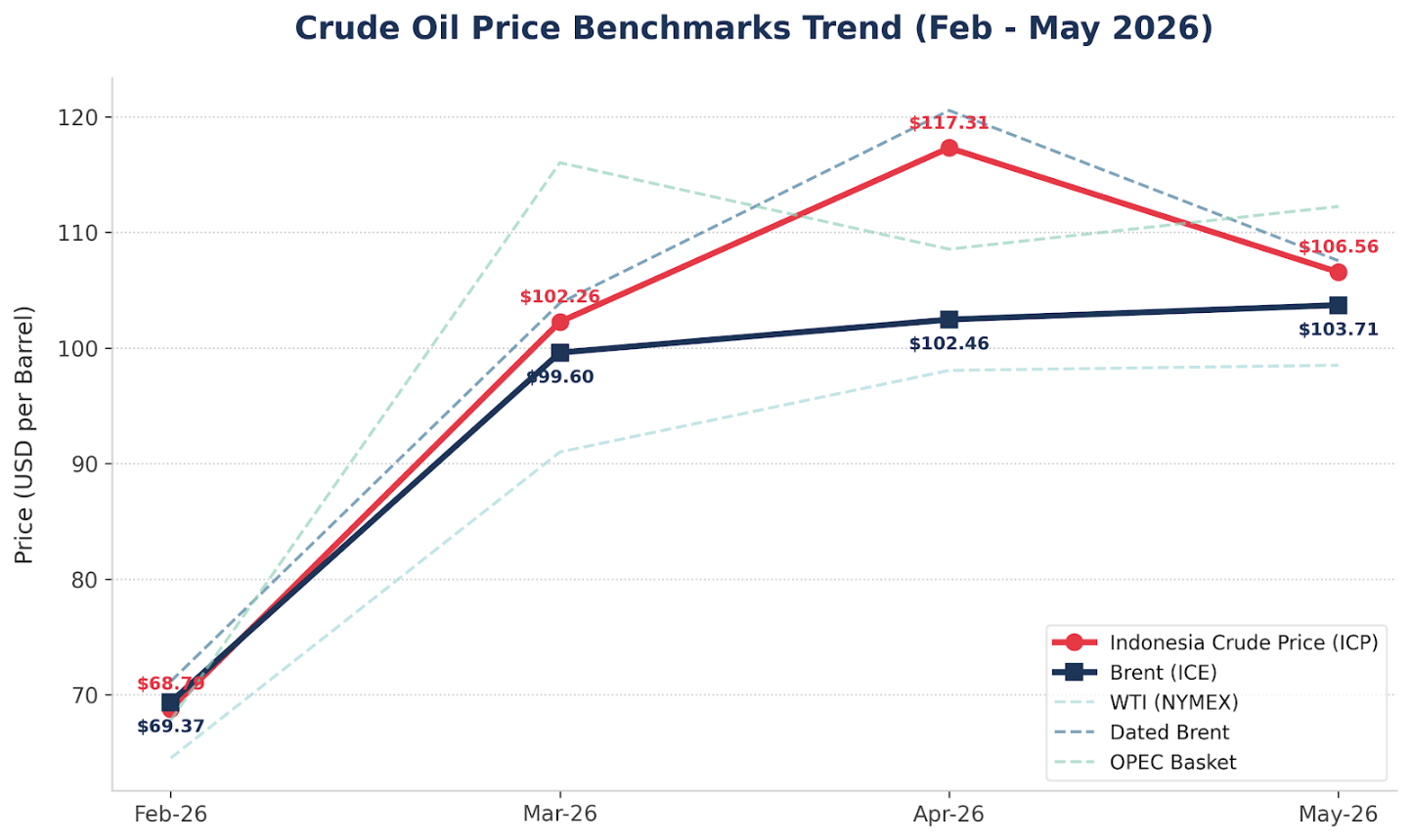
As the Middle East conflict intensified in February 2026, international crude oil prices shifted to an upward trend. Brent oil (ICE) rose from $69.37 per barrel in February to $99.60 in March and $102.46 in April. Indonesia crude oil pricing (ICP) also rose from $68.79 to $117.31 in the same period, an approximately 70% increase in just two months. The upward oil price trend quickly spread to the petrochemical raw materials market.
<Crude Oil Price Benchmark Trends (February-May 2026)>
[Source: Indonesia Ministry of Energy and Mineral Resources (ESDM)]
Naphtha Price Increases and Regional Supply Instability
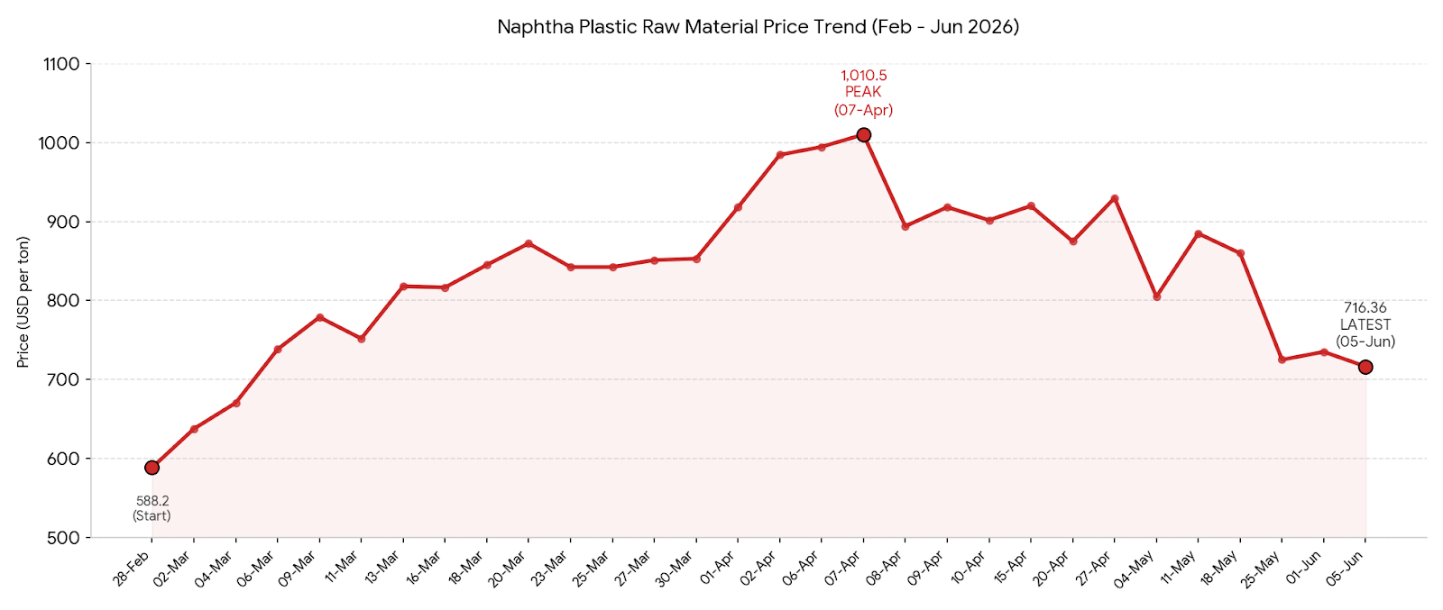
Naphtha, a key raw material for plastics, was directly affected by the oil price surge. Naphtha prices rose 71.8% in about five weeks, from $588.2 per ton on February 28 to $1,010.5 per ton on April 7. Subsequently, finding partial stability, it recorded $716.36 per ton as of June 5, but compared to pre-war levels, it remains 21.8% higher.
<Naphtha Plastic Raw Material Price Trends (February-June 2026)>
[Source: Trading Economics]
The price surge also led to regional supply instability. South Korea's Yeocheon NCC, Singapore's PCS Pte. Ltd., and manufacturers in Thailand and Taiwan successively declared force majeure, showing how price shocks connected to supply-side instability. Yusuf Rendy Manilet, an economist at Indonesia's Economic Reform Center (CORE), stated that "plastics are not finished products but are essentially intermediate inputs embedded across virtually all industrial sectors," and "when prices rise, the impact is directly reflected in the cost structure of downstream industries, which can account for 30-50% of costs." In this way, naphtha price fluctuations serve as a factor affecting Indonesia's overall economic cost structure, going beyond a simple raw materials market issue.
Indonesia's High Dependence on Middle Eastern Naphtha
The background to Indonesia being significantly impacted by this price fluctuation lies in the structural characteristic of high Middle East dependence in naphtha imports. According to Indonesia Statistics Bureau (BPS) data, the Middle East naphtha share has consistently remained at high levels: 71.6% in 2023, 67.7% in 2024, and 75.7% in 2025.
<Indonesia Naphtha Import Trends (2023-2025)>
|
Country/Region |
2023 |
2024 |
2025 |
|
Import Volume (Tons) |
Ratio (%) |
Import Volume (kg) |
Ratio (%) |
Import Volume (kg) |
Ratio (%) |
|
Saudi Arabia |
1,206,063 |
58.80% |
1,070,676 |
55.20% |
1,398,648 |
36.20% |
|
United Arab Emirates |
135,571 |
6.60% |
160,863 |
8.30% |
618,098 |
16.00% |
|
Qatar |
76,851 |
3.70% |
0 |
0.00% |
305,539 |
7.90% |
|
Egypt |
0 |
0.00% |
0 |
0.00% |
140,396 |
3.60% |
|
Kuwait |
50,120 |
2.40% |
0 |
0.00% |
213,782 |
5.50% |
|
Bahrain |
0 |
0.00% |
82,276 |
4.20% |
166,876 |
4.30% |
|
Iraq |
0 |
0.00% |
0 |
0.00% |
41,407 |
1.10% |
|
Oman |
0 |
0.00% |
0 |
0.00% |
38,500 |
1.00% |
|
Middle East Total |
1,468,606 |
71.60% |
1,313,817 |
67.70% |
2,923,248 |
75.70% |
|
Other Regions |
581,459,482 |
28.40% |
626,350 |
32.30% |
937,326 |
24.30% |
|
Total |
2,050,065 |
100.00% |
1,940,168 |
100.00% |
3,860,575 |
100.00% |
[Source: Indonesia Statistics Bureau (BPS)]
This structure became apparent immediately after the conflict occurred. In early March 2026, PT Chandra Asri Pacific Tbk, Indonesia's largest integrated petrochemical producer, sent force majeure notices to business partners citing global raw materials supply chain disruptions, and began adjusting operating rates at some plants to maintain balance between raw material availability and production requirements.
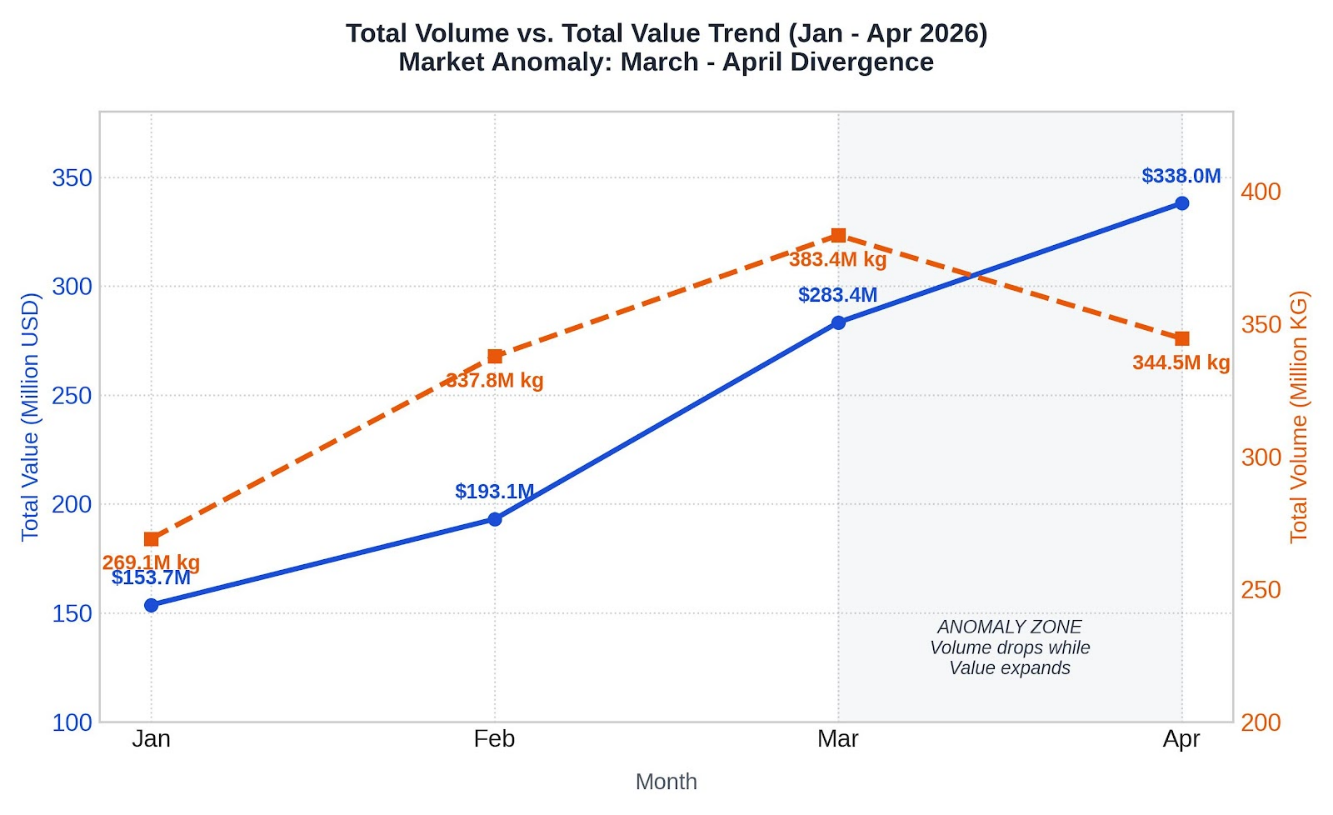
<Indonesia Naphtha Import Value and Volume Trends (January-April 2026) (HS 2710.12.80)>
(Unit: Million dollars, Million kg)
[Source: Indonesia Statistics Bureau (BPS), KOTRA Jakarta Trade Office Reprocessed]
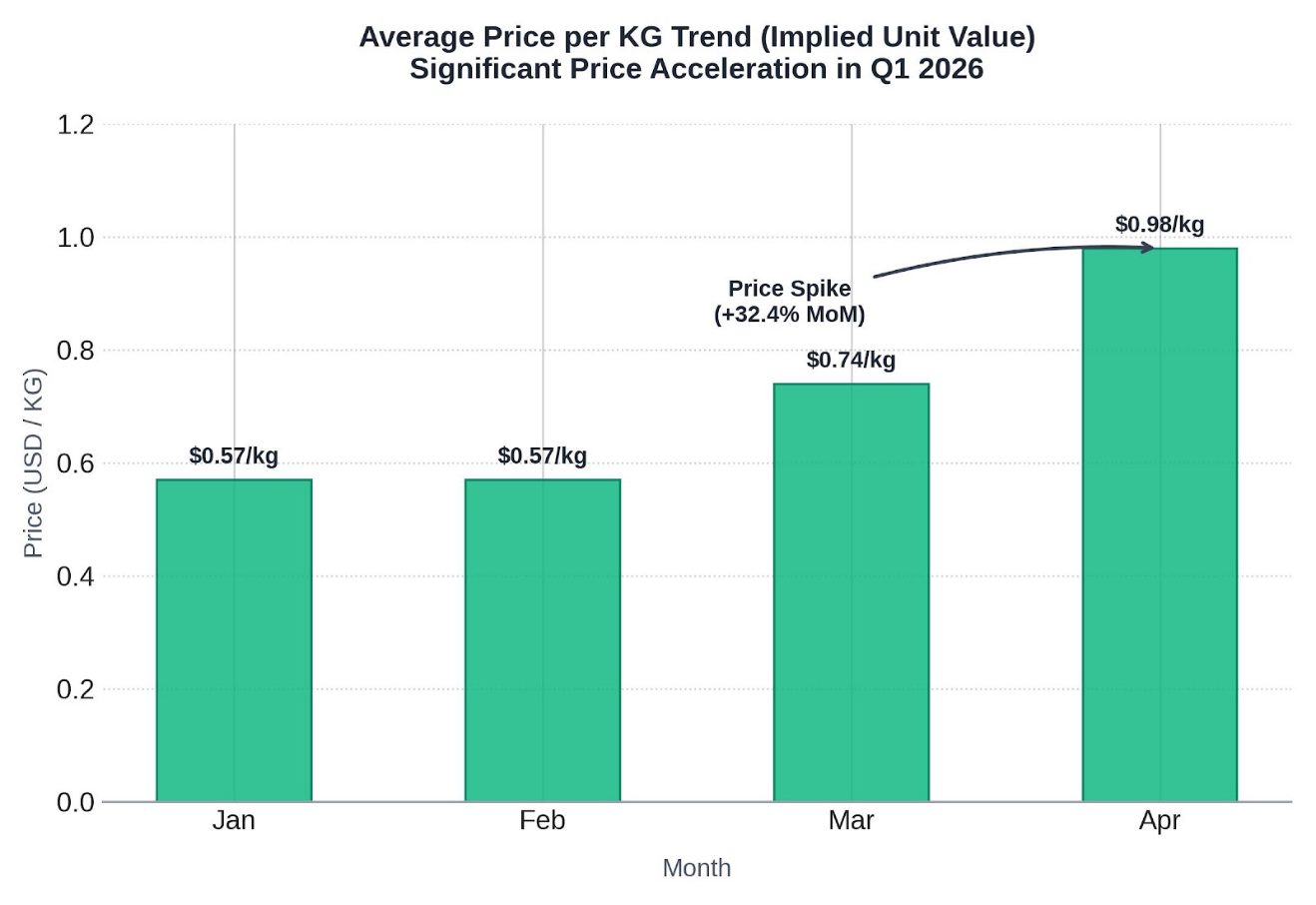
<Indonesia Naphtha Average Import Price per kg (January-April 2026)>
(Unit: $/kg)
[Source: Indonesia Statistics Bureau (BPS), KOTRA Jakarta Trade Office Reprocessed]
Looking at Indonesia Statistics Bureau (BPS) naphtha import data (HS 2710.12.80), we can confirm that global price fluctuations are directly reflected in Indonesia's domestic supply market. Unit prices (total import value/import volume) rose from $0.57/kg in January-February to $0.74/kg in March and $0.98/kg in April, a 71.9% increase similar to the global naphtha spot price increase rate of 71.8% in the same period. Between March and April, despite a 10.2% decrease in import volume, total import value increased by 19.3%, indicating that price factors are having a greater impact than volume.
Cost Burden Spreading to Indonesia's Downstream Industries and Consumer Goods Sectors
As Indonesia's naphtha supply tightened, cost burdens spread throughout downstream industries. The food and beverage sector, which depends on plastic packaging, is a prime example. According to the Indonesian Food and Beverage Association (Gapmmi), retail plastic packaging prices increased by 30-100%, and at the distribution level, packaged beverage prices rose by 1,000-2,000 rupiah per unit. The Acting Director General of Agricultural Industry at the Ministry of Industry noted that for products like bottled water, packaging costs have exceeded the cost of the contents.
The impact on small and medium enterprises (MSMEs) is also significant. Edy Misero, Secretary General of Akumindo, explained that companies using plastic only as a secondary material have limited impacts, but manufacturers heavily dependent on plastic resin production—such as tarpaulin manufacturers and food retailers—have faced significantly increased cost burdens as global plastic prices rose 40-50%. The cosmetics industry faces similar situations. Martha Tilaar, CEO of Kilara Tilaar, stated that the production cost structure of beauty and personal care products overall is currently responding sensitively to supply conditions, and consumer price adjustments may be considered in the second half of this year. Henky Wibawa, Secretary General of the Indonesian Packaging Federation (IPF), explained that as naphtha distribution disruptions, rising import costs due to rupiah weakness, and decreased domestic supply converge simultaneously, packaging manufacturers have no choice but to increase import dependence.
Esther Sri Astuti, Executive Director of the Institute for Economic and Financial Development (INDEF), analyzes this situation as a result of steady demand alongside contracted supply, and notes that uncertainty about the conflict's duration acts as a factor increasing price volatility. She stated that companies face a choice between passing high costs to consumers or switching to alternative packaging materials, with the former being the predominant choice at present, though if the situation persists, a shift to alternative materials could become a structural trend.
Indonesia Government Policy Response
As raw material price increases and domestic supply instability continued, the Indonesian government began policy responses from multiple angles. Industry Minister Agus Gumiwang stated that he would pursue response measures in three directions: diversifying supply sources beyond the Middle East, optimizing the use of liquefied petroleum gas (LPG), and promoting high-quality recycled plastic.
Policy intervention began in earnest in late April 2026. Economic Coordination Minister Airlangga Hartanto announced a reduction in import tariffs on LPG from 5% to 0%, and expanded tariff exemptions to major plastic resins including polypropylene, polyethylene, LLDPE, and HDPE. This measure, implemented from May 2026 for six months, aims to protect petrochemical production stability, consumer purchasing power, and downstream packaging costs. However, industry reactions to this policy are mixed. Downstream packaging industries showed favorable reactions, seeing potential for lower raw material procurement costs through tariff exemptions, while domestic petrochemical producers expressed concerns that an influx of low-cost foreign resins could burden domestic industry price competitiveness.
In terms of supply diversification, Trade Minister Budi Santoso stated that alternative suppliers are being sought in India and Africa, and mentioned additional shipment possibilities from the United States. However, as of June, no confirmed shipment records have been found, suggesting supply chain diversification remains in its early stages. At the industry level, PT Chandra Asri Pacific Tbk lifted its force majeure status in early May and announced recovery of operational stability, and is pursuing measures to expand procurement sources to international markets including the United States and optimize use of refining facilities in Singapore. Long-term considerations include diversifying biomaterials programs utilizing seaweed and cassava as alternative raw materials, though seaweed-based plastics still face high production costs limiting market size.
Indonesia Consumer Behavior Change and Environmental Transition Movements
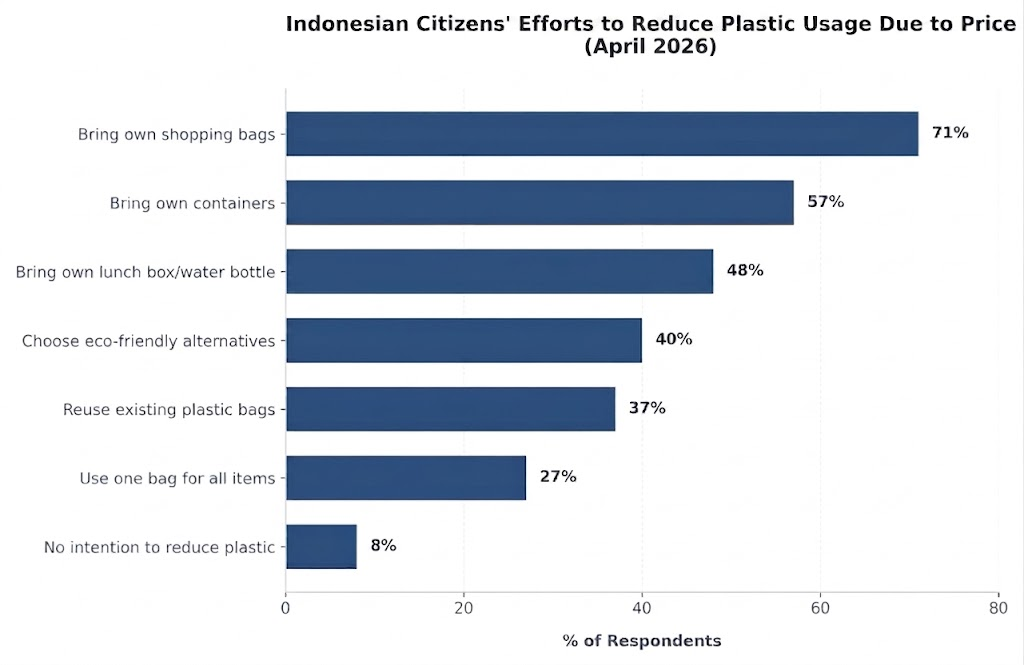
The impact of rising raw material costs is also manifesting in consumer behavior changes. According to a Jakpat survey conducted in April 2026, 92% of Indonesians affected by plastic price increases took measures to reduce plastic use. Since plastic use is routinized in Indonesia across various sectors including parcel packaging and food delivery, consumer behavior changes driven by cost increases could increasingly become a structural trend.
<Indonesian Consumer Plastic Use Reduction Efforts Due to Plastic Price Increases (April 2026)>
[Source: Databoks (Jakpat Survey), KOTRA Jakarta Trade Office Reprocessed]
Implications and Recommendations
This naphtha price fluctuation is evaluated as a case that reconfirms the structural characteristic of Indonesia's economy's high dependence on external raw materials. While the Indonesian government has undertaken multi-faceted responses including tariff exemptions, supply diversification, and biomaterial development, considering the 75% Middle East dependence in import structures and alternative supply chain construction still in early stages, structural transformation within a short timeframe appears unlikely.
From a Korean company perspective, this situation warrants examination from several viewpoints. First, companies possessing technology in bioplastics, biodegradable packaging materials, and recycled resin sectors align with Indonesia's government demand for alternative material development, making cooperation opportunities worth exploring. Second, energy-efficient petrochemical alternative process technology and equipment sectors also present cooperation possibilities with Indonesian government and local companies. Third, recycling systems, refill infrastructure, and smart waste management solution sectors are projected to face increasing demand in the medium to long term as the government's 2029 waste reduction mandate policy converges with expanding consumer environmental consciousness. However, if raw material costs remain at elevated levels, effects may continue on consumer prices and SME business conditions, so companies entering or preparing to enter the Indonesian market should continuously monitor cost structure changes and government policy directions while establishing local partnerships and developing flexible supply chain strategies.
Sources: International Energy Agency (IEA), Indonesia Ministry of Energy and Mineral Resources (ESDM), Trading Economics, Indonesia Statistics Bureau (BPS), Bisnis.com, Kompas.id, CNBC Indonesia, CNN Indonesia, Databoks (Jakpat), KOTRA Jakarta Trade Office Compiled