
Since this is a translation of an overseas article, there may be mistranslations.
https://hothardware.com/news/nvidia-debuts-dlss-45-ray-reconstruction
Nvidia Releases DLSS 4.5 Ray Reconstruction with Second-Generation AI Denoising
When Nvidia first released DLSS Ray Reconstruction, the collective response from the gaming community was essentially "Hmm, that's pretty clean." DLSS Ray Reconstruction noticeably improved ray tracing lighting effects in most scenes within games it was applied to. However, like other technologies such as DLSS Super Resolution, it wasn't revolutionary enough for many gamers to pay much attention beyond simply leaving it enabled.
Well, think again now. This is because Nvidia has just released a new version of DLSS Ray Reconstruction called DLSS 4.5 Ray Reconstruction.
If this is your first time hearing about this technology, please refer to previous articles for more information. In short, DLSS Ray Reconstruction uses an AI model to perform denoising on ray tracing output. Because real-time ray tracing doesn't have the luxury of shooting 16 or more rays per pixel, the resulting image suffers from significant noise due to the forced low ray count.
Denoising is essential for making this work effectively, and Ray Reconstruction has so far presented the best way to do it, offering significantly better results than manually tuned deterministic denoisers.
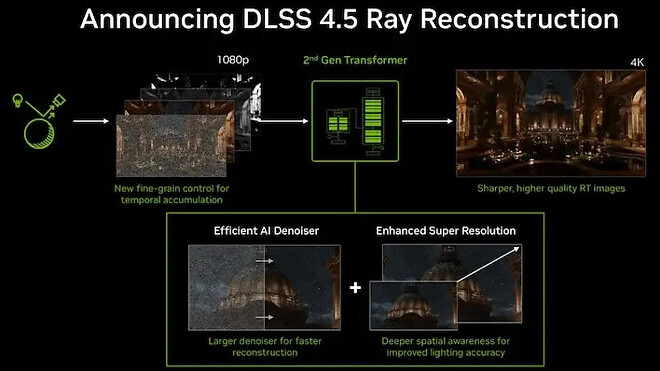
DLSS 4.5 Ray Reconstruction Slide - Image: Nvidia
As mentioned, this new version of the technology is a refinement of the previous one. It introduces a more powerful AI model using a second-generation transformer architecture that allows for finer control over temporal accumulation and improved spatial awareness. The end result is even more enhanced lighting accuracy compared to the existing DLSS Ray Reconstruction.
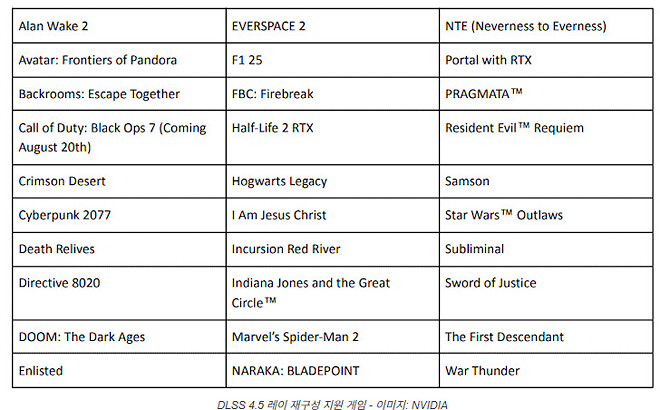
DLSS 4.5 Ray Reconstruction Supported Games - Image: Nvidia
To be honest, the improvement is subtle. Our CMS may not be able to preserve images of high enough quality for you to distinguish the differences. So, if you really want to compare them in detail, please click on this link to download a compressed file of the original resolution images from my personal Google Drive. I tested four games from the list of supported games above: Crimson Desert, Cyberpunk 2077, Hogwarts Legacy, and Pragmata, to see if I could notice any benefits. For convenience, let's look at them in alphabetical order.
DLSS 4.5 Ray Reconstruction in Crimson Desert
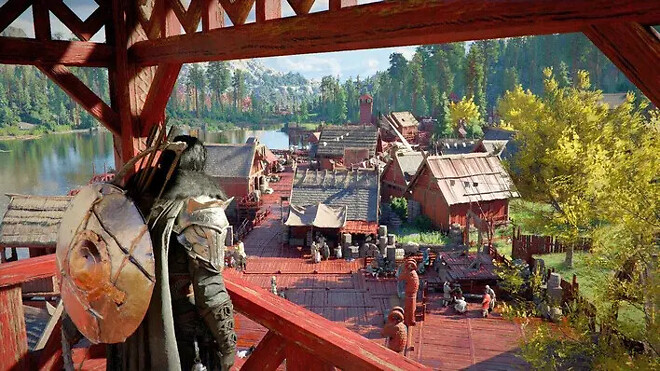
The open-world single-player action RPG from Pearl Abyss is a visually stunning game powered by its own in-house Blackspace engine. It boasts unique visual characteristics compared to most contemporary games, setting it apart. While the lighting engine is top-notch, it wasn't initially great without ray reconstruction. The company addressed some of these issues but not all:
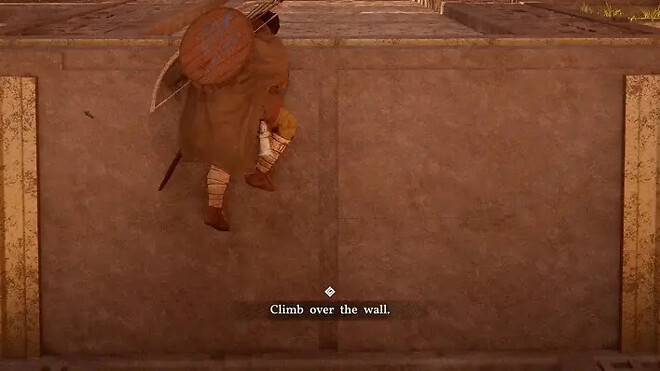
Using ray tracing without ray reconstruction is not recommended.
While difficult to see in screenshots, the difference is clear in motion. Using ray tracing in Crimson Desert causes significant ghosting, so it's best to turn it off if you can't use ray reconstruction. Unsurprisingly, ray reconstruction solves this problem. But does DLSS 4.5 ray reconstruction further enhance the graphics? Well...
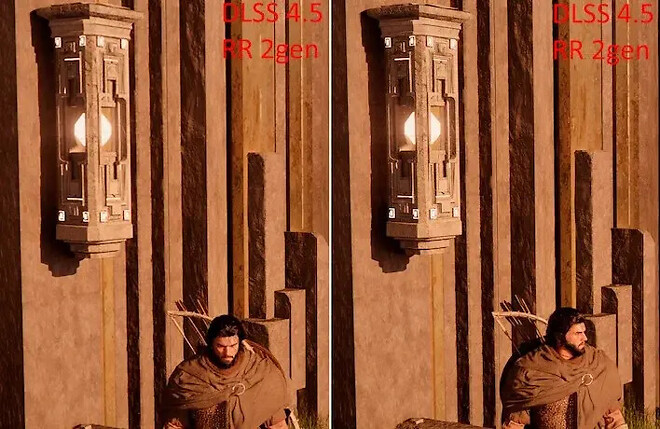
Lighting is subtly improved.
It's hard to distinguish without careful observation, and the reduced comparison images make it even harder. However, the candlelight on the walls and the lighting in protagonist Cliff's hair reveal slightly more refined details. The difference is very subtle and not noticeable while moving, but it exists nonetheless. Unfortunately, DLSS 4.5 ray reconstruction doesn't fix the strange water flow behavior within the game.
So, how much performance do you have to sacrifice for this barely perceptible visual difference?
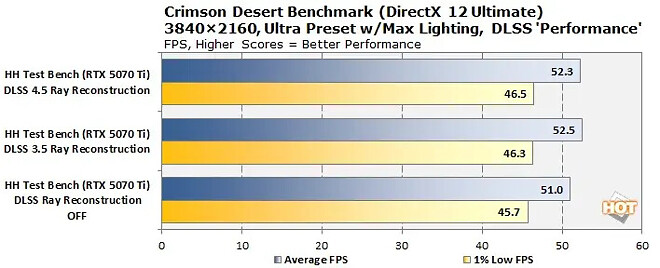
Crimson Desert ray reconstruction benchmark - Image: HotHardware
Thankfully, none at all. In fact, there's no measurable performance difference between versions 3.5 and 4.5. Nvidia had stated this would be the case, adding that older generation GPUs might see a slight performance hit, but we haven't had time to test that yet. Let us know in the comments if you want to see these benchmarks!
Cyberpunk 2077's DLSS 4.5 Ray Reconstruction
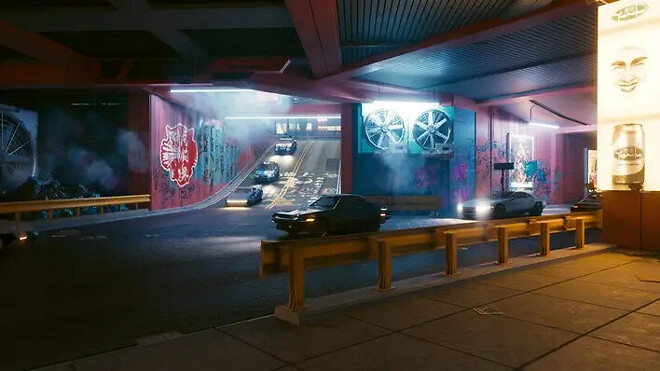
Cyberpunk 2077 screenshot - Image: Zak/HotHardware
Cyberpunk 2077 will be six years old come December, but thanks to continuous technological updates since its release, it remains one of the best benchmarks. Notably, Cyberpunk 2077 was the first game to support DLSS 3.5 ray reconstruction. In fact, this game's "RT Overdrive" path tracing mode doesn't render properly without ray reconstruction.
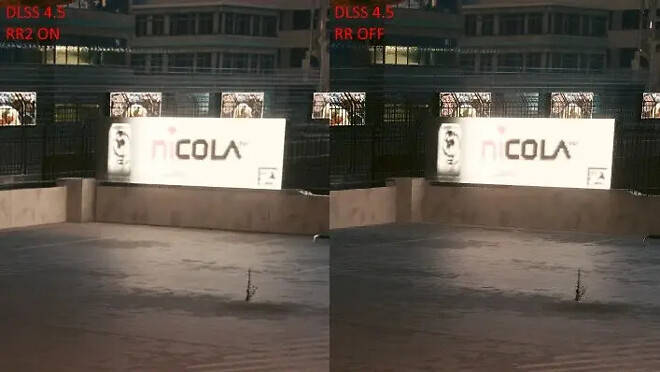
Ray reconstruction significantly enhances Cyberpunk's path tracing. - Image: Zak/HotHardware
Unfortunately, despite spending hours wandering Night City, I couldn't find many striking examples where the difference between DLSS 3.5 ray reconstruction and DLSS 4.5 ray reconstruction was noticeably good, except for this one spot that stood out due to visual issues rather than upgrades:
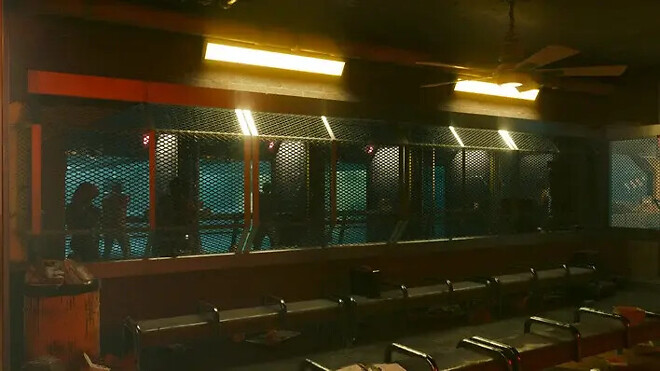
Cyberpunk 2077 without ray reconstruction applied - Image: Zak/HotHardware
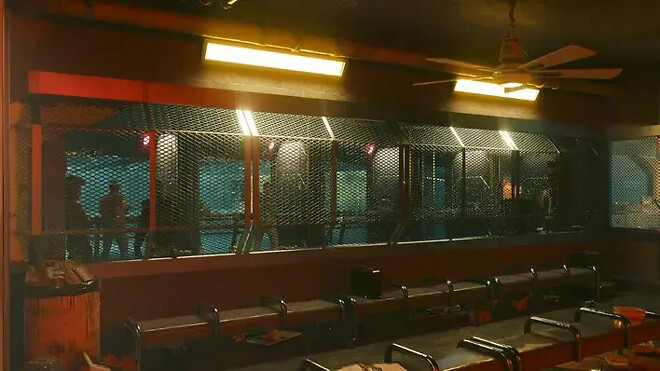
Cyberpunk 2077 with DLSS 4.5 ray reconstruction applied - Image: Zak/HotHardware
At the shooting range near V's apartment in Megabuilding H10, the chain-link fence covering the windows between the shop area and the shooting range exhibits severe visual artifacts when ray reconstruction is enabled. DLSS 4.5 actually makes it worse. It's not that ray reconstruction introduces a problem that wasn't there before; there was already an odd shimmering effect present without ray reconstruction.
However, enabling ray reconstruction turns it into a very distracting mess of flickering lights. It's not a common visual artifact, and while it doesn't make me reconsider using DLSS ray reconstruction in this game entirely, it does show that even the latest technology can have its downsides.
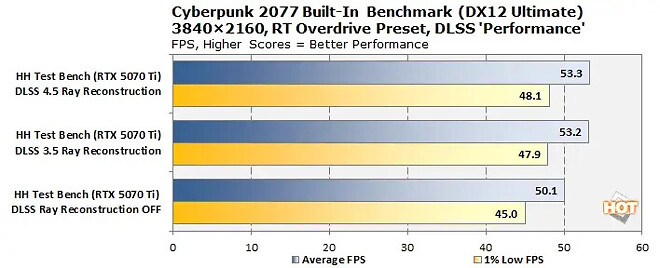
Cyberpunk 2077 ray reconstruction benchmark - Image: HotHardware
The second result mirrors the first. The performance difference on the Blackwell GPU is within the margin of error. DLSS 4.5 ray reconstruction appears to put a slightly heavier load on the tensor cores, but since tensor operations are rarely bottlenecked, it doesn't have a noticeable impact on actual performance.
DLSS 4.5 Ray Reconstruction in Hogwarts Legacy
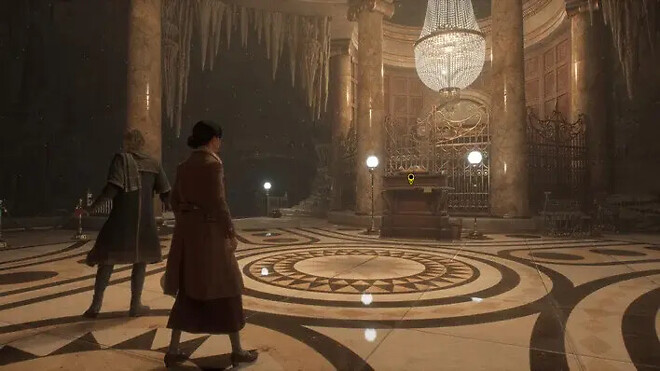
Hogwarts Legacy is the only game today that represents the Unreal Engine, but instead of relying on the Lumen ray tracing kernel built into Unreal Engine 5, it features a variety of ray tracing effects (shadows, reflections, ambient occlusion) backported to older Unreal Engine 4. Regardless, the game remains incredibly beautiful, and DLSS ray reconstruction plays a role in cleaning up the occasional noise that appears in shadows when ray tracing is enabled, especially at lower resolutions and frame rates.
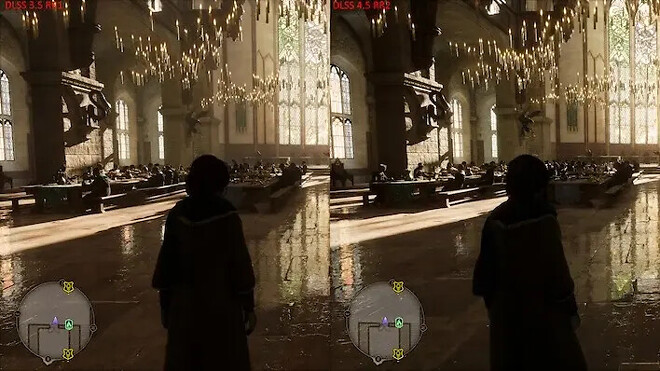
Hogwarts Legacy DLSS Ray Reconstruction Comparison - Image: Zak/HotHardware
Again, despite scouring the grounds of Hogwarts School of Witchcraft and Wizardry for hours, I couldn't find a place that clearly showed the difference between the two AI denoisers. Honestly, I felt that the latest DLSS 4.5 ray reconstruction slightly improved contrast and sharpness in certain scenes, resulting in a very subtle improvement in image quality, but I couldn't capture it in screenshots. Click the image above to go to the gallery and view larger individual photos for direct comparison.
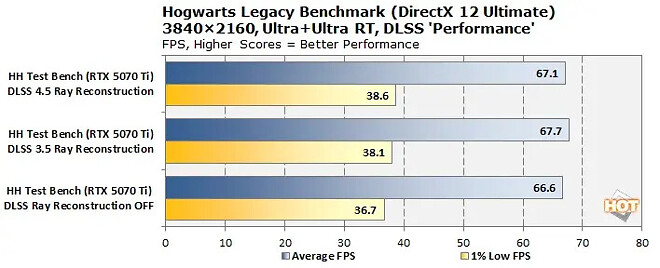
Hogwarts Legacy DLSS Ray Reconstruction Benchmark - Image: HotHardware
As with other games, the performance difference between DLSS 3.5 ray reconstruction and its successor, 4.5, is essentially within the margin of error. While it's definitely better to have it on than to play with ray reconstruction off, as the screen looks significantly better and performance improves, it's honestly hard to say exactly what role DLSS 4.5 ray reconstruction plays in this title.
Pragmata's DLSS 4.5 Ray Reconstruction
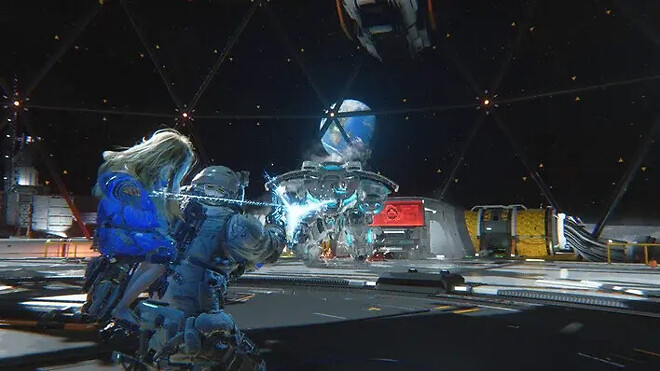
In the SF parenting game Pragmata, Capcom is pushing its own RE engine to the limit. What's unique about this game is that you can't manually activate ray reconstruction. Instead, it automatically activates when the game's path tracing feature is turned on. As a result, unlike its predecessor Dragon's Dogma 2 which used the same engine and had hidden path tracing features for all users, in Pragmata, only NVIDIA GPU users can use path tracing. Of course, the denoiser for that hidden feature was quite crude, so it may be why DLSS ray reconstruction became essential in Pragmata.
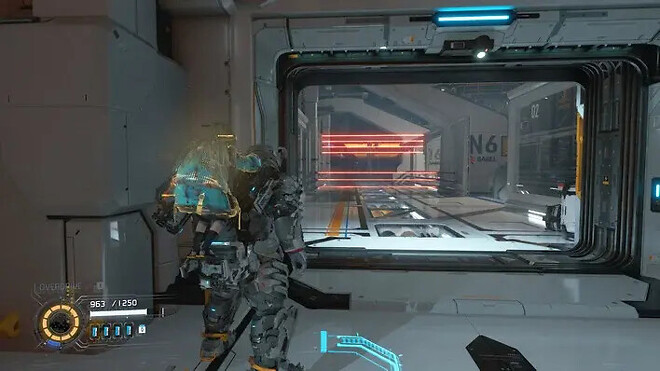
The beams in this area don't disappear properly when DLSS 3.5 ray reconstruction is applied. - Image: Zak/HotHardware
Pragmata is one of the games NVIDIA recommended for testing in its reviewer guide. Specifically, the company emphasized that this particular area was significantly improved by the new DLSS 4.5 ray reconstruction. Simply put, a set of beams at the bottom of this area travels along the floor and disappears at the end of the track. With DLSS 3.5 ray reconstruction, the beams strangely remained visible even when they were supposed to disappear. NVIDIA stated that DLSS 4.5 ray reconstruction would fix this cleanly, and we were able to confirm that it was indeed perfectly resolved.
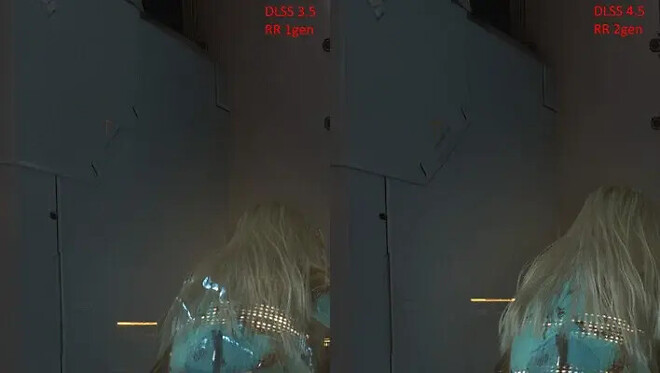
Lighting is noticeably improved with DLSS 4.5 RR applied. - Image: Zak/HotHardware
But honestly, I think the left area is more interesting. You'll need a good monitor to see the difference, but the shading of the metal box to the left of Hugh and Diana is much more realistic and detailed when using DLSS 4.5 Ray Reconstruction. Subjectively, I also observed that Diana's hair is less likely to turn into clumped pixels when moving with DLSS 4.5 Ray Reconstruction.
Another set of images from the gallery showing an empty hallway is also interesting. The soft light reflecting on the smooth metal surface of the hallway is noticeably less distorted in 2nd generation ray reconstruction, and the lighting in the scene is richer. It's very subtle, so you'll have to put both images full screen and tab back and forth to really distinguish them. But having played a lot of Pragmata recently, along with Hogwarts Legacy, I definitely got the impression that playing with DLSS 4.5 Ray Reconstruction resulted in a very slight, subtle improvement in lighting for all scenes.
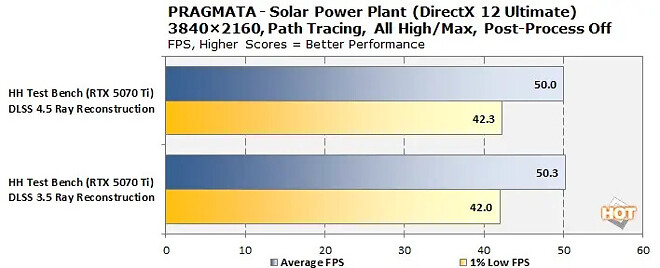
Pragmata Ray Reconstruction Benchmark - Image: HotHardware
In Pragmata, you can't turn off ray reconstruction without fundamentally changing the game's rendering load, so here we only compare DLSS 3.5 to DLSS 4.5. But again, there isn't a significant difference. While DLSS 4.5 Ray Reconstruction may cause performance degradation if you're using a significantly lower-tier GPU, playing at very high resolutions, or using older generation GPUs, it didn't make any difference in my tests.
DLSS 4.5 Ray Reconstruction: Our Thoughts
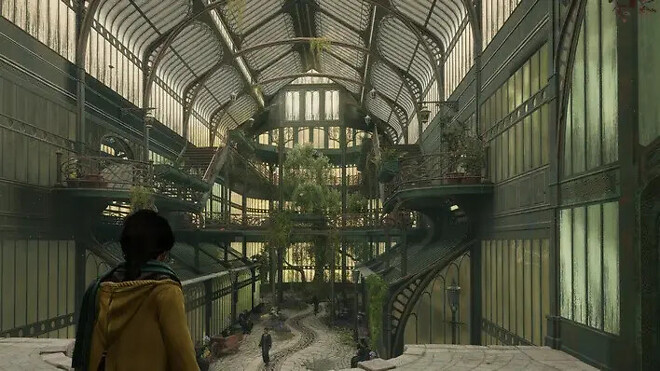
Hogwarts Legacy Greenhouse Screenshot - Image: Zak/HotHardware
DLSS 4.5 Ray Reconstruction is a very incremental change compared to DLSS 3.5 Ray Reconstruction. There's no significant performance impact from DLSS 3.5 on RTX 40 and RTX 50 series GPUs, and it significantly improves the graphics of almost every game you apply it to compared to not using it at all. Simply put, there's hardly a reason not to use DLSS 4.5 Ray Reconstruction.
There may be a broader debate about whether any form of ray reconstruction changes the lighting of a scene in a way that doesn't reflect the creator's intent, but we won't take sides on that today. Honestly, some games (like Pragmata) are now being developed with DLSS Ray Reconstruction as the target denoiser, so using it is actually the intended use by the creators. In other words, just turn it on. It solves most of the common complaints about ray tracing except for performance degradation and is actually faster than turning it off.
We've written a lot, done a lot of testing, and spent a lot of time to come to a simple conclusion, but this is the truth. Kudos to Nvidia for continuously advancing technology and bringing it to customers just a few years ago. DLSS 4.5 Ray Reconstruction has some performance impact, but it works on GeForce RTX 20 and RTX 30 series cards as well. We didn't have time to test it today, but if you're curious how much DLSS 4.5 Ray Reconstruction degrades performance on older GPUs, let us know in the comments below.
▶ Source: https://hothardware.com/news/nvidia-debuts-dlss-45-ray-reconstruction