Since this is a translation of an overseas article, there may be some inaccuracies.
LG, 2026 C6 and G6 OLED TV US Launch Prices Revealed
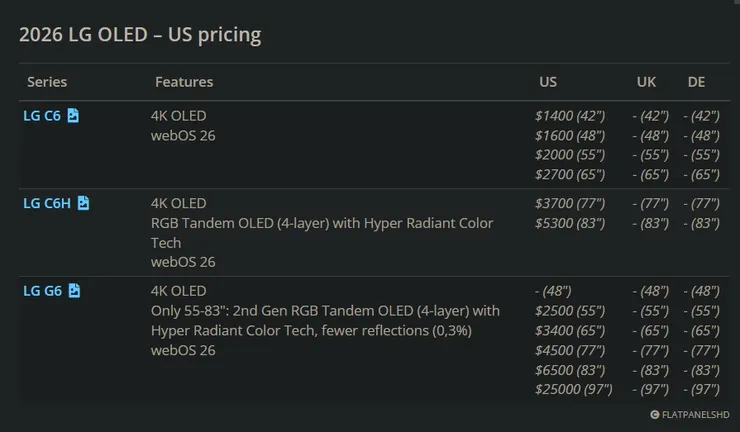
LG's 2026 OLED TVs will feature an upgraded Tandem WOLED panel on the 83-inch C6H model, except for which all models will be priced the same as last year's models.
Detailed US pricing information was announced at a launch event for the new OLED TVs. Yesterday, FlatpanelsHD published an in-depth first look article on the LG G6.
The TVs are not yet available in stores and prices for other regions have not yet been determined, but LG USA said it will begin rolling out releases at the end of this month. As always, prices are expected to drop significantly later this year and even further next year.
C6H Excluded, Same Starting Price
Comparing the starting prices of the 2025 OLED models, we see that the prices are the same. While OLED TV prices are expected to become more affordable in 2026 and for the next few years, this is not yet reflected in the starting prices of the C6, C6H, and G6. On the other hand, LG's B6 model will use a more affordable OLED SE panel.
The only exception is the 83-inch C6H model, which has a starting price that is $100 lower. The 77-inch C6H model is also cheaper or at least offers better value for money. Unlike smaller C6 models that continue to use standard OLED panels, the 77-inch model now uses an improved Tandem WOLED panel that delivers higher brightness and enhanced colors.
Like the B6, it remains to be seen what price the 'Wallpaper' OLED W6 will have.
Details are as follows:
Have LG G6 & C6 Finally Solved the Biggest Weakness of LG OLED TVs?
1. Next-Generation Processor: Alpha 11 AI Processor Gen 3
* 6nm Process Adoption: The world's first adoption of a 6nm manufacturing process reduces the size of the chipset and lowers heat generation, enabling thinner TV designs.
* Performance Enhancement: GPU performance has been improved by 70% compared to the previous generation, and powerful NPU performance enables sophisticated image processing.
2. Addressing the Chronic 'Gradation' Issue
* 12-bit Color Processing: Going beyond the conventional 10-bit (1,024 steps), a 12-bit (4,096 step) pipeline has been established. This dramatically improves color banding (posterization) that used to occur in dark areas close to black.
* 13-bit Luma Processing: Applying 13 bits to the brightness channel (Y), HDR content's bright areas (specular highlights) are expressed with twice the detail.
3. User Convenience Features and Setting Updates
* 24-Point White Balance: More finely tuned than the previous 22 points, allowing for precise adjustments, especially in near-black areas.
* AI HDR Remastering: SDR content is analyzed by AI and automatically converted to HDR-level brightness and contrast ratio.
Dynamic Tone Mapping Improvement: The maximum mastering luminance of the content (e.g., 4,000 nits) is displayed on the screen.
* Users can directly adjust the gain of the tone curve to control the overall brightness of the screen.
* An initialization function has been added to easily reset settings values.
4. Other Improvements
* Interface Optimization: The menu background has been slightly darkened to protect the screen and reduce power consumption.
* Upscaling: 'Dual Super Resolution' processing removes noise from streaming content and delivers sharper image quality.
▶ Source: https://www.flatpanelshd.com/news.php?subaction=showfull&id=1772689803
▶ Source: https://www.hdtvtest.co.uk/news/lg-electronics-now-taking-pre-orders-for-its-2026-g6-and-c6-oled-t-vs