One of the illogical arguments seen in Dosa is,
"If we follow the law well, awareness about bicycles will improve,"
and people express it as if it were an immutable truth.
But that's what we call legalism.
More loosely, it's also expressed as authoritarian legal positivism.
"Don't complain because the law is like this." While attacking theories quite aggressively,
that's not the rule of law in a democratic state.
It's 'fascism within us.'
When that happens, we can't explain why laws change.
Anyway, the world is gradually changing urban design itself from car-centered to bicycle-centered, one by one.
We need to reduce carbon.
We're at the stage just before car-centric laws and urban planning themselves are perceived as outdated and backward.
In France, since the previous mayor before Anne Hidalgo, there's been the "Plan Vélo" policy,
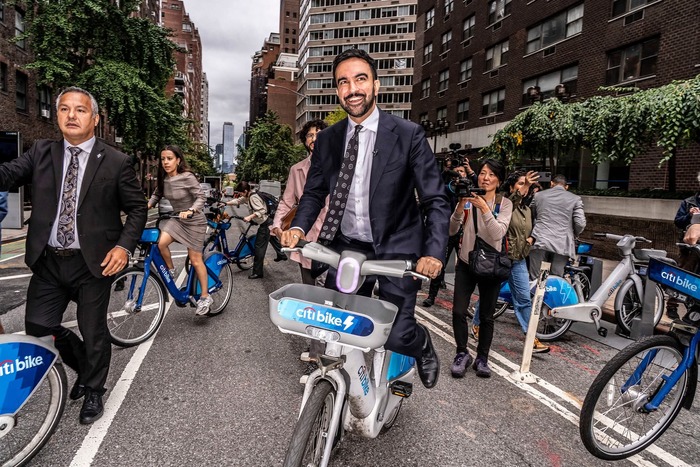
and in the United States, Mayor Janette Sadik-Khan is implementing Vision Zero, a vision to make traffic policy pedestrian and bicycle-centered and reduce deaths to zero.
No matter how much people say Korea's land is small and it's a car republic, what could K not do?
If we say let's reduce car-centeredness right away,
people will worry about economic growth and ask, "Who will raise the cows?"
But the larger-scale economic powers who have ridden bicycles longer than us are not doing such policies for nothing.
In that regard, I don't think it's the case that people with narrow experiences are reacting aggressively to different ideas that 'haven't been heard or seen so far.'
Such people will criticize Mayor Sadik-Khan's commute route for parallel riding, no hands riding, and not wearing a helmet,
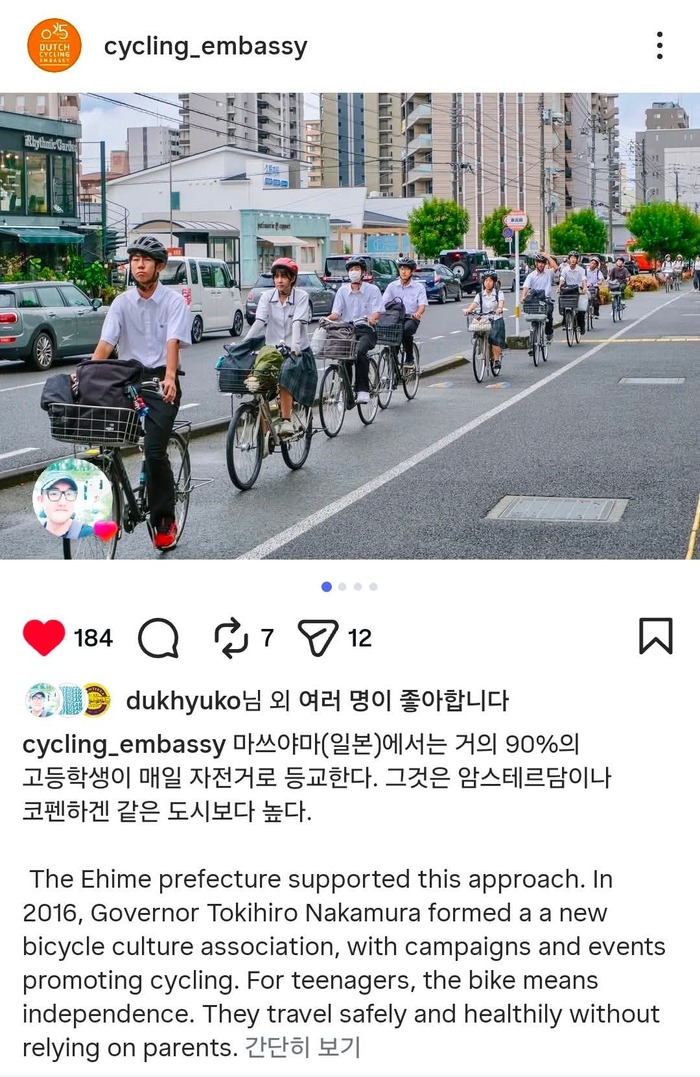
Japanese students' bicycle commute route as no hands riding,
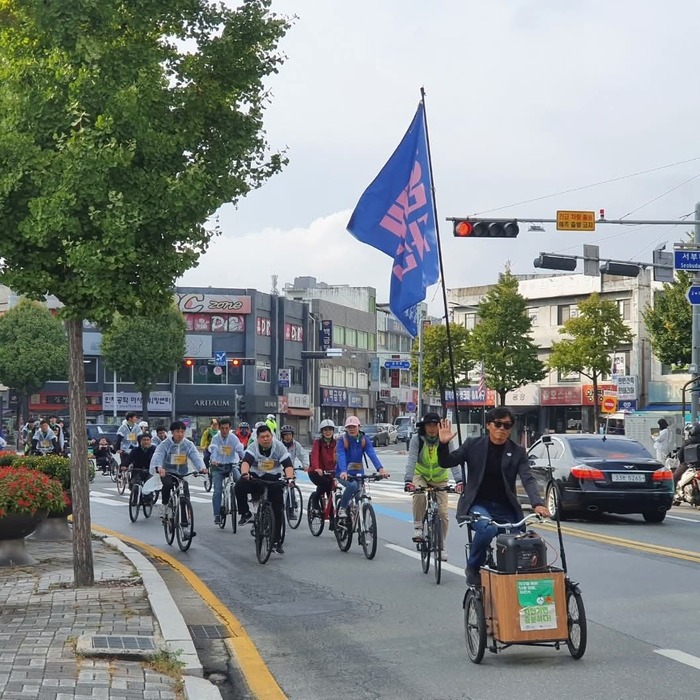
and Chuncheon citizens' bicycle campaign as blocking the road and doing who knows what as a group.
For us to ride safely, we need to raise objections to situations where the law fails to keep up with reality.
That's what it means to be a citizen of a democratic state.