This is a translation of an overseas article, so there may be errors in translation.
Two articles have been combined.
https://www.flatpanelshd.com/news.php?subaction=showfull&id=1777456862
Samsung Develops 'Breakthrough' Glasses-Free 3D OLED Technology
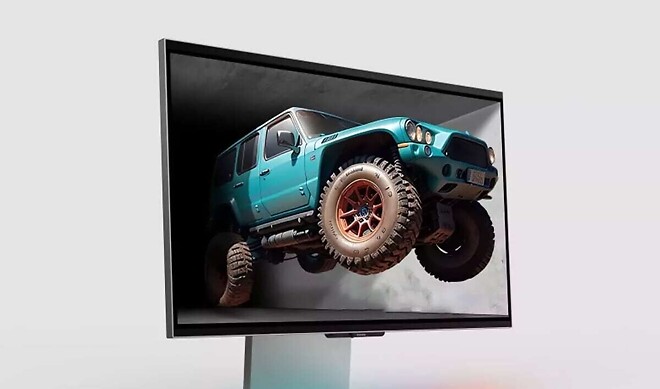
The new approach advances light field technology to improve both 2D and 3D image quality simultaneously, while widening the 3D viewing angle to allow multiple people to watch at the same time.
The results of a joint project by Samsung Research, Samsung Electronics, and Korea's POSTECH have been published in the peer-reviewed academic journal Nature under the title 'Switchable 2D-3D Display via Metasurface Lenticular Lens.' This approval suggests that this technology is worth noting.
Better 2D and 3D
Next-generation 3D systems are still based on light field technology, which is the same principle used in Samsung's 27-inch Odyssey 3D G90XF and the upcoming 32-inch Odyssey 3D G90XH that rely on eye-tracking cameras.
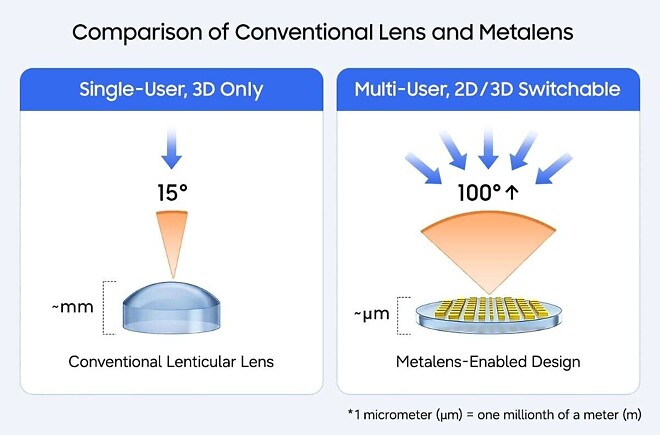
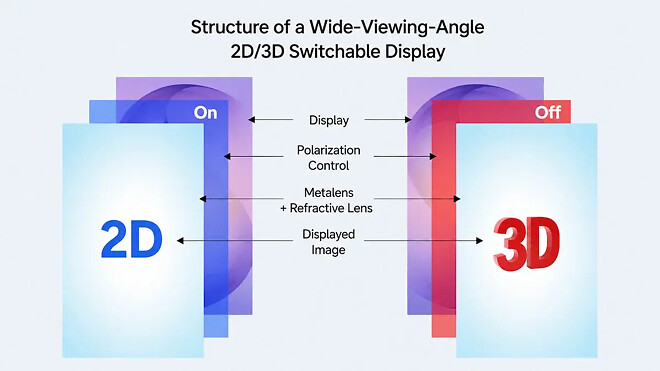
However, the new method uses an ultra-thin 'metalens' that can switch between concave and convex states using voltage. This allows the display to maintain its thin form while switching between high-resolution 2D and glasses-free 3D.
This system provides a maximum 3D viewing angle of up to 100 degrees, much wider than current systems, and also improves overall image quality. Samsung refers to this as a breakthrough advancement.
Samsung explained, "Although light field displays have long been considered promising in entertainment, augmented reality (AR), and medical imaging fields, existing light field displays have faced commercialization challenges such as bulky optical devices, narrow viewing angles (approximately 15 degrees), reduced resolution, and dependence on real-time eye tracking. The research team overcame these limitations by designing a metasurface lenticular lens (MLL) that dynamically adjusts focal properties using polarization, which is the direction in which light oscillates."
Will 3D OLED Be Released?
This is not merely a proof of concept. Samsung has developed a 50x50mm metalens and integrated it with OLED panels currently used in smartphones.
Samsung revealed that this technology has "the potential to reshape next-generation displays," but its initial focus is on smartphones, tablets, and commercial displays. Samsung has not provided a specific timeline, and there has been no mention of 3D TVs yet.
This research is part of Samsung's broader efforts to leave behind past failures based on 3D glasses and revive 3D starting with gaming using glasses-free technology.
https://www.avpasion.com/samsung-resucita-3d-sin-gafas-pantalla-cambia-2d/
Samsung Revives Glasses-Free 3D with Technology to Erase Bad Memories of 3D TVs
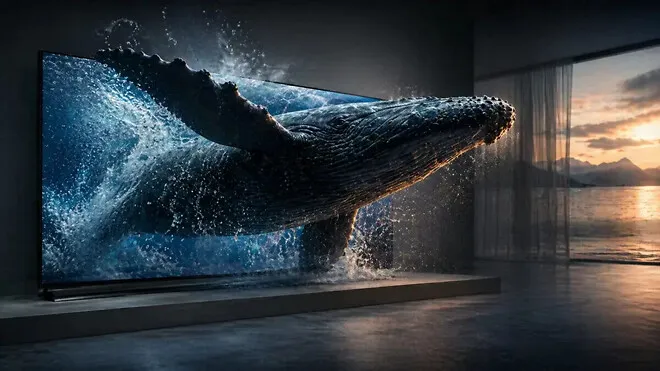
The term glasses-free 3D sounds a bit like "been there, done that." And that's understandable. Many people's minds will recall the era of 3D TVs, glasses stuffed in drawers, store demonstrations, and movies that promised the future but ended far too quickly. However, Samsung's new approach is taking a much more sophisticated and less cumbersome path.
Samsung, together with POSTECH, has developed a display that can switch from normal 2D images to glasses-free 3D images using metasurface lenticular lenses. While the name might sound a bit intimidating, the idea is easy to understand. It's a technology that places microscopic structures in a very thin layer to guide light in different ways. As a result, the display can create a sense of depth without wearing anything on your face.
This is because it's not the typical 3D where viewing angles are terrible, resolution is sacrificed, or you have to keep your head fixed at an exact point like defusing a bomb. Samsung is talking about a light field system with a maximum 100-degree viewing angle and a lens that's only 1.2mm thick. In short, it's no trivial achievement.
Samsung's New Glasses-Free 3D Aims to Avoid the Mistakes of 3D TVs from Years Ago
To understand why this technology is interesting, you need to remember what killed 3D for home use. It wasn't simply a lack of content. The experience itself was inconvenient. Glasses, dimmer brightness, finicky viewing angles, people feeling dizzy, formats that were never quite satisfying... In the end, it looked less like a normal way to watch television and more like a permanent demo version.
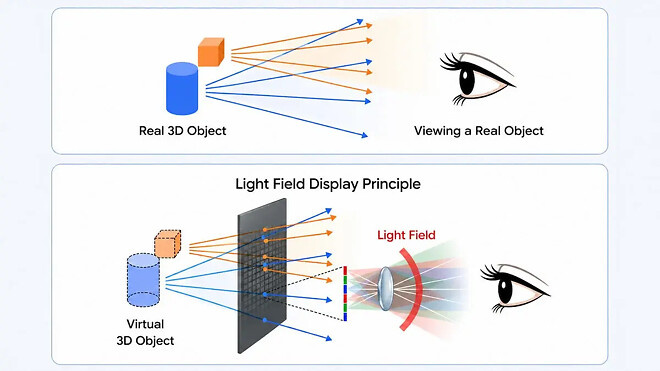
Samsung took a different path. This technology reproduces the light that reaches our eyes from objects and sends information simultaneously from multiple directions. In other words, rather than simply 'separating' two images for two eyes like classic 3D, it uses light fields to allow the brain to perceive depth without glasses.
The key lies in a metasurface lenticular lens that can change its properties based on voltage. In simple terms, when 3D isn't needed, it can work as a regular 2D screen, and only switch to 3D mode when content utilizes it. This is very important. A screen that can only display 3D is ultimately just a toy, but a screen that can do both starts to have much greater significance.
Don't expect Samsung 3D TVs in your living room… at least not yet
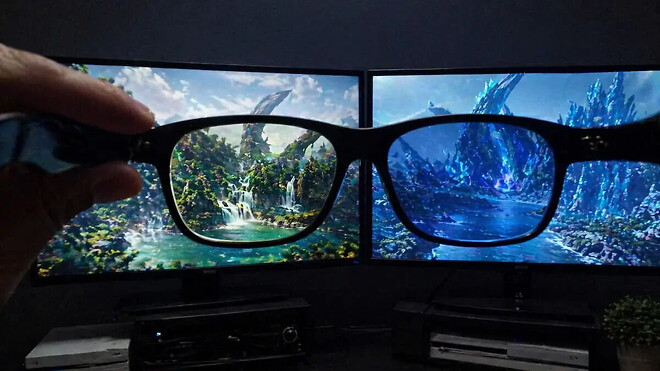
The less exciting part is that this technology is still far from being applied to 65-inch living room TVs as it stands. According to the released materials, Samsung has been working with samples around 25 square centimeters in size, which is very small compared to a TV. There's still a long way to go before it can be applied to smartphones or tablets.
Therefore, if this technology reaches the market, it would be most logical for it to first be applied to small screens, tablets, mobile devices, digital signage, or professional displays. It could have considerable significance there. Imagine storefront windows, advertising, museums, portable video games, photos using depth maps, or interfaces that utilize volumetric depth without anything worn on your face.
In fact, Samsung isn't the only player in this field. Other companies, including TCL, have shown advances in light field-based glasses-free 3D displays. What's interesting is that this is no longer a one-off idea but looks like a fairly serious technological competition to strip away the worst habits of the past and reclaim 3D.
3D could come back, but not in the form we remember
No, 3D TVs won't be making a comeback tomorrow. Samsung won't suddenly launch glasses-free 3D OLED or Mini LED lineups for living rooms. This still smells of the laboratory and is closer to very specific first applications or small and professional-use screens rather than mass-market products.
However, it's also true that this technology is precisely addressing the points where 3D fell short in the past: reduced thickness, expanded viewing angles, switching between 2D and 3D, and the absence of glasses. If they scale it up while maintaining high resolution and ensure content support, this won't sound so far-fetched anymore.
Perhaps 3D won't make a comeback like the glasses-based fad that many eventually put in a drawer. Instead, it could return in a more thoughtful and integrated form, with more specific use cases. Samsung has put another card on the table, and while there's still a long way to go, this innovation looks much more sophisticated than that 3D that promised the world only to disappear out the back door.
▶ Original source: https://www.flatpanelshd.com/news.php?subaction=showfull&id=1777456862
▶ Original source: https://www.avpasion.com/samsung-resucita-3d-sin-gafas-pantalla-cambia-2d/