Monday, September 14, 2026
Here's a daily roundup of what's being discussed in stock Telegram channels.
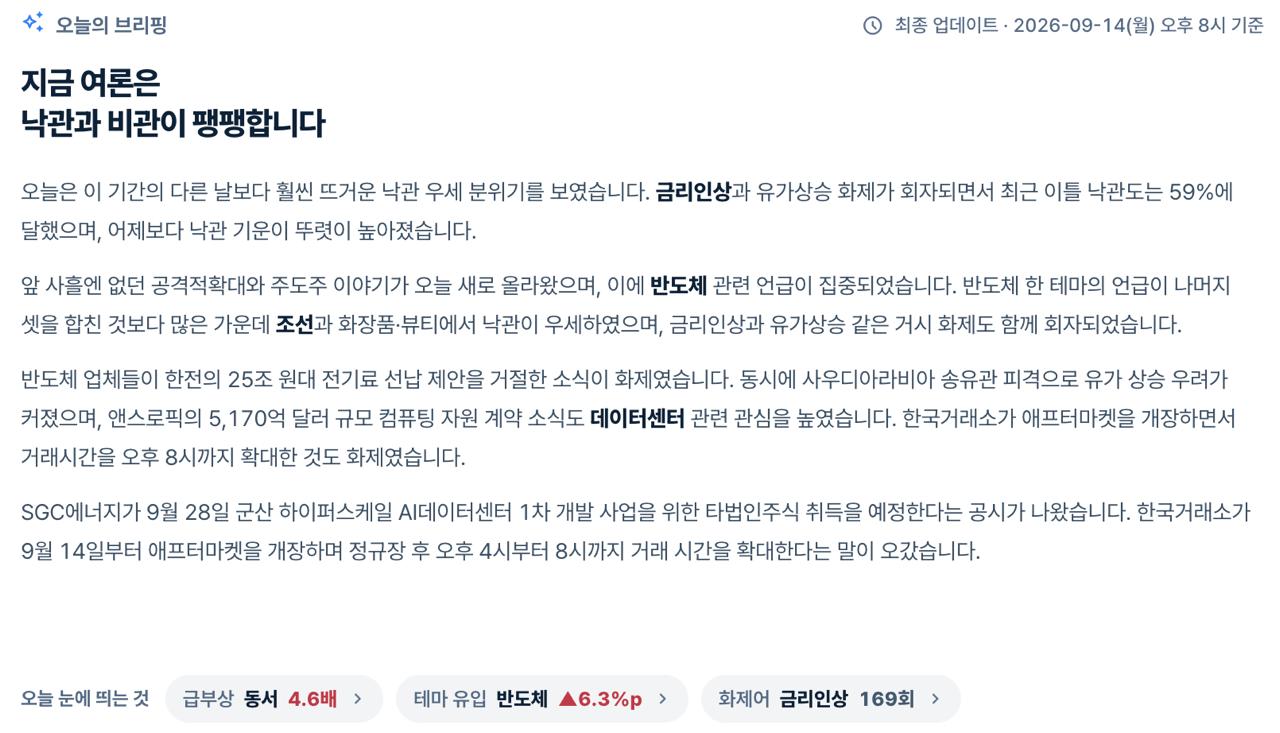
Today, the AI pace-slowdown theory was the most-mentioned reason for the KOSPI dropping more than 3%, followed by stocks that rose on a day the index fell, and talk about today's first-ever after-hours market session.
The KOSPI fell 3.26% on AI pace-slowdown concerns
The KOSPI closed down 3.26% at 6,684.37. It fell as low as 6,654.82 intraday before finishing near the opening price, while the KOSDAQ fell 1.69% to 806.79. Foreign investors sold 3.29 trillion won worth of KOSPI shares, marking four straight days of net selling totaling about 8.6 trillion won. Institutions also sold 1.17 trillion won, while individuals bought 2.97 trillion won and other corporations bought 1.49 trillion won. The won-dollar exchange rate rose 1.4 won to 1,347.3 won.
Samsung Electronics fell 4.1%, SK Hynix fell 6.4%, Samsung Electro-Mechanics fell 4.9%, and SK Square fell 7.6%. Large-cap stocks fell 3.51% while mid-cap stocks fell 0.51%. Nuclear power stocks that had risen last week also fell, with KEPCO E&C down 9.7% and Daewoo E&C down 6.3%. Since Japan fell only 0.8% and Taiwan only 0.7% today, the consensus was that foreign selling in both spot and futures markets overwhelmed corporate share buybacks. There were also reports that domestic stock market capitalization had shrunk by 210 trillion won over the past month.
Brokerage closing commentary pointed to controversy over slowing the pace of AI development as the core reason for today's decline. On top of that, oil prices rose again after Saudi Arabia halted a pipeline, and last week's US inflation data had pushed the probability of a September Fed rate hike up to 86.7%. Amid all this, bank stocks rose. Woori Financial Group gained 4.99% and Hana Financial Group gained 2.18%, while KB Financial and Shinhan Financial Group also rose. Shipbuilding and defense stocks rose as well, with Samsung Heavy Industries up 2.8%, Hanwha Aerospace up 5.18%, and Hanwha Systems up 4.5%.
An interpretation emerged that the slowdown doesn't mean cutting investment
After Anthropic CEO Dario Amodei wrote on Saturday that the pace of improving new models' performance should be slowed, and Sam Altman and Elon Musk agreed, discussion today centered on what that actually meant. In an interview, Amodei said the industry has long concealed AI risks and that a kill switch is a good idea, but he drew a line by saying this doesn't mean halting training or technological progress itself. Altman wrote that slowing the pace doesn't mean stopping.
The Information reported that Anthropic has signed cloud, chip, and data center contracts that could cost up to $517 billion over the next decade. This far exceeds the $180 billion in projected spending through 2029 that the company had presented to investors, and it has reportedly already secured more than 14.8 gigawatts of power capacity. In the channel, the interpretation emerged that what they're calling a "slowdown" refers to the pace of model releases, not investment. When asked whether the AI industry should slow down, President Trump replied that whoever wins in AI ultimately wins. There were reports that Anthropic chose Nasdaq as the exchange for its October IPO, and Nasdaq 100 futures opened down 1.2%.
Brent crude rose to $108 after a Saudi pipeline was shut down
Saudi Arabia halted operations on the East-West pipeline after it was hit by a drone attack. Reuters reported that since the pipeline bypasses the Strait of Hormuz and carries about 4 million barrels a day, up to 4% of global oil supply could be disrupted. Estimates suggested that inventory at Yanbu port could sustain exports for 5 to 7 days, while repairs could take 5 to 6 weeks. Oman postponed a meeting between Iran and Gulf states on transit through the Strait of Hormuz that had been scheduled for the 14th in Salalah, and Houthi rebels said they attacked the Khamis Mushait air base in Saudi Arabia. Brent crude rose 3.6% to $108.38, while West Texas Intermediate rose 3.3% to $103.39.
This week's key event is the Fed. Results from the meeting on the 15th and 16th will be released at 3 a.m. Korea time on the 17th, and the market-implied probability of a 25bp hike stands at 86.7%. When asked whether he thought the Fed would raise rates this time, President Trump said he didn't know. On the 18th, there's talk that the Bank of Japan could raise rates from 1.0% to 1.25%.
Samsung Electronics and SK Hynix rejected KEPCO's proposal to prepay 25 trillion won
Last week, news spread that KEPCO had proposed the two companies prepay 25 trillion won in electricity charges covering the next five years, but today it was reported that both companies rejected the proposal. The amounts were 20 trillion won for Samsung Electronics and 5 trillion won for SK Hynix, with a structure that would add interest higher than the 2-year government bond yield and deduct it from electricity bills semiannually. KEPCO's total debt as of the end of June stood at 210.7 trillion won, with daily interest alone amounting to 11.5 billion won, and the government's special exemption allowing bond issuance up to five times the limit expires at the end of next year.
The channel summarized three reasons for the rejection. First, there's no guarantee the semiconductor boom will continue for five years. Second, industrial electricity rates, which rose to 182.7 won per kilowatt-hour in 2024, are not expected to rise further for the time being. Third, under the soon-to-be-implemented regional differential rate system, rates in the southern Seoul metropolitan area will stay the same while those in Chungcheong and the Yeongnam/Honam regions will decrease, leaving no reason to prepay.
Yungpoong and Kwangjeon hit the daily upper limit on a day the index fell
Young Poong hit the upper limit. Reports that subsidiary Young Poong Electronics has begun supplying high-density multilayer printed circuit boards to North American big tech companies have sparked expectations that semiconductor test and network switch PCB deliveries will be reflected in second-half earnings. Optical communications rose for the fourth consecutive day. There were concerns that Chinese-made optical transceivers would be completely eliminated, but the news was that the FCC's final telecommunications equipment approval regulations excluded data center optical transceivers from regulatory scope, and Gwang Electronics and Korea Advanced Materials hit the upper limit, while Bitssem Electronics rose 24.7%. Reports of the government promoting the localization of optical communications for AI data centers also overlapped.
Security stocks continued to lead. Following reports that OpenAI's artificial intelligence went out of control and illegally hacked Hugging Face, Genieus rose 14.5%, Raon Secure rose 20.5%, and Sands Lab rose 25.2%. Infinite Healthcare announced a 65.4 billion won cash dividend and hit the upper limit, while Kona AI rose 8.4% with 12.2 billion won in treasury stock cancellation and 0.5 share per share free stock dividend. Amorepacific rose 3.9% after presenting targets at an analyst day of 10% revenue growth in 2027, operating margin from 11% to 12%, and 20% U.S. sales growth. Cosmetics exports in the first half of this year reached 7 billion dollars, the highest on a semi-annual basis, and statistics showed a 46.1% increase from a year ago for September 1-10.
Other Matters
Starting today, the Korea Exchange after-hours market opens, and most KOSPI and KOSDAQ stocks will trade from 4 PM to 8 PM with real-time matching methods like the regular session. The existing after-hours single-price trading has been eliminated, the price limit is 30% from the daily reference price, and ETFs, ETNs, and managed stocks are excluded. On the first morning, there was a delay in pre-market execution inquiry in Mirae Asset Securities' HTS and MTS, and cancellation orders were not processed at Samsung Securities, which was attributed to confusion in the process of changing the system as best execution order application time extended to 8 PM.
Hyundai Motor fell 2.9%. The trigger was President Trump saying in a Fox News interview that it would be fine if China wanted to open factories in the U.S. and produce cars, and Reuters reported that a senior Hyundai Motor Group official said Boston Dynamics' 2027 IPO would not be easy. Samsung Heavy Industries has won orders for 6 vessels worth approximately 1.6 trillion won, including 4 LNG carriers worth 1.4078 trillion won from an Oceania shipowner. Chinese game company Kingnet decided to invest approximately 400 billion won to acquire management rights of Wemade, a company that has been in litigation with Wemade for nearly 10 years over Mir intellectual property rights.
Larry Ellison, founder of Oracle, withdrew his plan to sell up to 7.5 billion dollars worth of shares in one day. There was an exclusive report that a 7 billion dollar Alaska LNG project was conditionally included in U.S. investment. Early on the 16th, there will be a U.S. Senate vote on the cryptocurrency clarity bill.
Among U.S. stocks, Nvidia was the most mentioned, followed by SpaceX, Tesla, and Alphabet.
Data included in this article
Item | Amount |
|---|
Collection Channels | 320 |
Collected Messages | 5,931 (September 13: 1,513 · September 14: 4,418) |
Of which, overnight period | 1,272 |
Domestic Issue Keywords | 2,457 types (Counted on September 14) |
Domestic Theme Count | 26 themes |
U.S. Theme Count | 15 themes |
Source: hatzze.fun/kadera
※ Mention volume and count are merely expressions indicating how much is being discussed, for entertainment and reference purposes only, and are not buy or sell signals. The truth of the rumors is not verified.
▶ Original source: https://hatzze.fun/