
This is a translation of a foreign article, so there may be translation errors.
https://www.ecoustics.com/news/apple-four-homepod-surround-sound-system/
Apple is Testing a 4-Channel HomePod Surround Sound System for Apple TV 4K
Could Apple be developing a surround sound system using four HomePods? In audioOS 27 code, rear speakers, spatial correction, bass management, and mysterious hardware have been discovered.
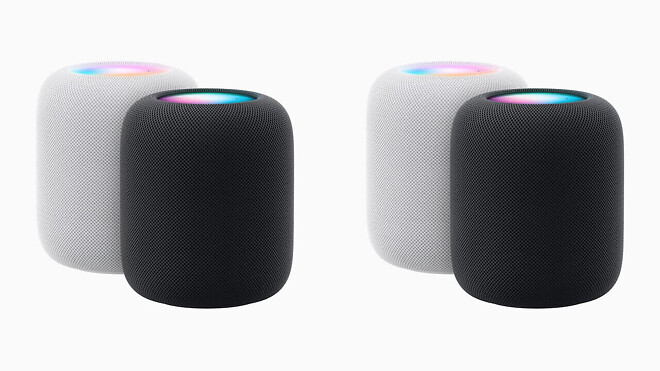
For years, Apple has claimed that one or two HomePods alone can adequately serve as a home theater. To be fair, a second-generation HomePod stereo pair can play Dolby Atmos with Apple TV 4K, and Apple's computational audio performs remarkably well, creating a much wider soundstage from two speakers positioned at the front of the room than their actual size would suggest.
But two speakers are still just two speakers, and newly discovered code in audioOS 27 beta 8 suggests Apple is experimenting with a much more ambitious project: a four-HomePod surround sound system with separate front-left, front-right, rear-left, and rear-right speakers. If Apple actually releases this, HomePod could evolve from simply a high-performing stereo TV sound solution into something much closer to an authentic wireless home theater platform.
This would push Apple into an entirely new competitive landscape.
What is Apple Actually Testing?
According to the discovered code, Apple has created tuning settings for four second-generation HomePods arranged around the listening position. References within the software include front-left, front-right, rear-left, and rear-right speakers, along with automatic spatial correction, speaker position mapping, timing adjustments, bass management, EQ, dialogue enhancement, and separate processing modes for movies and music.
Additionally, for stereo content, Apple appears to be experimenting with two approaches: spatializing music across all four speakers and maintaining traditional stereo playback through the front pair only.
This is far more sophisticated than simply grouping four AirPlay speakers to output the same sound. Since it's rare for four HomePods arranged around a room to be equidistant from the listener, timing correction and speaker position mapping are essential. And considering each full-size HomePod has its own 4-inch high-excursion woofer, bass management becomes a particularly interesting element.
Apple already uses computational audio, spatial sensing, and automatic bass correction technology inside individual HomePods. If these capabilities could be coordinated and controlled across four independent locations, it would provide much more powerful control over soundstage development and surround placement compared to the existing one or two speaker approach.
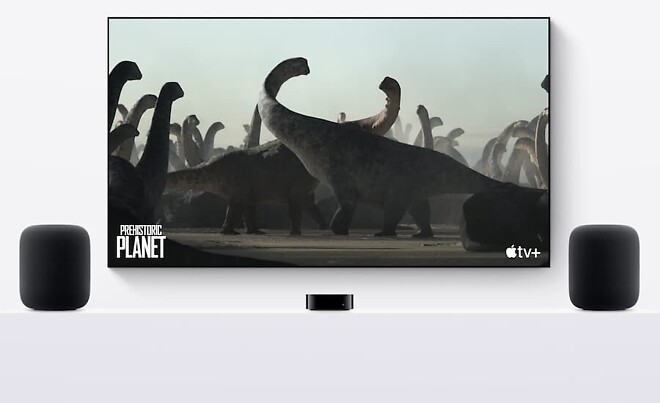
Apple HomePod 2nd Generation Stereo Pair
There's Also Mysterious Hardware
The beta code also includes references to a tuning system called "Forklift" that combines two second-generation HomePods with two speakers with the hardware identifier AID12007, which has not yet been identified. This identifier does not match any HomePod product currently on sale.
So what is this exactly? It appears that no one outside Apple knows.
The upcoming HomePod mini, the third-generation full-size HomePod, or even other unreleased Apple audio products are possibilities. There is currently no evidence that Apple plans to sell dedicated wireless surround speakers, so further speculation would be meaningless.
However, it's interesting that two configurations exist. This suggests that Apple may be testing more than one approach. One involves placing four existing full-size HomePods, while the other combines current and next-generation hardware.
The code also mentions a new "Party Mode" for paired HomePods in stereo, designed to create a more expansive sound field across the entire space rather than optimizing playback for a narrowly focused listening position. This could be useful for music enjoyment but is significantly more important for home theater applications.
What We Still Don't Know
Apple has not officially announced a surround sound system using four HomePods, and there is no guarantee that the features discovered in beta software will be commercially available. Currently, the Home app and Apple TV do not provide a way to configure four HomePods as a permanent home theater system, and Apple's current implementation only supports one HomePod or a stereo pair with Apple TV 4K.
We also don't know if the existing second-generation HomePod will be supported, whether new hardware will be required, what AID12007 actually means, or how Apple will map Dolby Atmos channels to four speakers. There are no signs of a dedicated center speaker or wireless subwoofer, and there is no confirmed release date. We also don't have evidence indicating how Apple might name the completed system (4.0, 5.1.4, 7.1.4, etc.).
Finally, it is worth emphasizing that four physical speakers do not necessarily mean only four audio channels. The latest spatial audio systems routinely use beamforming and virtualization techniques to reproduce more channels than the number of physical enclosures. Current HomePods already use five tweeter beamforming arrays and computational processing to implement spatial audio with Dolby Atmos.
The absence of a physical center channel will still be an interesting challenge. Since movie dialogue is typically fixed to the center speaker, Apple will need to create a convincing phantom center or use other computational techniques to make dialogue appear anchored to the screen across multiple seating positions. HomePods already offer a Dialogue Enhance feature, but it remains to be seen how Apple will integrate this technology into a four-speaker layout.
Unfortunately, the laws of physics do not accept firmware updates.
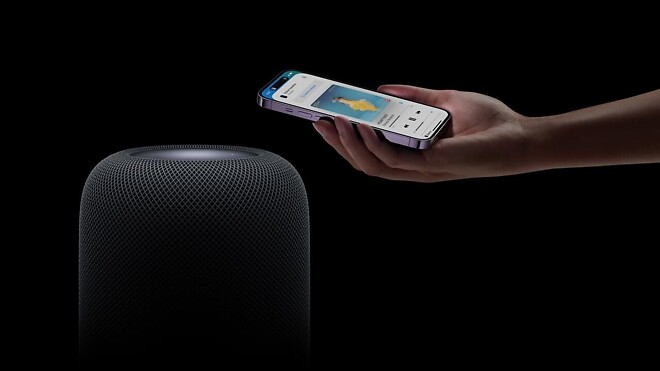
Apple HomePod 2nd generation (2023 model)
Why This Matters
HomePod has always occupied a somewhat unique position within the Apple ecosystem. The second-generation model, priced at $349, boasts impressive performance for its size, featuring a 4-inch high-excursion woofer, five beamforming tweeters, spatial awareness, automatic bass correction, computational audio, and Dolby Atmos support for spatial audio.
Purchasing two creates a surprisingly excellent wireless TV sound system for Apple TV 4K users. The clear limitation is that all physical speakers remain at the front, requiring Apple to create most of the surround experience through processing.
Adding actual rear speakers would fundamentally change this situation. Instead of being entirely virtualized from the front, surround sound information could originate directly behind the listener. Four independently powered HomePods would also provide Apple with multiple low-frequency sources and significantly more powerful audio output.
Configuring four HomePods at the current price of $349 each would cost $1,396 before adding an Apple TV 4K. While not inexpensive, this price point puts it in direct competition with premium soundbars and wireless home theater systems.
More importantly, Apple would finally be able to offer an upgrade path for HomePod. Users could theoretically start with one speaker, move to a stereo pair, and ultimately expand to surround sound without discarding their existing hardware.
Sonos has built a successful business model precisely on this concept.
Sonos is the Most Formidable Competitor
The recently released Sonos Beam Ultra makes this comparison even more timely. This compact soundbar, priced at $699, transforms Sonos into a true 7.1.2 Dolby Atmos architecture with its nine drivers, including a dedicated upward-firing height driver. It also maintains the ability to expand the system by adding Trueplay spatial correction, wireless surround speakers, and a Sonos Sub.
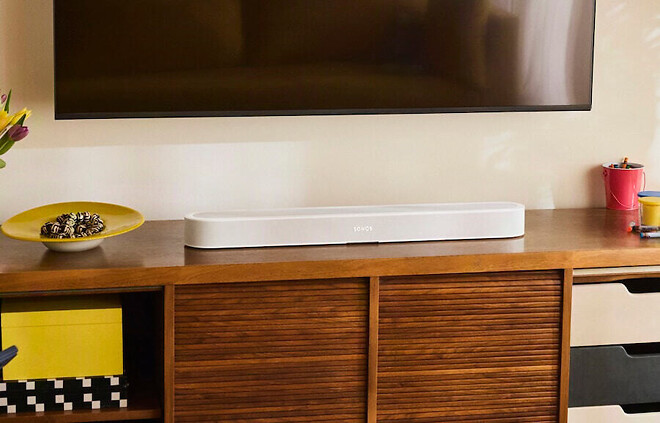
Sonos Beam Ultra Soundbar in 2026
This means that users can start with the Beam Ultra and gradually build up to a larger home theater system instead of buying everything on the first day. Moreover, Sonos has the advantage of years of experience integrating soundbars, surrounds, subwoofers, headphones, and multiroom audio into one platform through its HDMI eARC connectivity.
The larger Arc Ultra model offers 9.1.4 channel output and can be expanded with wireless surrounds and a subwoofer. Therefore, Apple is entering a category where Sonos already provides consumers with clear steps to expand from a single soundbar to a much more immersive system.
Apple's potential advantage could come from the architecture side. Instead of relying mostly on front channel work in the soundbar, four HomePods can distribute amplifier output, bass reproduction, beamforming, and computational processing throughout the space.
Whether this approach will deliver better sound is a question for after Apple actually makes it available to consumers.
Sony could be an even more similar comparison point
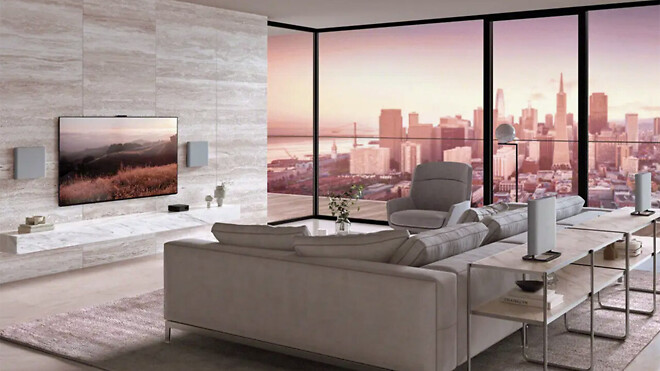
Sony BRAVIA Theatre Quad is a 4-speaker surround sound system
The Sony BRAVIA Theatre Quad presents an even more interesting technological comparison point as it deviates from the traditional soundbar layout. Sony places four independent wireless speaker enclosures around the listening space and uses 360 Spatial Sound Mapping to create additional virtual speaker locations within the space.
This seems remarkably similar to the problem Apple is trying to solve. Moreover, Sony has a clever solution for the absence of a physical center speaker. Compatible BRAVIA TVs can participate in the system through Acoustic Center Sync to help anchor dialogue directly to the screen.
While there is currently no evidence that Apple plans a similar feature utilizing the TV's internal speakers, the similarity between Sony's four-speaker architecture and audioOS testing is hard to ignore.
Apple is going beyond Google
Google has also expanded into the TV audio space by allowing one or two Google Home speakers to work with a Google TV streamer, providing consumers with a wireless audio solution that serves as an alternative to traditional soundbars.
If Apple adds physically separated rear speakers, the HomePod would surpass this two-speaker setup. Looking at the bigger picture, Apple, Google, Sonos, Sony, and Samsung are all targeting the same consumer: those who want immersive TV sound without needing an AV receiver, speaker wires, or seven individual amplifiers scattered throughout their living room.
Traditional home theaters aren't disappearing, but the market center is shifting increasingly towards a wireless environment.
Apple hasn't announced a 4-HomePod surround system, and beta code shouldn't be mistaken for a product launch announcement. Features are often internally tested and then removed.
However, the mention of four physical speaker locations, spatial correction, speaker mapping, timing calibration, bass management, dialogue processing, various listening modes, and hints at next-generation hardware suggest that Apple is investigating something far more ambitious than just another HomePod software update.
If Apple were to transform HomePod into an expandable wireless surround platform, it would create a clear bridge between TV speakers and traditional separate home theater systems while directly competing with solutions like the Sonos Beam Ultra and Arc Ultra, Sony BRAVIA Theatre Quad, and other increasingly sophisticated wireless options.