
Since this is a translation of an overseas article, there may be mistranslations.
https://www.ecoustics.com/products/klipsch-reference-signature-speakers-2026/
Klipsch Reference Signature Speakers First Unveiled: First Listening Held at CEDIA 2026 Ahead of Winter Release
Klipsch unveiled a 3-way Reference Signature speaker at CEDIA 2026, but will the new horn design raise the bar for the Reference Premiere III?
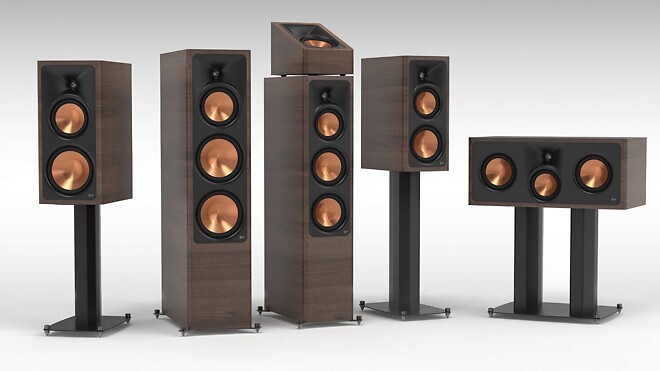
While Klipsch showed a lot of hardware at CES 2026, some of the most interesting products were behind closed doors, with a rather important footnote that we were seeing concepts.
One of them was the new Klipsch Reference Signature series.
Eight months later, Klipsch brought the Reference Signature to the CEDIA Expo 2026 in Denver, and this time attendees were able to actually listen to the products. The company also finalized a six-model lineup, revealed more details about the acoustic design, and provided initial indicators of speaker pricing when some models are released this winter.
If Reference Signature sounds familiar, it's because you've been paying attention.
We covered an early version at CES last January, and at the time Klipsch described the Reference Signature as a rather more experimental project Apollo alongside its modern horn-loaded speaker platform.
What we didn't see at Audio Advice Live 2026 was the launch of the Reference Signature. Klipsch used the Raleigh show in August to include a rather formidable 7.4.4 channel home theater demonstration with Onkyo electronics, marking the global debut of the Reference Premiere III series.
It's another speaker. It's another series. We already have enough Klipsch model numbers circulating without having to create yet another family reunion that no one can follow.
Six Reference Signature Speakers
The new Reference Signature lineup consists of two floorstanding speakers, two monitor models, one center channel, and one multi-purpose Dolby Atmos•Heights and surround speaker.
Klipsch Reference Signature Series
• RS•8301F• 3-way 8-inch floorstanding loudspeaker
• RS•6301F• 3-way 6.5-inch floorstanding loudspeaker
• RS•8301M• 3-way 8-inch monitor loudspeaker
• RS•6301M• 3-way 6.5-inch monitor loudspeaker
• RS•6301C• 3-way 6.5-inch center channel loudspeaker
• RS•6101SA• 2-way 6.5-inch Dolby Atmos, Heights and surround loudspeaker
The biggest difference from the Reference Premiere is not the cabinet or Klipsch's familiar copper-colored driver variations.
It's the dedicated midrange driver.
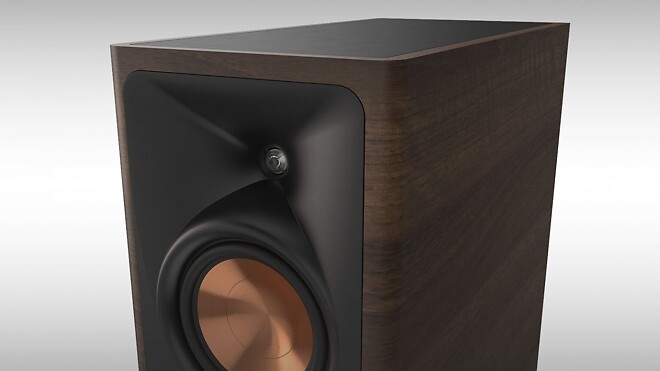
Completely new Klipsch tweeters and midrange drivers.
Floorstanding, monitor, and center channel models feature a real 3-way design with separate high-frequency, midrange, and bass drivers. Klipsch explains that this allows each driver to handle a narrower portion of the audible spectrum, pushing crossover points away from frequencies where human hearing is most sensitive.
Paul W. Klipsch famously said, "The midrange is where we live," and it's clear someone in Indianapolis was reading his notes.
A Different Kind of Klipsch Horn
The Reference Signature still relies on the horn-loading method and Klipsch's titanium diaphragm linear travel suspension tweeter, but a more intriguing development is the new phase-aligned horn architecture.
Klipsch has positioned the midrange driver directly within the tweeter horn to ensure that both high frequencies and midrange originate from the same acoustic center. The goal is for better consistency through the crossover region and a more balanced tonal character across a wider listening area.
This proves particularly important in home theaters, where it's common for multiple listeners to be enjoying the system.
Larger Reference Signature models combine an 8-inch cerametallic bass driver with a 6.5-inch midrange, while smaller models pair a 6.5-inch bass driver with a 5.25-inch midrange. Floorstanding speakers utilize dual woofers, whereas monitors use a single bass driver.
Klipsch's spun copper cerametallic cones remain part of the recipe, maintaining visual and technological continuity with the Reference Premiere.
The Center Channel May Be the Most Important Speaker Here
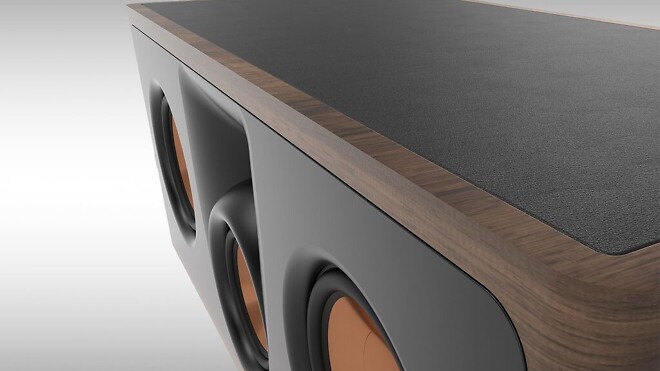
The RS•6301C warrants additional attention because Klipsch has deviated from the typical horizontal MTM array often used in center channel loudspeakers.
Instead, the Reference Signature employs a vertical driver arrangement designed to minimize horizontal lobing and comb filtering issues that can alter dialogue and tonal balance as listeners move away from the center seat.
For serious multichannel systems, this is more than just an engineering footnote.
The center channel handles a massive proportion of movie dialogue and front stage information, yet it's often the most compromised loudspeaker due to furniture placement, screen positioning, and seating arrangements. Klipsch's approach aims to achieve closer tonal matching with the Reference Signature towers while delivering clearer dialogue and more consistent tonality across multiple listening positions.
Before drawing conclusions, I'd like to hear these products from off-axis positions.
Atmos Without Being Trapped in Atmos
Klipsch didn't limit the RS•6101SA to a single function as a Dolby Atmos module.
This 2-way speaker can be placed atop Reference Signature towers or monitors and angled upward towards the ceiling, but it can also be wall-mounted for use as directional height or rear surround channels.
A rear panel switch alters the crossover configuration between Atmos and surround operation.
Such flexibility is useful when someone relocates, transitions from reflective Atmos to direct-firing height channels, or simply realizes that drilling holes in drywall is less daunting than explaining another speaker upgrade to a spouse.
Klipsch Dressed Up
The Reference Signature showcases noticeable industrial design upgrades compared to the Reference Premiere.
Clipsh uses a single-part BMC front baffle designed to reduce unnecessary cabinet resonance while providing a denser and more robust mounting surface. The rounded cabinet edges are intended to reduce diffraction and improve off-axis performance.
Ebony and walnut finishes feature horizontal grain patterns that flow along the curved cabinet profile, and Clipsh has added a decorative leather top panel along with metal carpet spikes and rubber feet.
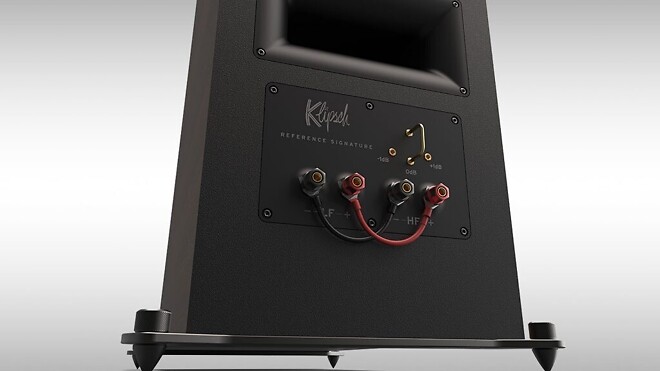
Rear speaker connections with a jumper to adjust tweeter output.
All models also allow for adjustment of tweeter output by +1 dB, 0 dB, or -1 dB, allowing owners to fine-tune the tonal balance in small steps without touching DSP, depending on the space or preference.
Dual binding posts for bi-wiring and bi-amping will also be available on some models. While these features alone don't change loudspeaker performance, they suggest that Clipsh wants buyers to move beyond the Reference Premier if they choose.
Overall
The Reference Signature should not be confused with the Reference Premiere III series, which was introduced at Audio Advice Live.
The Reference Premiere III remains Clipsh's extensive modern passive loudspeaker platform for both two-channel and home theater systems. The Reference Signature takes it a step further with a dedicated three-way design, more sophisticated horn geometry, upgraded cabinet construction, and a significantly more premium appearance.
It's also not Project Apollo.
Clipsh showcased Apollo at CES alongside the Reference Signature as a separate and more ambitious exploration of high-performance two-channel audio. The Reference Signature is a more familiar Clipsh offering - a complete modern speaker family capable of supporting both serious stereo listening and immersive home theater.
These distinctions make the new series commercially potentially more significant.
Clipsh already has a heritage product that can very convincingly occupy that space. There's no need for another loudspeaker when what engineers can build when cost and living room compromises are removed from the equation is already proven.
The Reference Signature needs to work in real homes.
Pricing and Availability
Clipsh is aiming for a price range of $1,600 to $3,000 per pair, with final pricing and full specifications to be announced at launch. Some Reference Signature models are expected to launch in winter 2026.
With CEDIA currently underway, we will have the opportunity to listen directly to the new three-way horn architecture and see if the Reference Signature lives up to the promise Clipsh first showed at CES.
For more information • Klipsch Reference Signature
▶ Original Source: https://www.ecoustics.com/products/klipsch-reference-signature-speakers-2026/