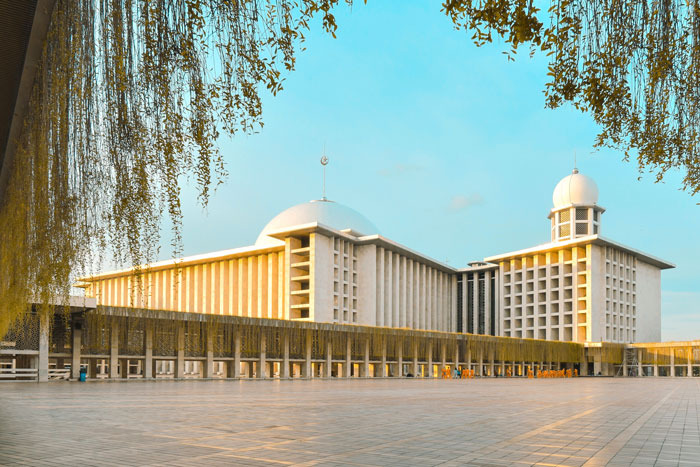
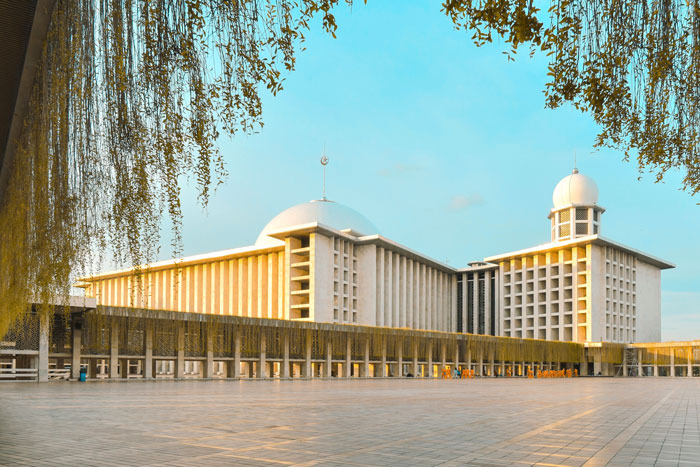
 Behind Southeast Asia’s largest mosque lies the story of a park, a fort, and a republic remaking its capital
The site on which Istiqlal Mosque was built near Pasar Baru in Central Jakarta, was once the colonial-era Wilhelmina Park, which also extended towards the Jakarta Cathedral. The historic Lapangan Banteng square and Medan Merdeka are also nearby—both clear examples of how post-independence Jakarta rewrote the meaning of its inherited spaces.
Long before Southeast Asia’s largest mosque stood there, the site had already served several functions. In the 1820s, it was occupied by a hospital. By the early 1830s, as the colonial government sought to strengthen Batavia’s military defences, the area became part of a wider defence scheme associated with Governor-General Johannes van den Bosch. At its centre was the Prince Frederik Citadel, a military fortification that was later used as a weapons storehouse for many years.
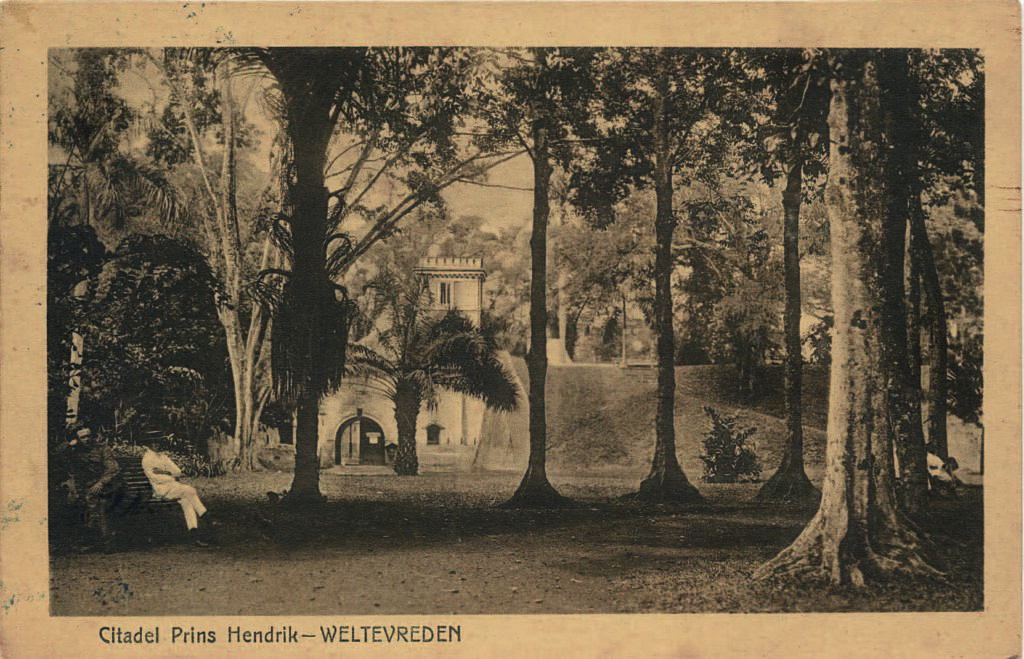 The Prince Frederik Citadel within Wilhelmina Park, pictured on a postcard that appears to carry an incorrect label identifying it as Citadel Prins Hendrik—Weltevreden. Prince Hendrik Citadel was located in Surabaya, while the fortification shown here was the Prince Frederik Citadel, later used as a weapons storehouse before being demolished for Istiqlal Mosque
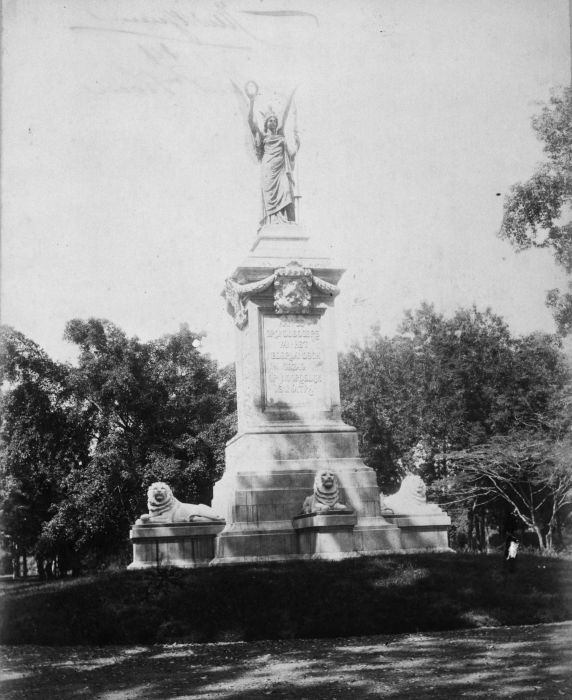 The Aceh Monument, also known as the Angel of Peace Statue
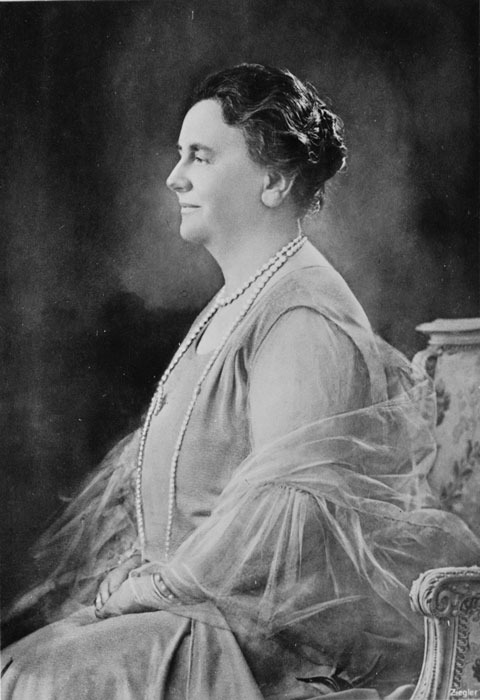 Queen Wilhelmina of the Netherlands, after whom Batavia’s Wilhelmina Park was named to celebrate her inauguration
In 1898, when Queen Wilhelmina reached the age of majority and was inaugurated, the site was made into a formal public park and named in her honour. An ornate footbridge was built over the nearby Ciliwung River, marked with a large “W” for Wilhelmina, while the old citadel remained within the park grounds. In this form, Wilhelmina Park became one of Batavia’s most prominent urban open spaces, remembered for its central location and proximity to the Ciliwung and the colonial civic district.
Old descriptions present Wilhelmina Park as a shaded, pleasant place for walking, where families, couples, and the city’s Dutch elite could spend part of their weekend. Yet the park’s beauty sat beside symbols of conquest. Within its grounds stood the Aceh Monument, also known as the Angel of Peace, erected during the long and violent Aceh War to commemorate Dutch soldiers who had died in northern Sumatra. Its inscription and placement made it less a neutral memorial than a marker of the colonial worldview behind Batavia’s public spaces.
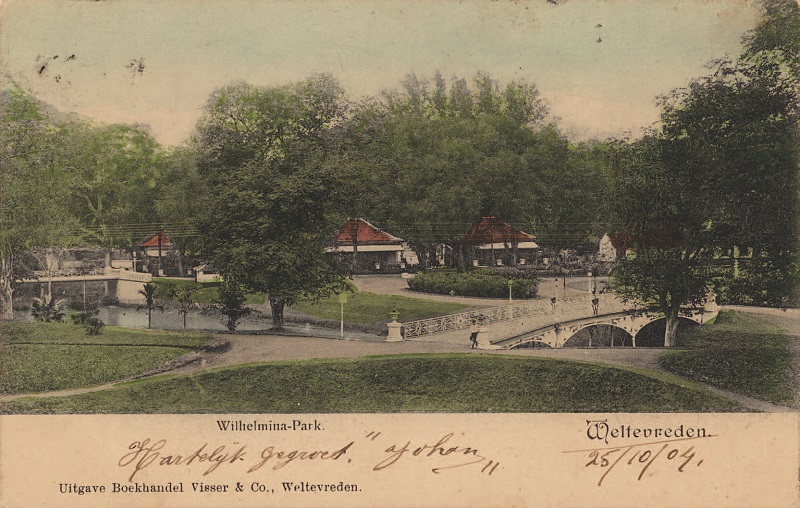 Wilhelmina Park in Weltevreden, with its landscaped grounds, waterways and ornamental bridge
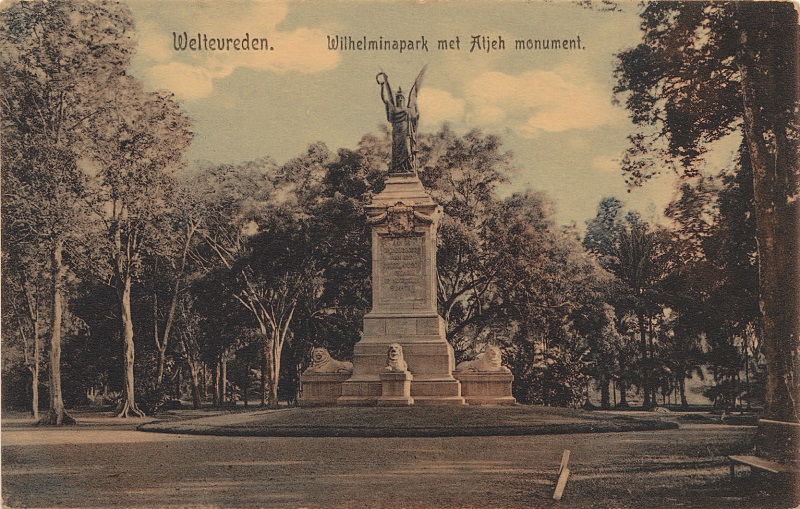 The Aceh Monument surrounded by the trees of Wilhelmina Park
After Indonesia’s independence, the park was renamed Taman Wijaya Kusuma, but a change of name alone could not hide the colonial structures still standing on the grounds. The Prince Frederik Citadel still stood there, and the site remained marked by the memory of a city planned around imperial power.
The idea of building a national mosque emerged soon after independence. KH Wahid Hasyim, then Minister of Religious Affairs, Anwar Tjokroaminoto, and other Muslim leaders were among those who proposed a grand mosque as an expression of gratitude for Indonesian independence. In 1954, a foundation was formed to oversee the project, followed by a design competition in 1955. The winning design came from Friedrich Silaban, a Christian architect from North Sumatra, whose selection later became one of the most frequently cited details in Istiqlal’s history.
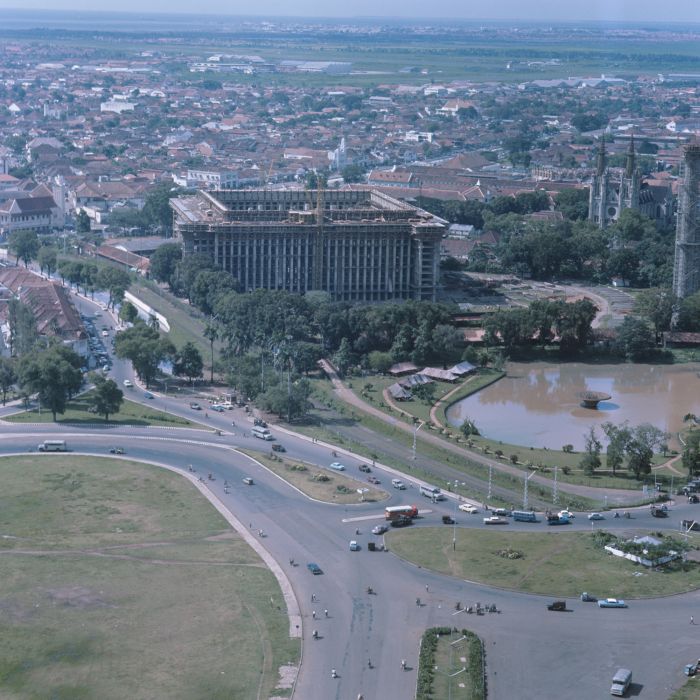 Istiqlal Mosque under construction, with Jakarta Cathedral visible nearby. Its location placed the two religious landmarks within the symbolic centre of the capital
The plan was to place the national mosque near Merdeka Square, Merdeka Palace, Jakarta Cathedral, and Immanuel Church, situating Istiqlal within the symbolic centre of the capital. It also put the mosque directly opposite the Cathedral, allowing the new republic to present the site as an Islamic landmark and a statement of religious coexistence.
To make way for the mosque, the old citadel had to be removed, and this was not a minor act of clearing land. The fortification was so strong that its demolition reportedly required dynamite and took around one and a half years. In that process, the transformation of Wilhelmina Park became physical as well as symbolic. The colonial park and its military remains were not just renamed or repurposed; they were dismantled.
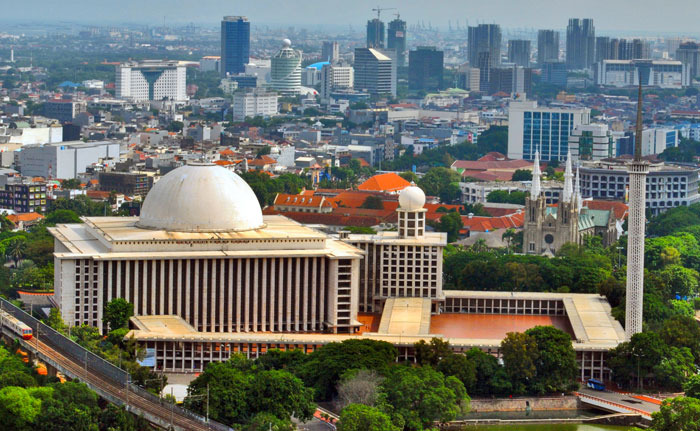 Istiqlal Mosque and Jakarta Cathedral in modern Jakarta. Their proximity has become one of the capital’s clearest visual expressions of religious coexistence
Construction of Istiqlal Mosque began in 1961, the same year the Aceh Monument was demolished. The mosque was completed in 1978 and officially opened by President Suharto on 22 February that year. Its name, taken from Arabic, means “independence”, making the building’s purpose even more explicit.
Today, Istiqlal’s position beside Jakarta Cathedral remains one of the capital’s most recognisable urban pairings. That relationship became even more pronounced with Terowongan Silaturahmi, a pedestrian tunnel linking the mosque and the cathedral, inaugurated by President Prabowo Subianto on 12 December 2024 as a symbol of inter-religious harmony. A place once tied to colonial rule had become one of the republic’s most visible expressions of freedom, faith, and coexistence.
Read our other Time Capsule articles:
Societeit de Harmonie | Metropole Cinema | Hotel des Indes
Sources:
Merrillees, Scott. Greetings from Jakarta: Postcards of a Capital 1900–1950. Malaysia: Hanusz Publishing, 2019.
Merrillees, Scott. Jakarta: Portraits of a Capital 1950–1980. Singapore: Equinox Publishing, 2015.
Nahdlatul Ulama. “Kiai Said: Pendirian Masjid Istiqlal Digagas KH Wahid Hasyim”. NU Online.
Sopandi, Setiadi. “Indonesian Architectural Culture during Guided Democracy (1959–1965): Sukarno and the Works of Friedrich Silaban”, in Tuong Vu and Wasana Wongsurawat, eds., Dynamics of the Cold War in Asia: Ideology, Identity, and Culture. Springer, 2009.
Teeuwen, Dirk. Batavia’s Wilhelmina Park – Jakarta’s Mosque Istiqlal, 2011.
Photography and image credits:
Historical postcards from Greetings from JAKARTA: Postcards of a Capital 1900–1950, Scott Merrillees Collection.
Archival images courtesy of Collectie Wereldmuseum, formerly Tropenmuseum, part of the National Museum of World Cultures.
Image courtesy of the United Nations Information Office, New York.
Contemporary mosque photography courtesy of Mosquographer, via Instagram