
Since this is a translation of an overseas article, there may be some mistranslations.
https://www.ecoustics.com/products/asus-rog-gjallar-gaming-soundbar/
ASUS ROG Gjallar Gaming Desktop Soundbar Released: Dolby Atmos and HDMI 2.1 Support
The ASUS ROG Gjallar offers 2.1.2 channel Dolby Atmos, HDMI 2.1, 4K/120Hz passthrough, and a wireless subwoofer for desktop and console gamers.
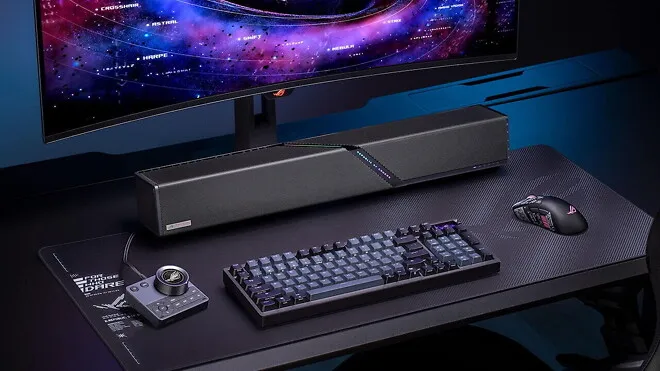
ASUS is further expanding into the gaming audio space, and its latest offering aims to break free from the limitations of monitor-integrated speakers that make a $2,000 gaming PC feel like a desktop radio with a graphics card.
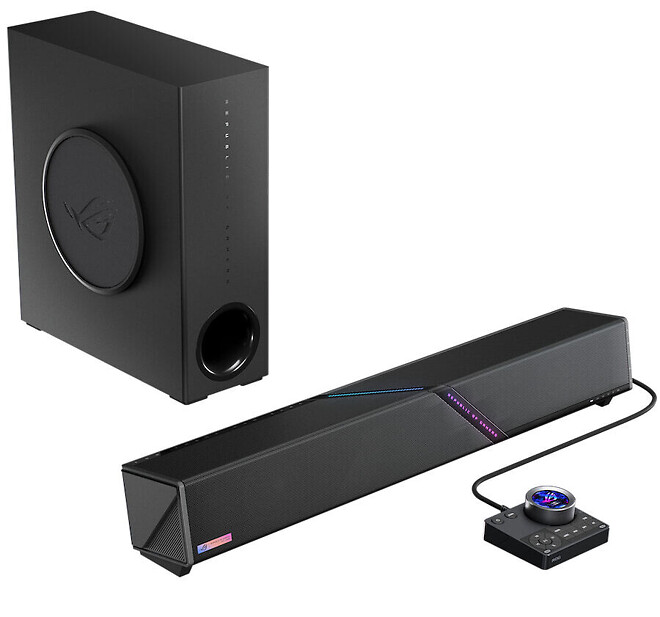
The new ASUS ROG Gjallar gaming soundbar is a compact 2.1.2 channel Dolby Atmos desktop soundbar with a wireless subwoofer. It features HDMI 2.1 eARC, 4K/120Hz passthrough, USB-C, optical output, AUX, Bluetooth 5.3, built-in beamforming microphone, RGB lighting, and a dedicated audio control hub.
This is no small list of specs. ASUS is aiming to deliver a product that connects PC desks, console environments, and small home theater setups with just 14 cables or complex technical knowledge, challenging established players like Razer, Creative, and OXS in this market.
The name is derived from 'Gjallarhorn,' a mythical horn from Norse mythology. ASUS explains that it pronounces the name as 'ga-lar.' While you don't need to pronounce the name accurately to use the product, someone in the comments section will surely point out your pronunciation.
ASUS ROG Gjallar: A True Dolby Atmos Gaming Soundbar
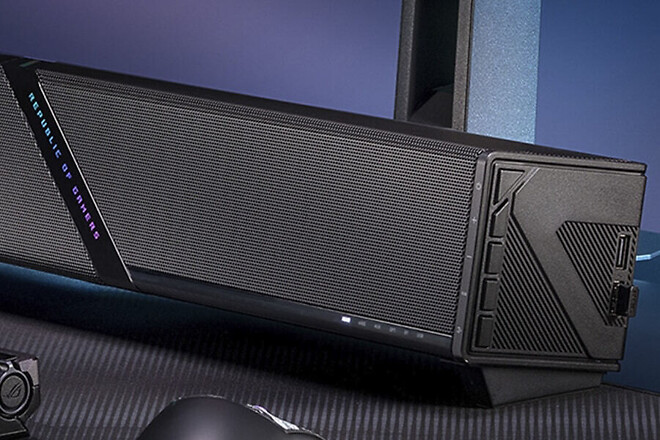
The ROG Gjallar uses a 2.1.2 channel configuration with four 50mm full-range drivers, two 27mm tweeters, up-firing height channels, and a 6.5-inch wireless subwoofer.
The soundbar itself measures 607 x 92 x 82 mm and weighs 2.4 kg. The wireless subwoofer measures 125 x 315 x 356 mm and weighs 5.7 kg.
The reason for this driver array is that most products called "gaming speakers" are just flashy desktop toys with RGB lighting or replacements for headsets masquerading as home theater products. The Gjallar aims to be a compact, yet useful compromise, allowing you to enjoy games, movies, music, and console use without constantly searching for headphones.
The Key is HDMI 2.1
The most important feature may not be Dolby Atmos, but HDMI 2.1.
The ROG Gjallar includes HDMI IN and HDMI OUT/eARC ports, and ASUS states that it supports up to 4K@120Hz video passthrough. This allows the soundbar to offer true versatility from PS5, Xbox Series X, gaming PCs, Blu-ray players, and streaming devices. The HDMI OUT/eARC can be connected to the TV's HDMI eARC/ARC port, while the HDMI IN can receive audio and video from external sources. This is a strong advantage compared to many desktop gaming soundbars that still only rely on USB, Bluetooth, or basic analog connections.
The Razer Leviathan V2 Pro (Razer Leviathan V2 Pro) remains the most solid competitor with its head-tracking AI, adaptive beamforming, THX Spatial Audio, and dedicated subwoofer. Razer products are cleverly made and are currently one of the most interesting PC soundbars available. However, while Razer focuses more on PCs with USB, Bluetooth 5.0, and a 3.5mm headset jack, ASUS clearly targets gamers who want a more versatile audio hub encompassing PC, console, and TV/display environments.
Control Hub, Microphone, and of Course RGB
The ROG Gjallar also includes a separate audio control hub with an LCD display. Users can use it to adjust volume, EQ, playback, input selection, microphone settings, and RGB lighting. This control hub also features built-in Acoustic Echo Cancellation (AEC) microphones designed to filter out game audio, teammates' voices, PC fan noise, and system hum noise for clearer voice capture.
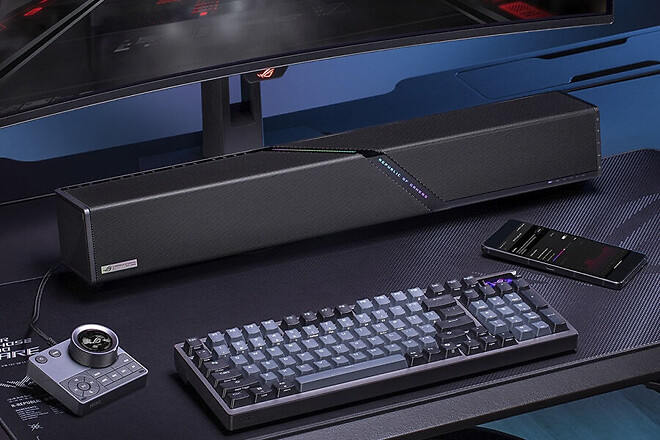
This could be useful for gamers who don't want to wear a headset all night, but testing is needed to see how well these microphones work in real desk environments. While 'AI Beamforming' in the press release sounds great, mechanical keyboard clicks, noisy GPU fan noise, and your mom calling from upstairs to eat dinner can affect its actual performance.
Gear Link support allows users to fine-tune EQ, lighting, microphone settings, and more through web-based PC tools or mobile apps. ASUS also includes Aura RGB lighting with up to 16.8 million colors and four preset effects. It seems that no gaming product can leave the factory these days without a light show worthy of a small electronic music club in Zurich.
Competing Products
The ROG Gjallar enters a small but increasingly important category. For PC gamers who want head-tracking beamforming and THX Spatial Audio, the Razer Leviathan V2 Pro remains a key competitor. Creative's Sound Blaster Katana SE and Katana V2/V2X are also important alternatives for those who want powerful desktop audio without going full home theater. The OXS Thunder Pro 5.1.2 is also a direct competitor as it supports Dolby Atmos and 4K/120Hz passthrough, but it's positioned as a more sophisticated 5.1.2 desktop gaming sound system.
The SteelSeries Arena 9 ($679.99) is worth mentioning but has a slightly different character. This product is a 5.1 desktop speaker system with a 6.5-inch subwoofer and wireless rear speakers, requiring different installation space and needs. It can be an excellent choice if you want to place actual surround speakers around your desk, but it may not be as appealing if your workspace is already as cluttered as the Best Buy store during inventory week.
Traditional soundbars from Samsung, LG, Sonos, Bose, Sony, and JBL could also be considered for broader comparison, but the Gjallar doesn't aim to replace a living room flagship system. This product targets gamers who want better performance than basic desktop speakers, a more open experience than headphones, and a more versatile solution than USB-only gaming bars.
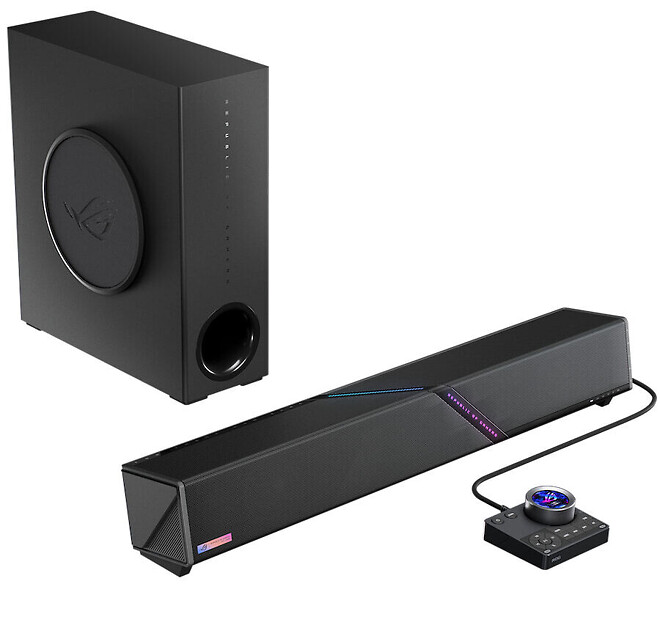
ASUS ROG Gjallar Gaming Soundbar Specs:
• Price: TBA
• Speaker configuration: 2.1.2 channel Dolby Atmos gaming soundbar with wireless subwoofer
• Drivers:
• 4 x 50 mm full-range drivers
• 2 x 27 mm tweeters
• 1 x 165 mm / 6.5 inch wireless subwoofer driver
• Subwoofer output: 65 watts
• Frequency response: 50 Hz ~ 20 kHz
• Wireless subwoofer connection: 5 GHz
• Connectivity:
• HDMI 2.1 input
• HDMI 2.1 output supporting eARC
• USB-C
• Optical digital input
• 3.5 mm AUX input
• Bluetooth 5.3
• 2 x USB-A hub ports
• Video passthrough: Supports up to 4K/120Hz via HDMI 2.1
• Microphone: Built-in beamforming microphone supporting acoustic echo cancellation
• Microphone frequency response: 100 Hz ~ 10 kHz
• Microphone sensitivity: -37 ± 3 dB
• Control hub: Includes an audio control hub with LCD display
• Control hub functions: Volume, EQ, playback, input selection, microphone settings, RGB lighting adjustment
• Software: Gear Link and Gear Link Mobile
• Lighting: ASUS Aura RGB supporting up to 16.8 million colors and 4 preset effects
• Supported platforms: Windows PC, Mac, PS5, PS4, Xbox Series X/S, Nintendo Switch, mobile devices, and Bluetooth devices
• Soundbar dimensions: 607 x 92 x 82 mm
• Subwoofer dimensions: 125 x 315 x 356 mm
• Control hub dimensions: 90 x 82 x 37 mm
• Soundbar weight: 2.4 kg
• Subwoofer weight: 5.7 kg
• Control hub weight: 0.191 kg
• Included accessories:
• 2 x AC cables
• Power adapter
• USB cable
• Pair of soundbar stand feet
• Quick start guide
• Warranty booklet
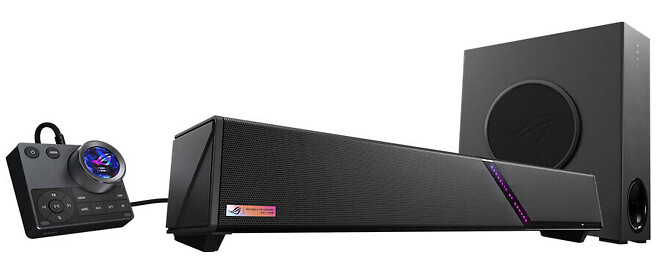
The ASUS ROG Gjallar gaming soundbar isn't just another RGB speaker bar for those who think "immersive audio" simply means bass and flashing lights. The combination of 2.1.2 Dolby Atmos, HDMI 2.1 eARC, 4K/120Hz passthrough, a 6.5-inch wireless subwoofer, built-in beamforming microphone, USB-C, optical input, AUX, Bluetooth 5.3, and a proper control hub makes this one of the most well-rounded desktop gaming soundbars released to date.
It's best suited for PC and console gamers who want a cleaner, more cinematic experience without wearing a headset every night. While it can't replace a full-fledged AVR-based speaker system or a full-size Dolby Atmos soundbar with rear channels, ASUS has created something worth considering for desks, bedrooms, dorm rooms, or compact gaming setups.
Pricing and Availability
ASUS hasn't publicly announced a confirmed US launch price as of this writing. This is a crucial factor, as the success of ROG Gjallar will likely hinge on its pricing.
Considering that the Razer Leviathan V2 Pro starts at $499.99 and the OXS Thunder Pro launched for $599, ASUS has a relatively clear price window to choose from if it wants to be taken seriously in the market.
▶ Source: https://www.ecoustics.com/products/asus-rog-gjallar-gaming-soundbar/