7/13 Market Summary - Iran Tensions and Soaring Oil Prices, Bond Rates Rise Amid Simultaneous Weakness in AI and Cryptocurrencies
# July 13, 2026 Macroeconomic Daily Market Report
## Today's Market at a Glance
Today (July 13, Monday), the keywords for global markets are "US-Iran Tensions Reignite → Oil Prices Surge → Inflation Concerns Resurface → Pressure on Risk Assets (Stocks and Cryptocurrencies)".
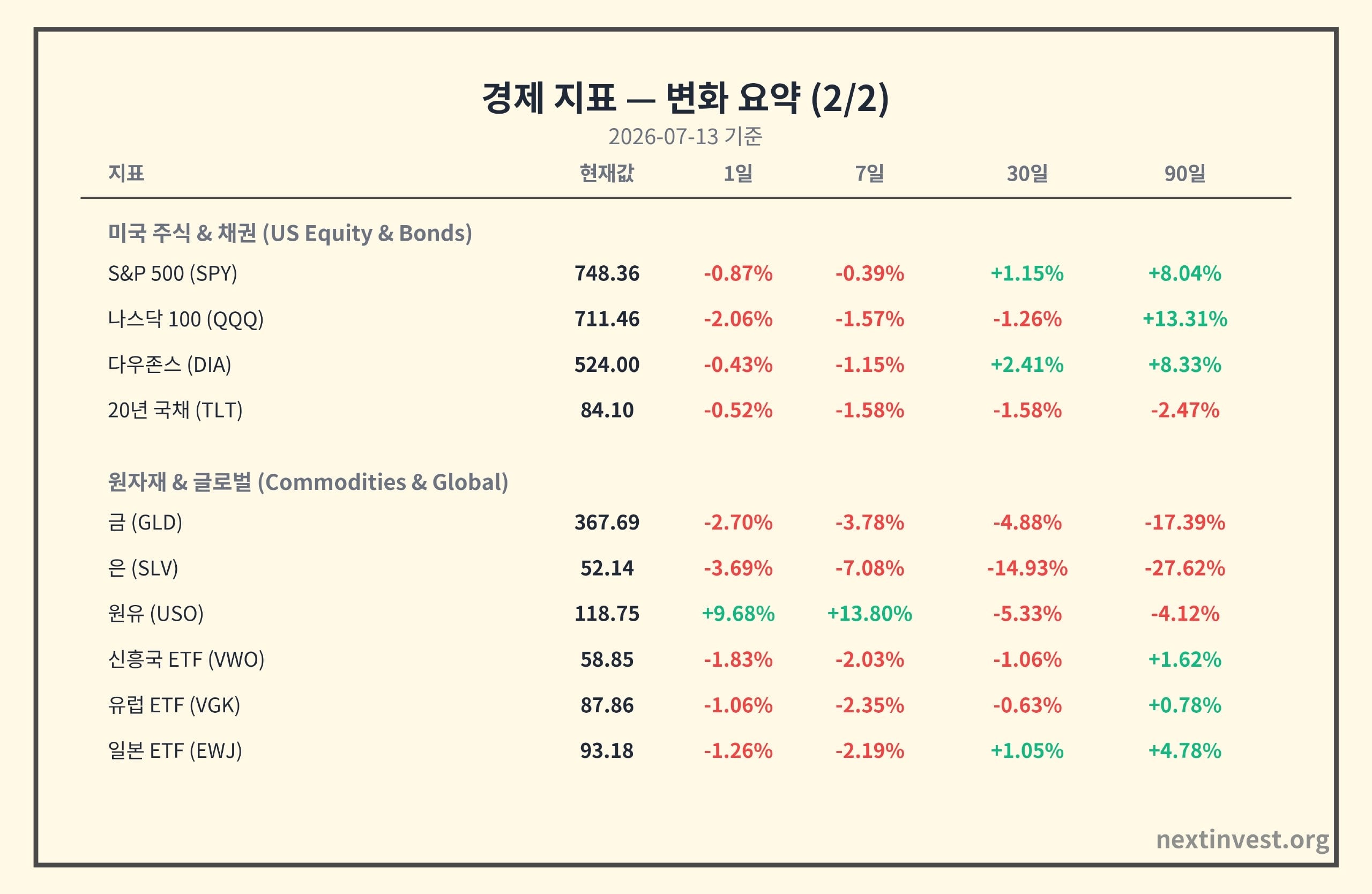
- US Stock Market: S&P 500 ETF (SPY) -0.87%, Nasdaq 100 ETF (QQQ) -2.06%, Dow (DIA) -0.43% decline
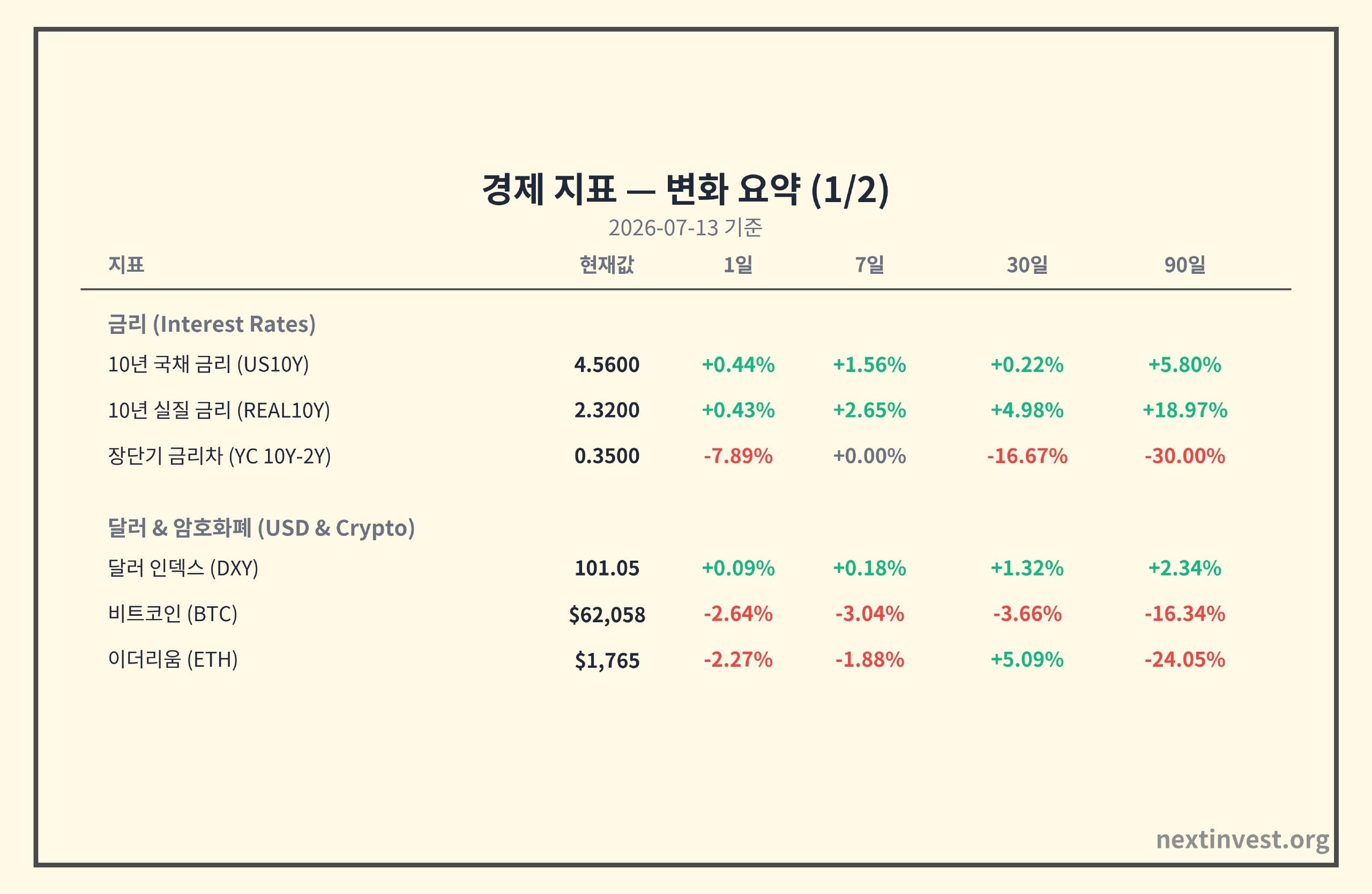
- Bonds: 10-year US Treasury yield 4.56% (+0.44%/day), Inflation-adjusted bonds (real yield) 2.32% (+0.43%/day)
- Oil Prices: USO (Oil ETF) +9.68% surge
- Dollar: DXY 101.05 (+0.09%/day) slight strength
- Gold and Silver: GLD -2.70%, SLV -3.69% simultaneous sharp decline
- Bitcoin: $62,058 (-2.64%), Ethereum $1,765 (-2.27%) weakness
The key flow can be summarized as: Middle East (US-Iran) military tensions escalate → Oil prices surge → Inflation and interest rate concerns reignite → Pressure on growth stocks, tech stocks, cryptocurrencies, long-term bonds, and precious metals overall. (apnews.com)
---
## 1. US-Iran Tensions Reignite and Oil Prices Surge
### What Happened?
- Over the weekend, tensions escalated significantly as the US and Iran conducted mutual airstrikes on targets in the Gulf region and within Iran. (washingtonpost.com)
- Due to growing concerns about crude oil supply disruptions, international oil prices surged from the start of Monday's session, and the USO ETF tracking US oil prices jumped +9.68% in just one day.
### Why Is This Important (Explained Simply)
- Oil prices = the foundation of inflation. Since petroleum is involved in transportation costs, electricity, plastics, fertilizers, and factory operations, when oil prices rise significantly, prices for various goods and services tend to follow.
- The market immediately worries, "So inflation (price increases) will get worse again?", "Will the Federal Reserve keep interest rates higher for longer?".
### Connecting with Long-term Trends
- Based on 5-year monthly data, CPI and core PCE showed stabilization with a gradual uptrend (around mid-2% annual pace) entering 2026, and accordingly, the federal funds rate (FFR) has been declining with a gradual downtrend (approximately -21.8%) since the end of 2024.
- However, this surge in oil prices is a variable that could shake the "inflation slowdown-interest rate cut" narrative that has been painstakingly constructed.
### What Does This Mean for Investors?
- Short-term: Energy, defense, and some commodity-related stocks may see relative gains, but for the overall market, it's "uncomfortable good news." While oil prices rise, this weighs on consumption and growth.
- Medium-term: If oil prices rise further from this level, upward pressure will build again on future CPI and PCE readings, potentially pushing back expectations for further Fed easing (faster interest rate cuts).
---
## 2. Interest Rates: 10-year Yield and Real Yield Rise Together
### Today's Interest Rate Movements
- 10-year US Treasury yield: 4.56% (vs. previous day +0.44%)
- 10-year real yield (TIPS basis): 2.32% (+0.43%)
- 10-year-2-year spread: 0.35, contracting -7.89% in one day (the gap between long and short-term rates narrowing)
Here, real yield is "the interest rate adjusted for inflation." In other words, it's the concept of measuring how much gain you'd have on a deposit or bond "after accounting for price increases."
### Why Did They Rise Together?
- Concerns are growing that consumer prices could rise again due to tensions between the US and Iran and a surge in oil prices. (investing.com)
- The market is interpreting this as a signal that the Federal Reserve may cut interest rates less or later than previously thought, leading to higher demand for long-term (10-year) bond yields.
- The rise in real interest rates also reflects investor sentiment that "instead of keeping money safe in bonds, they want a higher return."
### Long-Term Trends
- Looking at the average level of 10-year yields, since September 2023, 10-year bond yields have been on a gradual upward trend (near the highest level in five years) in the 4.3~4.6% range.
- While benchmark interest rates are expected to decline gradually after November 2024, long-term bond yields haven't fallen significantly and have even risen in recent months.
- This suggests that "even if policy interest rates fall slightly, the market remains conscious of high inflation, fiscal deficits, and war risks, leading to higher demands for long-term bond yields."
### What Does This Mean for Investors?
1. Continued Burden of Loan and Mortgage Interest Rates
- When 10-year yields are high, mortgage interest rates and corporate loan interest rates also remain at elevated levels. In fact, today's mortgage market commentary mentions that the 10-year yield rising to 4.58% is causing weakness in mortgage prices. (reddit.com)
2. Pressure on Valuation (Stock Prices) of Growth and Tech Stocks
- Since future earnings are discounted at higher interest rates, growth stocks, particularly those in the "AI and tech" sectors that rely on future growth prospects, face a larger impact.
3. Pain for Long-Term Bond (TLT) Investors
- Today, TLT (an ETF tracking long-term US Treasury bonds with maturities of 20 years or more) fell by -0.52%. As interest rates rise, bond prices fall, making long-term bonds particularly sensitive to interest rate fluctuations.
---
## 3. Stocks: Tech Stock Adjustment Centered on AI and Semiconductors, Value Stocks Offer Relative Defense
### Index Performance
- S&P 500 ETF (SPY): -0.87%
- Nasdaq 100 ETF (QQQ): -2.06% (largest decline)
- Dow (DIA): -0.43%
News headlines indicate that the decline today was centered on AI and semiconductor-related stocks.
- As tensions between the US and Iran escalated and oil prices surged, the market shifted into "risk-off" mode, leading to profit-taking in AI and semiconductor stocks that had performed well this year. (apnews.com)
- Some large-cap AI and semiconductor stocks experienced declines of -10% or more today, highlighting increased volatility. (apnews.com)
### Structural Context
- Over the past few years, particularly from 2023 to 2025, the AI and semiconductor sector has been a key driver of the S&P 500 and Nasdaq's rise.
- However, as expectations for interest rate cuts have weakened (due to hawkish comments from the Federal Reserve and slower inflation moderation) and concerns about oil prices and inflation have resurfaced due to the Middle East conflict,
- there is a growing sentiment that "these stocks may have risen too much."
- Consequently, adjustments are becoming more frequent in the AI and semiconductor sector. (gold.org)
### What About Other Sectors and Regions?
- Emerging Market ETF (VWO): -1.83%
- Europe ETF (VGK): -1.06%
- Japan ETF (EWJ): -1.26%
Other regions, including Europe, emerging markets, and Japan, also experienced declines.
- The Middle East conflict and surge in oil prices have raised concerns about cost pressures and economic slowdown globally.
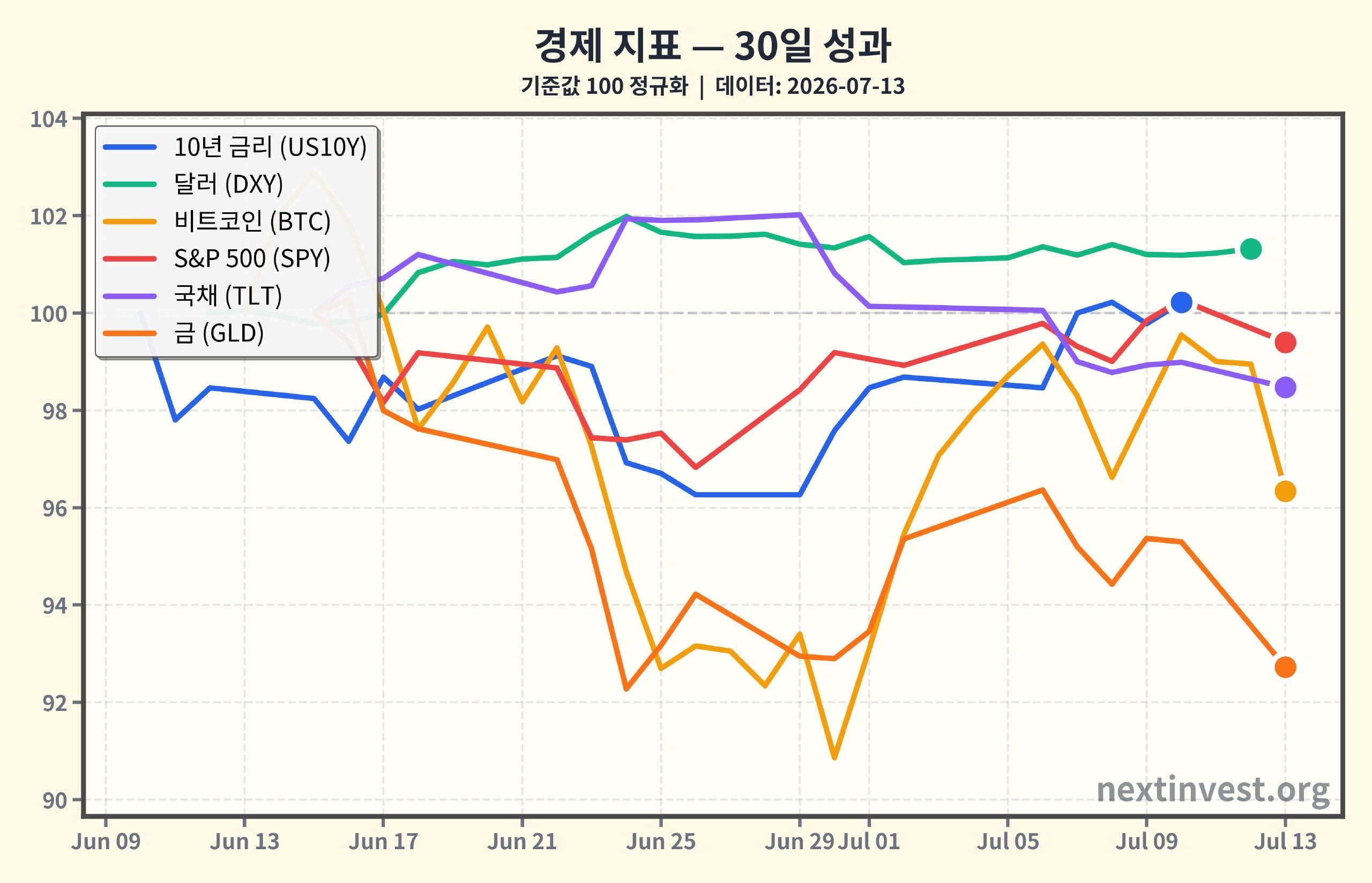
- Especially as the dollar strengthens (today DXY +0.09%, 30 days +1.32%), it puts a burden on emerging countries that have borrowed in dollars. This is because when the dollar strengthens, the cost of repaying dollar debt increases for these countries. (gold.org)
### What does this mean for investors?
1. Portfolio Diversification Check Needed
- If profits are excessively concentrated in AI, semiconductors, and big tech, it may be time to consider locking in some gains and increasing sector and regional diversification.
2. Re-examine Value Stocks with Solid Performance and Cash Flow
- In times of interest rate and inflation uncertainty, stocks with stable cash flow such as dividend stocks, essential consumer goods, and healthcare tend to have relatively higher defensive capabilities.
3. Always Be Prepared for Volatility
- Geopolitical events like the Middle East war are difficult to predict, and market sentiment can change dramatically in a single day depending on headlines. Therefore, it is important to set stop-loss levels, cash reserves, and split buying/selling strategies in advance.
---
## 4. Gold and Silver: Why Aren't Safe-Haven Assets Rising During the War?
Today, the gold (Gold) ETF GLD fell -2.70% and the silver (Silver) ETF SLV fell -3.69%, marking a significant drop.
### Counterintuitive Flow
It's easy to think "gold and silver will go up" when war news breaks, but the trend has been different since mid-year.
- Since the Iran War escalated in 2026, the price of gold has actually fallen by more than 20% for the year. (en.wikipedia.org)
### Reason 1: Rising Interest Rates and Opportunity Cost
- Gold is an asset that does not pay interest.
- On the other hand, with the 10-year Treasury yield rising to 4.5~4.6% today,
- there's a growing sentiment that "wouldn't it be better to hold bonds that pay 4~5% interest instead of holding gold, which doesn't pay interest?"
- In other words, rising interest rates → increased opportunity cost of gold → downward pressure on gold prices.
### Reason 2: Dollar Strength
- Gold is typically priced in dollars, so when the dollar strengthens, gold prices tend to be suppressed.
- Today, DXY rose slightly to 101.05 and has risen +2.34% over 90 days.
### What Does This Mean for Investors?
- It shows that gold and silver may not immediately react as a "safe haven" to war risks in the short term.
- If you hold gold from the perspective of "inflation hedge + currency value erosion hedge,"
- consider dollar-cost averaging, long-term holding, and a small portion (e.g., 5~10%) of your total assets,
- but also keep in mind that interest rates and the dollar could move in the opposite direction.
---
## 5. Bitcoin and Ethereum: The Ugly Face of Risk Assets
### Today's Crypto Market
- Bitcoin (BTC): $62,058 (-2.64%/day, -16.34% over 90 days)
- Ethereum (ETH): $1,765 (-2.27%/day, -24.05% over 90 days)
According to news reports, Bitcoin has fallen an additional 3~4% in the past 38 hours, reacting sensitively to a "risk aversion" environment ahead of the release of US inflation data (CPI) amid Middle East tensions and rising interest rates. (coinmarketcap.com)
### Why Did It Fall?
1. Risk-Off Environment
- US-Iran military tensions, soaring oil prices, and rising interest rates all contribute to a sentiment of "let's flee to cash, bonds, and the dollar instead of risky assets."
- Bitcoin is still classified as a "high-risk asset" in the market, so it tends to be sold off first in such situations.
2. Leverage Liquidation (Forced Closing)
- In the last 24 to 38 hours, hundreds of millions of dollars worth of leveraged positions (futures and margin) were liquidated, leading to a self-accelerating price decline. (coinmarketcap.com)
3. Awaiting Economic Indicators and Fed Events
- Ahead of the release of US inflation data and Fed statements this week, the market is moving towards "securing cash" for now. (blockhead.co)
### What Does This Mean for Investors?
- While Bitcoin is sometimes called "digital gold," its actual price behavior is often closer to that of "high-risk growth stocks or the Nasdaq."
- Keeping over 90% of your portfolio in coins means accepting very high volatility in times like these with geopolitical and interest rate fluctuations.
- Even if you maintain your coin allocation,
- Diversification with cash, dollars, short-term bonds, and stocks (especially those with strong cash flow)
- Minimizing leverage (debt investments)
- Establishing an investment plan in advance to prepare for potential downturns is crucial.
---
## 6. Today's Market Flow in the Context of a 5-Year Structural Trend
1. Interest Rate Structure
- Over the past five years, the Fed's benchmark interest rate has gone from zero → a rapid increase (5% range) → and is expected to gradually decline towards the end of 2024.
- However, the 10-year Treasury yield has not easily come down from the 4% range since 2023, and today it rose to 4.56% due to oil price shocks.
- Message: "Even if policy interest rates decline somewhat, market interest rates remain high due to inflation, war, and fiscal risks."
2. Inflation and the Real Economy
- CPI and core PCE have stabilized at an annual rate of 2-3% in recent months.
- The unemployment rate is projected to rise from 2023 to 2025 before slightly improving (4.5% → 4.2%) towards the end of 2025.
- Industrial production is expected to bottom out in 2024 and then recover gradually towards the end of 2025.
- Today's surge in oil prices has increased uncertainty about this "soft landing (delayed landing)" scenario.
3. The Dollar and Global Assets
- The DXY is expected to be lower than its peak in 2024-2025, but it will gradually rise again after April 2025.
- A strong dollar and high interest rates put pressure on emerging markets, commodities, and risky assets simultaneously.
---
## 7. Checkpoints for Investors Looking Ahead
1. Where will oil prices settle after today's surge?
- If oil prices continue to rise, concerns about inflation and interest rates will intensify.
- Conversely, if the surge is short-lived, today's shock may end up being just a "headline event."
2. This Week's US Inflation Data (CPI and PCE) and Fed Statements
- If the recent slowdown in inflation continues,
- "Oil prices rose, but overall inflation is still under control" → Market relief
- If inflation exceeds expectations,
- "War + Inflation Reactivation + Interest Rates Remain High for Longer" → Additional pressure on tech stocks and coins
3. Where Will the Adjustment in AI and Semiconductor Stocks End?
- This period could indicate whether the long-term growth story has been broken or if it's just a short-term overheating correction.
- It will be crucial to see if actual revenue and profits meet expectations in the next 1-2 quarters.
4. Portfolio Risk Management
- Diversification across sectors, assets, and regions (stocks/bonds/cash/gold/commodities/coins)
- It's time to review your investment principles that help you avoid being swayed by short-term fluctuations (rebalancing rules, stop-loss and take-profit criteria).
---
## Closing Message: Today's Takeaway in One Sentence
> "War news reignited inflation and interest rate concerns, leading the market to sell off the most expensive growth stocks and coins first."
> Oil prices · interest rates · the direction of the dollar, and it was a day when we needed to check the 'balance' and 'defense' of our portfolio.
This content is written for informational purposes only and does not constitute investment advice for any particular security or asset.
Source: https://nextinvest.org/ko
Free to share ^^