7/7 US Stock Market - Energy and Defensive Stocks Rise Amid AI Chip Shock... US Market, Mixed Day by Sector
July 07, 2026 Market Analysis
## 1. What Happened Today?
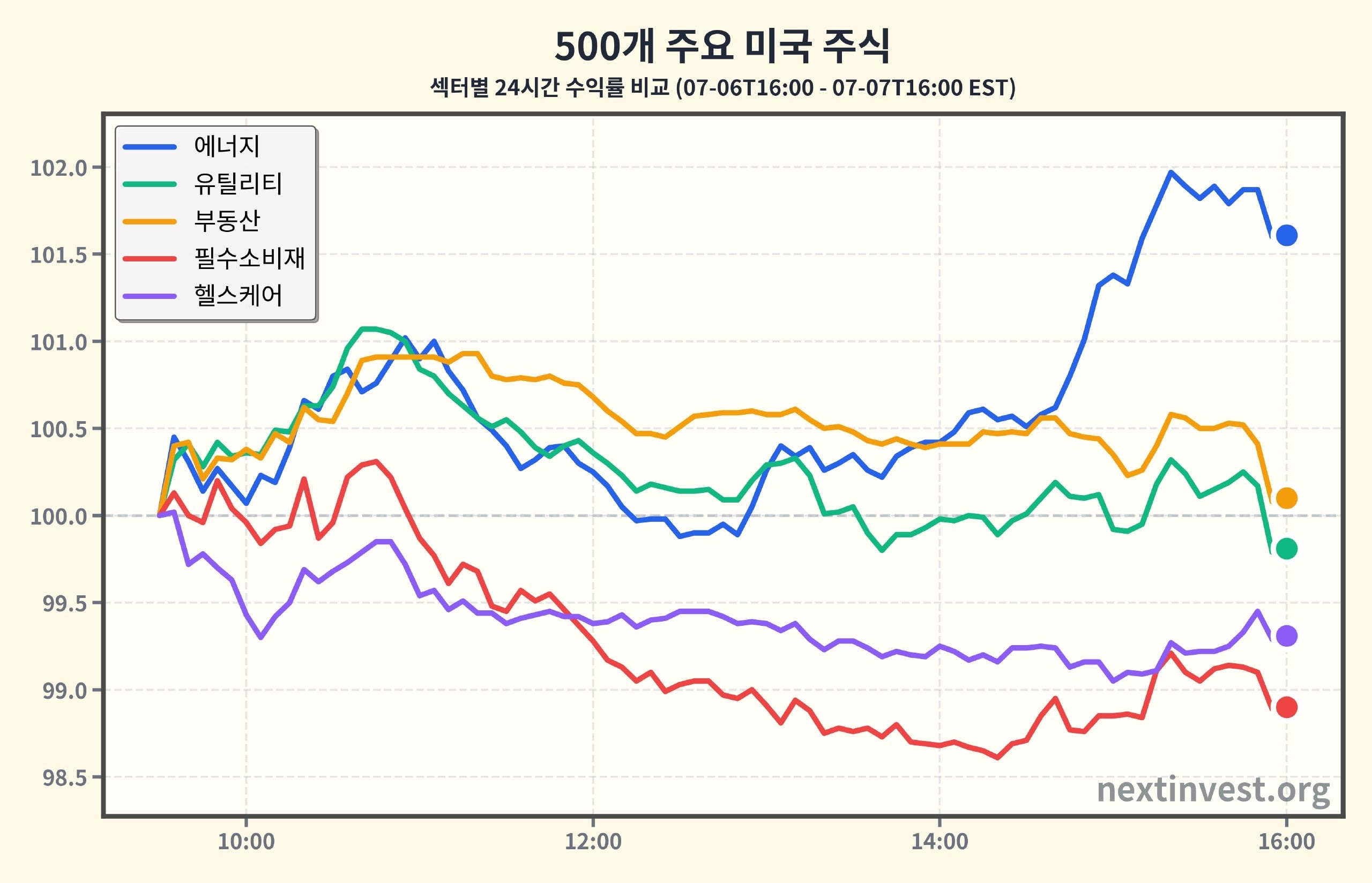
Summary: On Tuesday, July 7, the New York stock market closed lower as the Nasdaq was shaken by a sharp decline in AI and semiconductor stocks, which significantly rattled the technology sector. Meanwhile, rising Middle Eastern tensions pushed oil prices up sharply, with the energy sector posting the largest gains, while defensive sectors such as utilities, REITs, and consumer staples also showed corresponding strength.(apnews.com)
Looking at the actual indices, according to reports, the S&P 500 and Dow Jones declined slightly, while the Nasdaq fell relatively more sharply due to weakness in technology stocks.(apnews.com)
Organizing the sector performance data you provided on a daily basis:
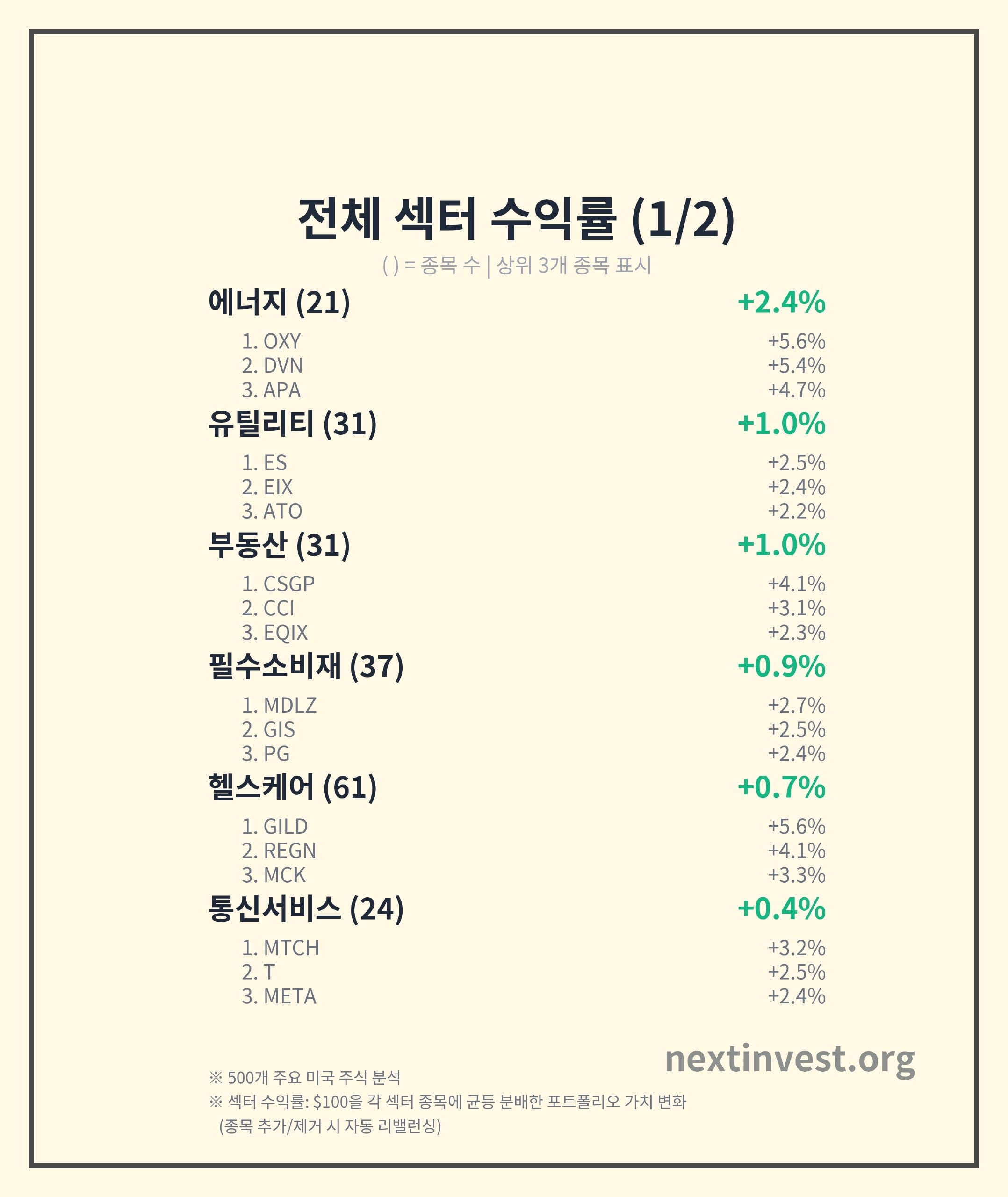
- Energy: +2.41% (1st place among 11 sectors)
- Utilities: +0.96%
- Real Estate: +0.95%
- Consumer Staples: +0.90%
- Healthcare: +0.70%
- Communication Services: +0.40%
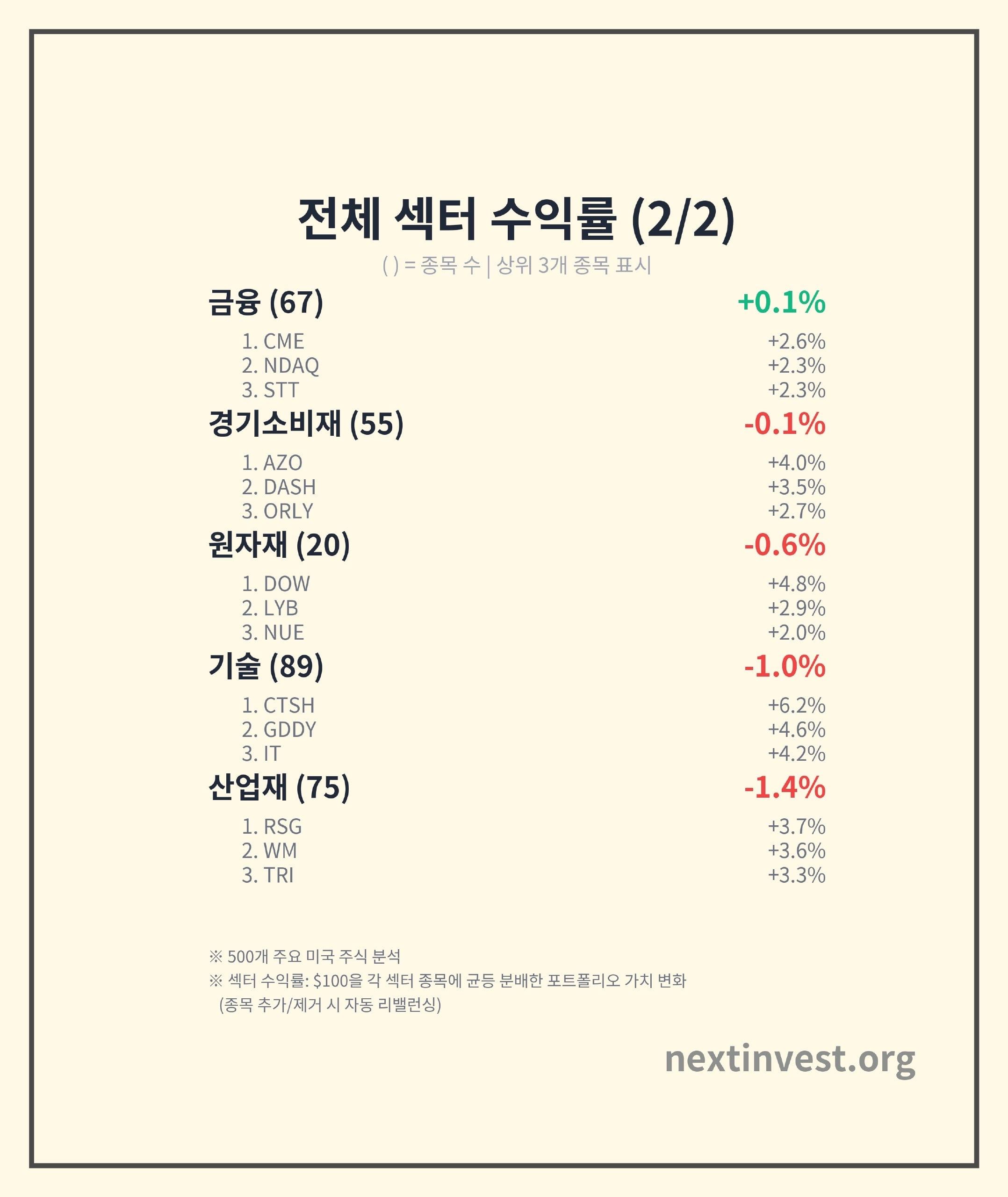
- Financials: +0.07%
- Consumer Discretionary: -0.14%
- Materials: -0.61%
- Technology: -1.00%
- Industrials: -1.42%
There are two key points.
1. Strong selling pressure on technology and AI-related stocks caused the Nasdaq and sector indices to decline together.
2. Surging oil prices and geopolitical risks caused energy stocks to rebound strongly, with funds temporarily seeking refuge in dividend-paying and defensive sectors.
This trend can be viewed as a day when tech and AI, which had been running ahead by too much, entered a period of consolidation.
---
## 2. Three Stories That Moved the Market Today
### 2-1. AI and Semiconductor 'Deflation'... Technology Sector -1.0%
Today, the technology sector recorded -1.0%, posting below-average results among all 11 sectors. The background is a concurrent adjustment in semiconductor and AI-related stocks.
- According to reports, selling pressure on AI-related and semiconductor stocks pulled down the Nasdaq, and valuations are being reassessed for the AI theme that led the market rally over recent quarters.(apnews.com)
- Intel (INTC) reportedly plunged about 9-10% today alone. Investors are beginning to question whether the stock price has risen too quickly relative to expectations for AI and foundry growth, and some reports explain that structural risks such as process (18A) schedule concerns and foundry business losses have come back into focus.(investing.com)
- Other semiconductor stocks, such as AI server and storage-related companies, also showed weakness due to profit-taking and valuation concerns, negatively impacting the entire technology sector.(investing.com)
Interestingly, despite the sector being down -1.0% overall, some individual stocks posted gains.
- For example, some IT services, software, and research companies such as Cognizant (CTSH), GoDaddy (GDDY), and Gartner (IT) posted gains in the +4-6% range.
- This suggests that within semiconductors/hardware versus software/services, funds may have partially shifted from the valuation-burdened hardware/AI theme to relatively less-appreciated services/software.
Short-term Context (7-day Flow)
- The 7-day performance chart shows that the technology sector has exhibited a volatile "hopping" pattern, fluctuating between +1.34% → -0.12% → -1.13% → +1.26% → -1.00% over the past week.
- Particularly on July 1st (-0.12%), July 2nd (-1.13%), and July 7th (-1.00%), there were alternating periods of increase and adjustment, resulting in heightened volatility.
Mid-term Context (Sector Trends)
- According to the sector trends you provided, the technology sector has surged by over +25% since mid-April, leading the overall market. However, since June 12th, it has entered a -2.42% adjustment phase.
- In essence, after a significant rise over the past 2-3 months, the sector has entered a "consolidation phase" characterized by ups and downs since mid-June.
What This Means for You
- Short-term: Overheating signal: AI and semiconductor stocks have been the "core story" of the market for several quarters, but today's individual setbacks (Intel report, valuation concerns, etc.) suggest that adjustments could be significant.
- Long-term story remains valid, but entry and weighting should be more cautious: The structural growth narrative of AI infrastructure, data centers, and cloud migration remains unchanged. However, a substantial portion of this may already be reflected in stock prices. In such cases, a "divide and conquer" strategy of phased buying and selling is preferable to avoid excessive risk.
### 2-2. Middle East Tensions + Oil Price Surge → Energy Sector +2.41%
The energy sector topped the charts today with a +2.41% gain. Individual stocks such as Occidental (OXY) +5.55%, Devon (DVN) +5.35%, and APA +4.74% saw strong surges, particularly in US shale, oil, and gas.
The backdrop is heightened Middle East tensions and a surge in oil prices.
- Reports indicate that news of an attack (strike) near the Strait of Hormuz and renewed tensions between the US and Iran have led to a 4-5% surge in WTI crude oil prices, reaching approximately $69 per barrel (investing.com).
- Major news outlets like Reuters also explain that the escalation of tensions in the Middle East has raised concerns about crude oil supply disruptions, benefiting oil prices and energy-related stocks (investing.com).
Short-term Context (7-day Trend)
- Over the past seven days, the energy sector has fluctuated between -0.55% → -1.20% → +0.60% → +0.03% → +2.41%, ultimately rebounding sharply today.
- This surge can be seen as a "technical rebound" that offsets previous declines.
Mid-term Context (Sector Trends)
- Mid-term trend data shows that the energy sector experienced a strong rally until May but entered an adjustment phase after May 18th, declining by -7.88%.
- Despite today's rebound, it remains down -1.96% from its April 10th peak of 100, currently at 98.04.
What This Means for You
- Short-term trading perspective: Today's surge is likely due to geopolitical risks and short covering (closing positions that bet on a decline), potentially leading to increased volatility depending on oil price and geopolitical news.
- Long-term/diversified investment perspective: The energy sector has been adjusting for nearly two months, so today's rebound could be a meaningful signal. If your portfolio lacks exposure, consider allocating 5-10% as a hedge against inflation and geopolitical risks.
- However, the energy sector is highly sensitive to economic cycles, policies, and war risks. Therefore, it's generally safer for individual investors to use sector ETFs (e.g., XLE, VDE) to diversify risk rather than investing in individual stocks.
### 2-3. "Quiet Refuge" in Defensive Sectors (Utilities, Consumer Staples, REITs)
Amidst the tech stock correction and oil price surge, investors have sought refuge in sectors with relatively lower volatility and stable dividends.
Today's performance shows:
- Utilities: +0.96%
- Real Estate (REITs): +0.95%
- Consumer Staples: +0.90%
- Healthcare: +0.70%
Signals from news and data are as follows:
1. Utilities (Electricity, Gas, Water)
- Stock prices of utility companies such as electricity and gas providers typically act as a safe haven during market turbulence, similar to bonds, due to their stable cash flows and dividends.
- This year, utilities have been sensitive to interest rates and yields (bond rates). Recent messaging from Federal Reserve officials suggesting less concern about inflationary pressures has partially eased market anxiety about the upper bound of interest rates, which appears to have provided psychological support as well. (investing.com)
- Looking at the 7-day trend, volatility has been significant at -1.40% → -1.10% → +2.23% → -1.15% → +0.96%, but over the medium-term period since June 1, the sector has sustained a rebound of around +7%, reversing a substantial portion of the decline since April.
2. Consumer Staples (Food & Household Products)
- Today's performance was solid at +0.90%, with global food and household goods companies such as Mondelez (MDLZ), General Mills (GIS), and P&G (PG) posting gains of +2–3%.
- This indicates that capital has rotated into companies selling products that people use every day, regardless of economic or AI narratives. It reflects these stocks performing their role as defensive plays during periods of economic slowdown and heightened volatility.
3. REITs & Real Estate
- The REIT sector rose +0.95% today, with data center and telecom tower REITs (EQIX, CCI) and commercial real estate platforms (CSGP) showing strength.
- This can be seen as a simultaneous reflection of the market's recognition that the data center demand story (cloud and AI infrastructure) and telecom infrastructure investment narrative remain intact, alongside a preference for REITs with dividend income and asset value.
What This Means for You
- Portfolio "airbag" role: Defensive sectors such as utilities, consumer staples, healthcare, and REITs can help reduce overall portfolio volatility on days like today when AI and semiconductor stocks swing sharply.
- Looking at your sector trend data, healthcare (+12.62%), financials (+11.33%), REITs (+8.33%), consumer staples (+5.76%), and utilities (-0.82% but recently rebounding) have all shown relatively stable upward trends or recovery patterns since April.
- If your current portfolio is heavily concentrated in growth sectors such as technology, consumer discretionary, and communication services, this may be a good time to consider increasing your allocation to defensive sectors to a level of 20–40% in order to reduce overall volatility.
---
## 3. Sector Positioning Ideas Based on 7-Day and 60-Day Trends
The following is a brief sector-by-sector overview combining short-term (7-day) and medium-term (approximately 60 trading days) trends. Please understand this as research-oriented insight, not investment advice.
### 3-1. Technology
- Today: -1.0%
- 7-day trend: Volatile swings (alternating gains and losses)
- 60-day trend: Up more than +25% since April; a moderate correction phase (-2.4%) since June 12
Insight:
- The long-term growth story remains intact, but in the near term the sector appears to be approaching a zone where "good news is already priced in."
- Today's pullback in Intel and semiconductor stocks can be viewed as a warning that a valuation reset may be beginning in an overheated segment.
Ideas (examples):
- If already overweight: Rather than adding new money, consider slowly rebalancing in line with correction and rebound phases.
- If still underweight: Consider a staged entry approach (spreading purchases over several weeks) during sharp short-term dips to reduce volatility risk.
### 3-2. Healthcare
- Today: +0.70%
- 7-day trend: A relatively steady rebound pattern following -0.82%, with moves of +1.34% and +2.51%
- 60-day trend: Up more than +10% since June 18, with a broadly gradual upward trajectory
Insight:
- This is a sector with low economic sensitivity; while regulatory and policy risks exist, long-term demand is relatively stable.
- During periods of high volatility in specific themes like AI and semiconductors, it can serve a role in lowering overall sector volatility.
### 3-3. Financials
- Today: +0.07% (roughly flat)
- 7-day trend: A pause for breath following strong gains of +2.67%, +1.86%, and +0.89% over recent days
- 60-day trend: Up more than +5% since late June, with overall returns of around +11%
Insight:
- Interest rates and yields are sensitive sectors to the Fed's message.
- Recently, funds flowing into AI and tech have partially shifted back to traditional finance (banks, exchanges, asset managers) showing a "balance shift".
### 3-4. Energy·Utilities·Basic Materials
- Energy: Short-term surge (+2.41%) but still in the -7% range adjustment since mid-May.
- Utilities: Short-term rebound, but +7% recovery since early June.
- Basic Materials: Adjusted -0.61% today, slight increase in the past week followed by a reversal.
Insight:
- These sectors are mainly driven by economic conditions, interest rates, and commodity prices.
- When oil prices surge and geopolitical risks overlap like today, energy and basic materials can spike, while funds flow into defensive utilities.
Ideas (Examples):
- Allocate a small portion to energy/commodity ETFs as inflation and war risk hedges.
- If you prioritize long-term dividends and stable cash flow, gradually increase the proportion of high-dividend sectors such as utilities and infrastructure REITs to reduce volatility.
---
## 4. What Today's Movement Means for Individual Investors
### 4-1. "AI/Semiconductors are not an eternal straight line"
- For the past few quarters, AI and semiconductor stocks may have looked like a "continuous upward graph".
- However, today's Intel plunge and sector-wide profit-taking remind us that even with a good growth story, stock prices move in a staircase or zigzag pattern.
- Lesson:
- Check if you are overly concentrated in one sector.
- Keep in mind that "natural adjustments" will eventually come after a short-term surge.
### 4-2. "Defensive sectors are boring but shine when needed"
- Utilities, consumer staples, healthcare, and REITs may not surge 50% at once, but they act as airbags protecting your portfolio during market turmoil.
- Like car insurance, which seems useless until an accident occurs, the value of defensive sectors increases when market volatility rises.
### 4-3. "Observe medium-term trends and interpret daily numbers"
- Looking only at today's numbers, energy +2.4%, tech -1.0% might make you think "should I switch to energy?".
- However, looking at the 60-day trend, tech is still up over 25%, while energy has been adjusting for the past two months.
- Therefore:
- View today's movement as a small wave within the larger picture,
- Base asset allocation on trends and risk tolerance over 1-3 months or a year.
---
## 5. Three Things to Check When Looking Ahead (Tomorrow and Beyond)
1. Whether the AI/semiconductor adjustment is a "one-day" event or a multi-day wave
- It's crucial to see if major semiconductor stocks like Intel hold technical support levels (50-day/100-day moving averages).
- If the adjustment continues for several days, the next quarter's earnings reports (late July to early August) will be key in confirming the growth story.
2. Oil prices and Middle East situation
- It's still unclear whether today's oil price surge is a one-time shock or the beginning of long-term supply concerns.
- If oil prices remain above $70, it could lead to upward revisions in earnings for the energy and basic materials sectors. However, it could also reignite inflation worries and pressure for interest rate hikes.
3. Changes in Fed expectations and interest rates
- Statements from Fed officials, like the New York Fed Chair, significantly impact utilities, real estate, and high-dividend stocks.
- If the "interest rate freeze/gradual easing" scenario persists, it could be favorable for both defensive sectors and growth stocks.
- However, if inflation concerns resurface due to factors like oil prices and wages, further valuation adjustments for growth stocks may occur.
---
## 6. Conclusion: Today's Numbers in One Sentence
> "Today was a day when the energy and defense sectors took over the baton, while tech stocks centered on AI and semiconductors caught their breath."
For long-term investors, it would be better to use today's performance as an opportunity to re-examine sector-specific mid-term trends and your own risk appetite rather than being swept away by it.
This content is written for informational purposes only and does not constitute investment advice for any particular security or asset.
Source: https://nextinvest.org/ko
Free to share ^^