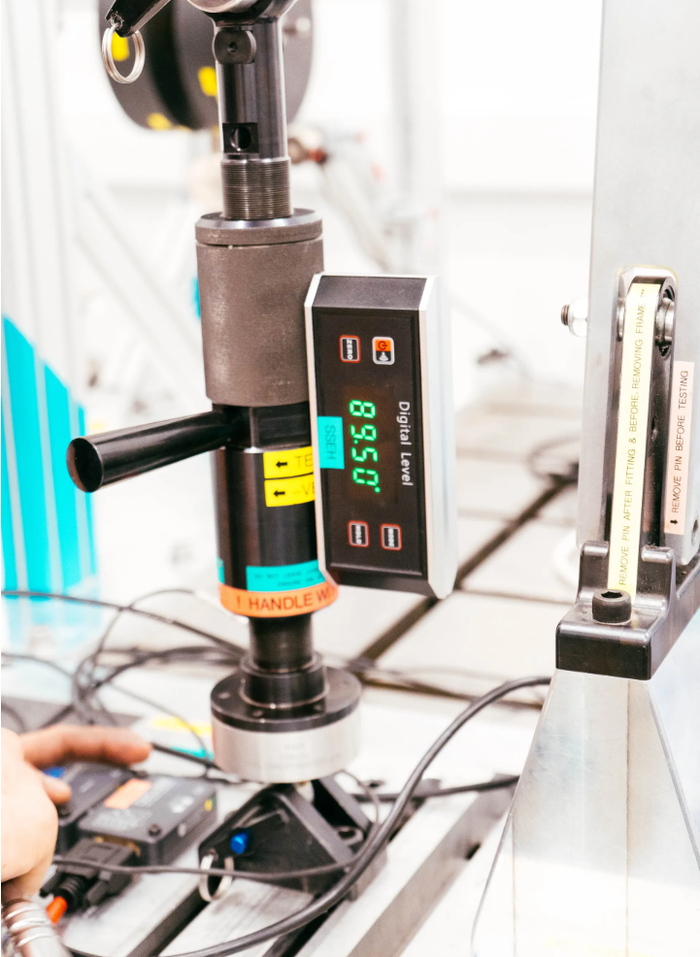
This post is about the cycling media Cyclingnews's test on 'frame stiffness' and 'vertical compliance,' which measured objective figures at the Silverstone Sports Engineering Hub in England. The first lab test report results have been summarized.
Previously, riders had to rely on subjective reviews or marketing terms from manufacturers ("the sides are stiff and vertically compliant"). However, this article tests 14 flagship bikes from each brand under the same conditions and quantifies 'stiffness without power loss' and 'ride quality' as numerical values (N/mm).
1. 테스트의 핵심: 무엇을 측정했는가?
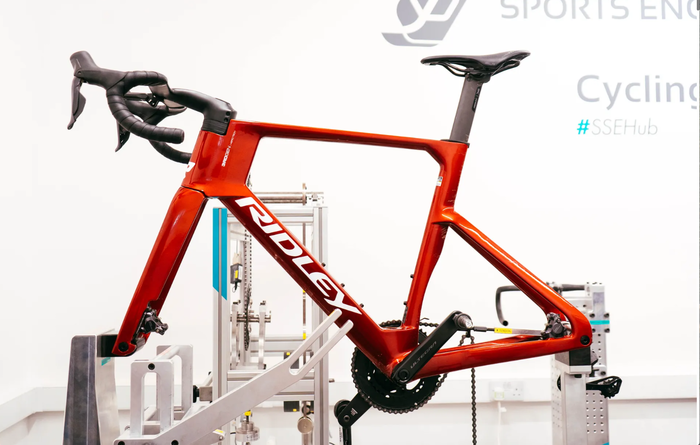
We tested two key factors that determine the performance of a frame.
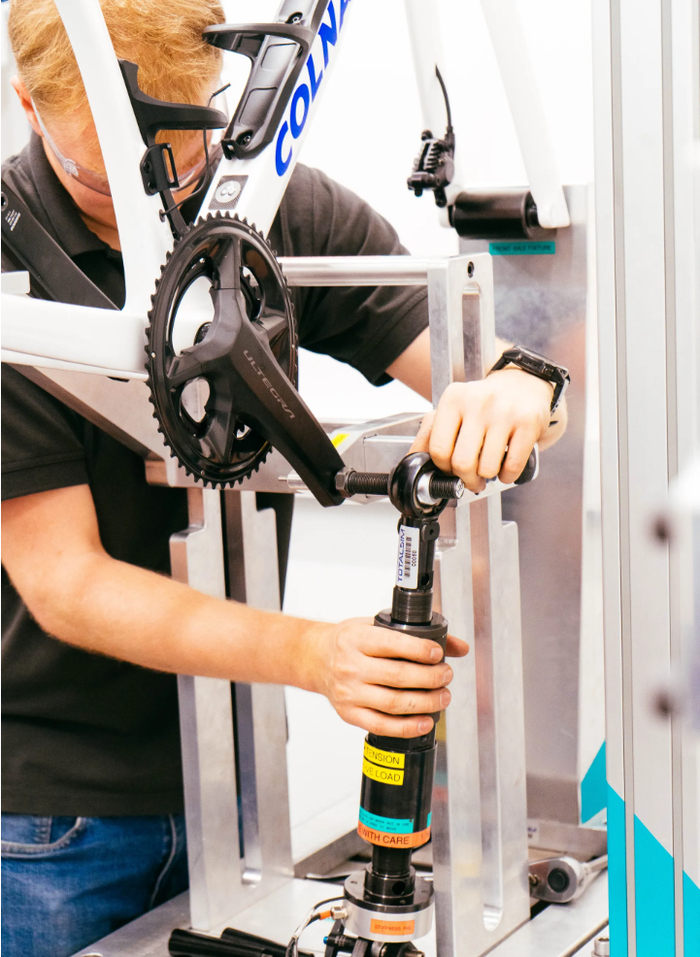
- BB (Bottom Bracket) Lateral Stiffness: This is the measure of how much the frame resists bending sideways when you press on the pedals. A higher number means that pedaling force is transferred more efficiently to the rear wheel, resulting in better responsiveness. The unit is N/mm(the force required to deform the frame by 1mm).
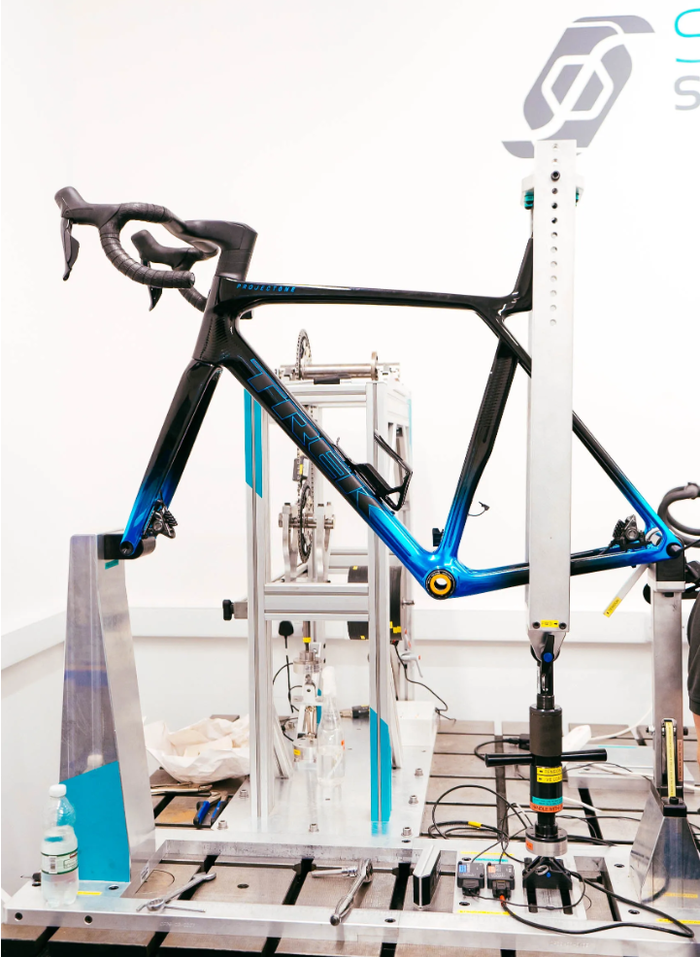
- Vertical Compliance (Vertical Compliance): This indicates how well the frame absorbs the impact and vibration of the road surface to reduce rider fatigue. The lower this value (N/mm) is the better the frame bends smoothly with little force, meaning good ride comfort.
2. 비비(BB) 측면 강성 테스트 결과 (반응성 / 단단함)
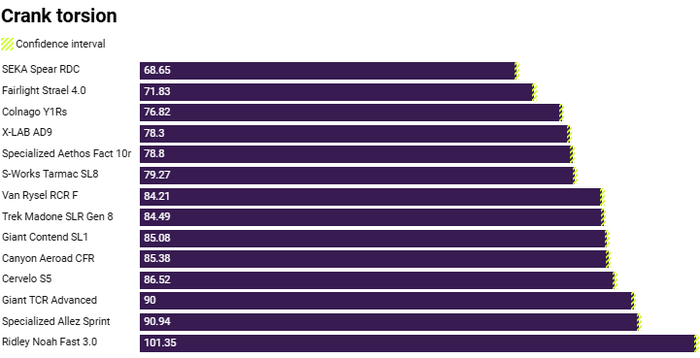
A total of 14 frames were tested, and the results ranged from 68.65 N/mm to 101.35 N/mm.
- Maximum Stiffness: The Ridley Noah Fast 3.0 showed the highest stiffness compared to other bikes.
- Unexpected Results: Colnago Y1Rs and Seka Spear are top-of-the-line racing models, but they surprisingly showed a very high level of frame flex (flexibility/low stiffness).
- Tarmac SL8 vs. Aetos: One of the most interesting points is that the stiffness values of the Eswork Tarmac SL8 (Fact 12r carbon) and Specialized Aetos (Fact 10r carbon) came out very similar. Specialized stated that these two models were designed to have a similar ride feel, so the BB stiffness targeting was similar. The difference in carbon grade (12r vs 10r) proves that it is not a difference in hardness but a difference in 'weight' of the carbon used to create the same hardness.
3. 안장 수직 순응성 테스트 결과 (승차감 / 피로도)
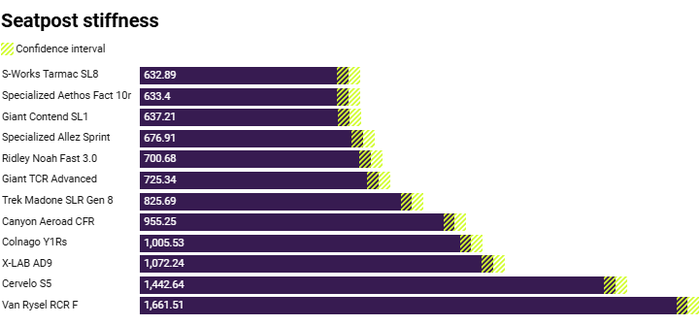
이 수치는 632.89 N/mm에서 1661.51 N/mm까지 측정되었습니다.
- The stiffest ride: The Van Rysel RCR F and Cervélo S5 had the highest compliance scores, meaning they transmitted the most road shock, making them the stiffest bikes.
- Best Ride Comfort: The Eswoks Tamac SL8 and Specialized Aethos are positioned on opposite ends of the scale, with the Aethos measured to have the best (smoothest) ride comfort.
- Best Balance: The Ridley Noah Fast 3.0 was rated as the model that caught 'two rabbits' - 'firm pedaling and soft ride' - because it was the stiffest in the BB stiffness test but still ranked on the softer side in terms of vertical compliance.
[Bottom Bracket]
[Seatpost]
4. 가격과 소재에 대한 편견 파괴
Before the test, reporters predicted that "racing bikes are sturdy, cheap bikes are flimsy, and steel bikes will be the most comfortable." But the actual results were different.
- The aluminum bicycle Giant Contend SL Disc (Giant Contend SL1) showed a very impressive BB stiffness. It was confirmed that expensive prices or high-grade carbon materials do not necessarily guarantee high stiffness or excellent ride quality.
마치며...
This Cyclingnews's Lab test articles brought the objective data realm to subjective reviews and marketing claims (e.g., "sides are stiff and vertically compliant") that had long been prevalent in the cycling industry. This is a very meaningful attempt in the history of cycling media.
1. Breaking Down Stereotypes The biggest takeaway was shattering the common Peloton stereotype that 'expensive high-end carbon bikes are always stronger than aluminum or endurance bikes.' The fact that high-end racing frames like the Colnago Y1Rs surprisingly showed high flexibility (Flex), while entry-level aluminum models demonstrated unexpected stiffness, proves that frame performance is not determined simply by 'material' or 'price tag'.
2. Controlled Variables and Compromises with Reality Journalists also clearly recognize the limitations of this experiment. The compliance rate may vary depending on the exposure length of the sheet post or the height of the stand-over, but the fact that they tested it in 'the setting that consumers actually purchase and ride' without artificially cutting it off is a great approach to bridging the gap between laboratory data and the real world.
3. Remaining Task: Relationship between Stiffness and Speed While it is possible to directly calculate how many watts (W) are saved when the coefficient of air resistance (CdA) decreases in aerodynamics (wind tunnel experiments), higher frame stiffness does not necessarily mean a faster bicycle. This is because the 'tipping point (Tipping point)' for accepting stiffness varies depending on the rider's weight and power.
Nevertheless, this article lays a solid foundation for comparing the frame characteristics that used to rely on 'feeling' with quantitative figures (N/mm). If more bicycle data accumulates in the future, it will become an important objective indicator as much as aerodynamic data when consumers choose bicycles that best suit their body weight and riding style (sprinter type or long-distance uphill type).
[참고자료]
- Cyclingnews : Stiffness testing: Colnago Y1Rs vs Cervélo S5, Specialized Tarmac vs Allez Sprint, steel vs carbon, budget vs expensive and much more
[포스팅 원글]
https://blog.naver.com/scvhwan/224259523936
즐거운 하루되세요~!