Week 4 of June Summary - Dashed Hopes in AI/Semiconductor Rally, US Economy and Rates in 'Stable Mode' Despite Tech Stock Adjustment
2026 June Week 4 Macroeconomic Weekly Market Report
## This Week's Core Theme: "Overheated Tech Stocks Take a Breather… Macro Still in 'Smooth Slowdown' Mode"
To sum up the US market this week (6/20~6/26, US Eastern Time) in one line: "AI and semiconductor tech stocks pulled back from overheating in a correction, but economic growth and rates were not significantly shaken."
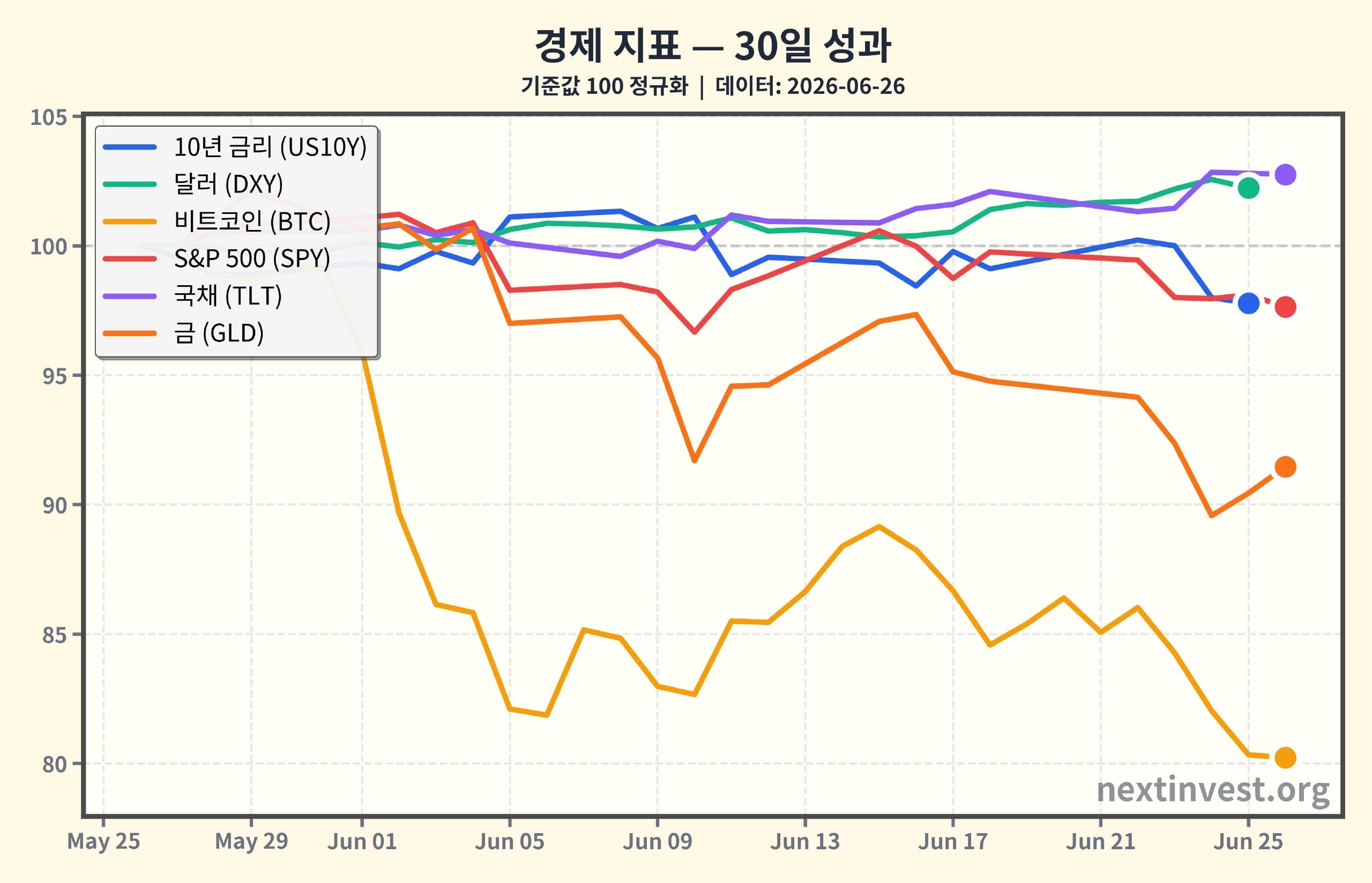
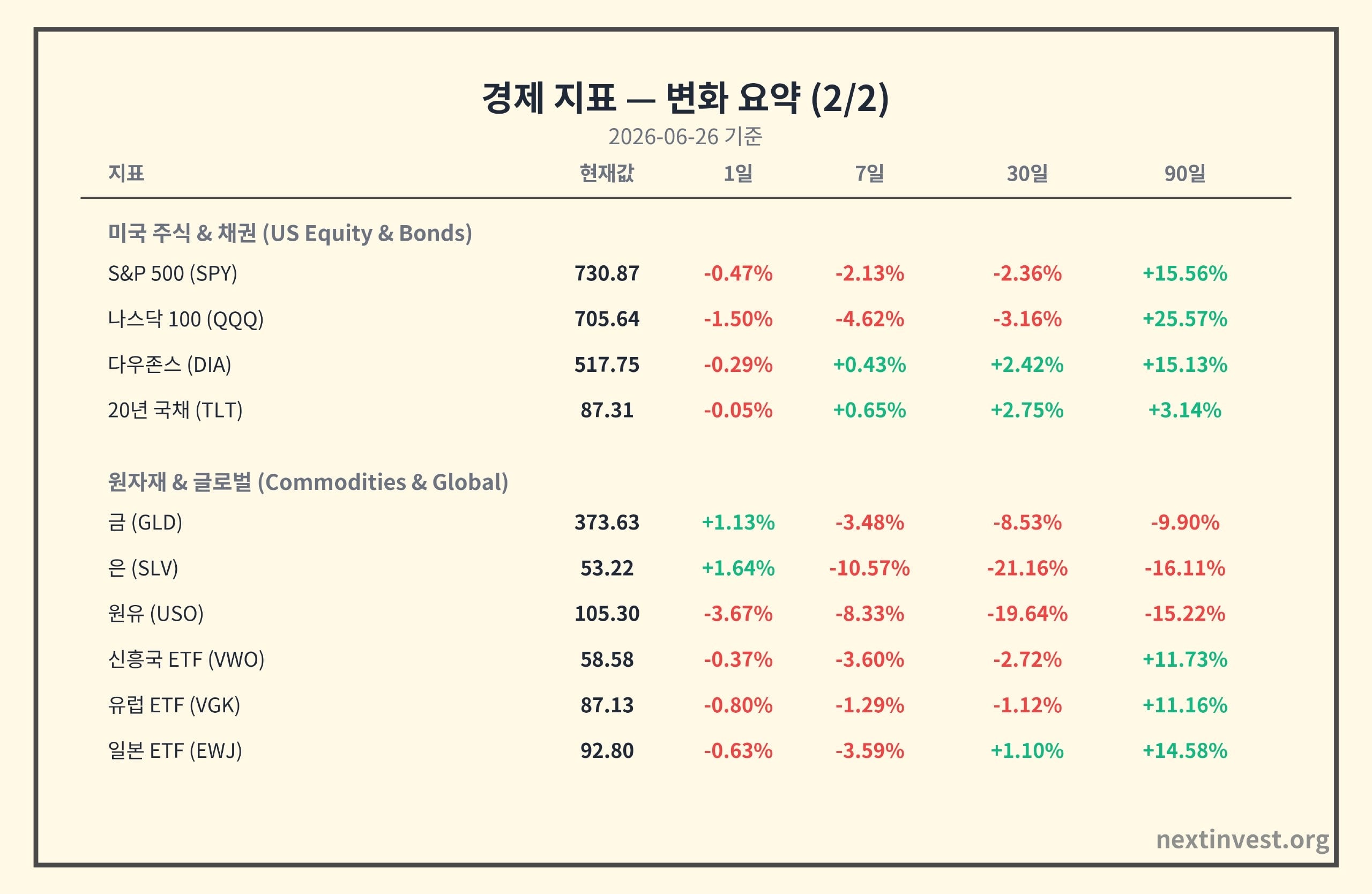
- Nasdaq and Growth Stocks Weak: Over 7 days, Nasdaq-100 ETF (QQQ) fell -4.62%, S&P 500 ETF (SPY) fell -2.13%. Meanwhile, the Dow (DIA), with higher exposure to traditional manufacturing and value stocks, held at +0.43%.
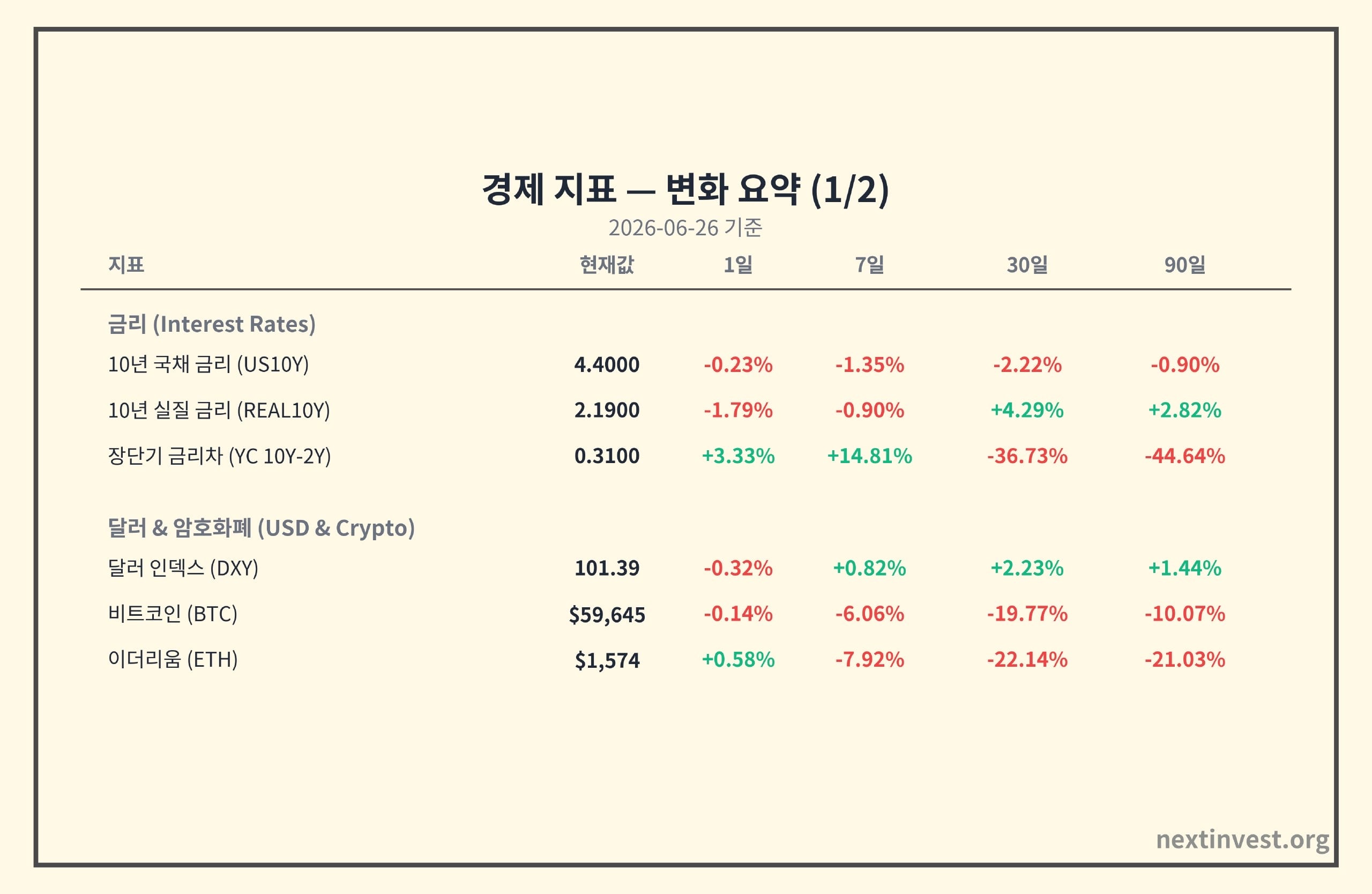
- Long-term Rates Slightly Down, Real Rates Still High: 10-year Treasury yields fell -1.35% over the week to the 4.4% level, while real yields (10Y TIPS), even after a -0.90% adjustment, maintained early 2% levels.
- Dollar Strong, Oil Prices Plummet, Bitcoin Below $60,000: The Dollar Index (DXY) rose +0.82%, the oil price ETF (USO) fell -8.33%, and Bitcoin dropped -6.06%.
The key point is that not fears about Fed policy and inflation exploding suddenly, but "valuation fatigue" and "pace adjustment" for AI and semiconductors that have already risen sharply led the market correction. From an investor's perspective, rather than seeing this as "a time to sell on fear," it is more reasonable to view it as a period requiring portfolio review.
---
## Interest Rates and Bonds: "Fed Holds Steady, Rates Down Slightly... But Real Rates Still at High Levels"
### 1) This Week's Interest Rate Movement Summary
- 10-year Treasury Yield: 4.40% level, 1 week -1.35%, 1 month -2.22%
- 10-year Real Yield (TIPS): 2.19%, 1 week -0.90%, 1 month +4.29%
- Yield Curve (10-year - 2-year Spread): 0.31%p (31bp), steepened slightly by +14.81% over 1 week.
> Translation: "Nominal rates (surface interest rates) have come down slightly, but 'real rates' minus inflation remain high, and the spread between long and short-term rates is following a gradual normalization trend."
### 2) This Week's News Points Related to Fed and Inflation
- Fed First Week After June FOMC Hold (6/17): In the first meeting of the new chair regime, the Fed held the benchmark rate in the 3.50-3.75% range and signaled "we will look at more data" through dot plot and statement changes. The market has already priced this in, with no major surprises this week. (traderc.com)
- Q1 GDP Revision (Released 6/25): The US Q1 real GDP growth rate's final figure was slightly downwardly adjusted, but it was not a major surprise. In other words, the existing perception that "growth is gradual, but not a sharp decline" was maintained. (bea.gov)
- In May trade and inventory leading indicators (released 6/26), inventory and trade balance showed gradual adjustment without major collapse, lending weight to a slow slowdown scenario rather than an economic crash scenario. (census.gov)
### 3) Looking at It in Connection with Long-term Structure
- The Fed's benchmark rate has been on a gradual decline since end-2024 (5.33% → 3.63%), and viewed as a 5-year trend, it's in a "phase of gradually declining from high rates."
- However, the 10-year real rate (2.18%) is historically quite high, still burdening risk assets like stocks and REITs.
- The situation where the 10-year-2-year spread returned to positive after 2025 and recently narrowed to 0.3%p is more naturally interpreted not as "on the brink of severe recession," but as "gradually easing recession concerns while moving toward normalization."
### What Does This Mean for Investors?
1. On the Bond Side:
- As long-term rates declined slightly, TLT (long-term Treasury ETF) recorded returns of +0.65% over 7 days, +2.75% over 30 days, and +3.14% over 90 days.
- "Is the High-Rate Era Over?" It's too early to say. However, if rates can decline gradually even in small increments, strategies with too small a proportion of medium- to long-term bonds warrant reconsideration.
2. On the Stock Side:
- High real interest rates mean an environment where "you can earn quite decent interest income through deposits and bonds alone".
- This puts pressure on growth stocks and high valuations (particularly AI and semiconductors), while giving a relative advantage to value stocks, dividend stocks, and companies with stable cash flows.
---
## Dollars and Currency Exchange: "The dollar is quietly strengthening… a burden on risk assets, a double-edged sword for overseas investment"
- DXY (Dollar Index): 101.39, 1 week +0.82%, 1 month +2.23%, 3 months +1.44%
- Looking at long-term trends, it has fallen significantly from the 2022 peak (105-114 range), but in recent months has shown a gradual strengthening trend again.
The reasons for the dollar's strength this week are largely two-fold.
1. U.S. real interest rates remain high → The appeal of dollar assets compared to other currencies is maintained.
2. Global tech stock correction and risk-averse sentiment → When money flows out of stocks, commodities, and cryptocurrencies, some of it moves into "dollar cash and short-term bonds". (cboe.com)
### What does this mean for investors?
- For dollar asset holders (primarily U.S. investment focused):
- Dollar strength increases the risk of exchange losses when converting foreign stocks and bonds later.
- Conversely, it can be an opportunity to buy foreign assets more cheaply now.
- For commodity and emerging market investments:
- Generally, dollar strength is a headwind for commodities, emerging market currencies, and stocks.
- In fact, this week also saw commodity and emerging market ETFs showing broad weakness.
---
## Stock Market: "A Week Where AI and Semiconductor Adjustments Dragged the Market Down"
### 1) Index Summary
- S&P 500 ETF (SPY): 730.87, 1 week -2.13%
- Nasdaq-100 ETF (QQQ): 705.64, 1 week -4.62%
- Dow ETF (DIA): 517.75, 1 week +0.43%
In other words, "it was a week where technology-focused indices fell sharply, while the Dow, which has a large weight in traditional industries and value stocks, actually rose".
### 2) Key News on Tech Stocks and AI
1. Global Tech Stocks and Semiconductors Plunge
- Around June 23 (Tuesday), U.S. semiconductor and AI-related stocks plunged sharply, dragging down the entire Nasdaq and S&P 500. (investing.com)
- Reports cited "overheating in AI infrastructure investment (data centers, high-performance semiconductors) and valuation concerns" and "profit-taking following recent rallies" as major causes. (cbsnews.com)
- The same phenomenon appeared globally, with semiconductor and AI-related stocks in Korea, Taiwan, and Europe showing concurrent weakness. (gulfnews.com)
2. Individual Company Issues Are Mixed
- Some memory semiconductor companies (e.g., Micron) showed short-term rebounds with better-than-expected results, but "valuation fatigue for the entire sector" had a larger effect even with good earnings. (apnews.com)
As a result, it was a week where the market structure itself, which had been excessively concentrated in AI, semiconductors, and big tech, was shaken.
### 3) Sector Rotation (Movement Between Sectors)
- Analysis showed that rotation into defense, industrial materials, value stocks, European, and Japanese markets was pronounced this week. This means investors are moving some funds from "high-valuation AI growth stocks" to "real economy and defensive sectors". (reddit.com)
### What does it mean for investors?
1. Portfolio with high proportion of tech stocks
- If over the past 1-2 years there has been a market environment where "you make profits by continuously buying only AI-related stocks," this week was a warning signal about that.
- We don't know how far the short-term adjustment will extend, but
- Whether funds are not excessively concentrated in a single stock or sector (e.g., AI, semiconductors)
- Whether you don't hold many stocks that are too expensive relative to earnings and cash flows
is the right time to check.
2. Value stock and dividend investors
- Like the Dow being up for the week, "boring but steady" stocks showed relative strength.
- In an environment with high real interest rates, companies that provide stable earnings and dividends tend to be re-evaluated more easily as markets become unstable.
3. Long-term investment perspective
- The 2025-26 AI rally has already shown a historic level of surge, and many interpret this adjustment as being closer to "speed adjustment" rather than "AI itself is over." (cboe.com)
- If you agree with the long-term growth story, rather than forcing chase buying during an overheating period, considering a phased approach during these adjustment periods can be more advantageous from a risk management perspective.
---
## Commodities and Cryptocurrency: "Oil and precious metals weakness, Bitcoin also adjusting in tandem"
### 1) ETF-based return summary
- Oil ETF (USO): 1 week -8.33%, 1 month -19.64%, 3 months -15.22%
- Gold ETF (GLD): 1 week -3.48%, 1 month -8.53%, 3 months -9.90%
- Silver ETF (SLV): 1 week -10.57%, 1 month -21.16%, 3 months -16.11%
Recent oil and gold and silver prices over the past few months are
- Dollar strength
- Concerns about slowing global growth (declining energy demand)
- The impact of overall declining preference for risk assets alongside tech stock adjustments
being affected simultaneously. (streetinsider.com)
### 2) Cryptocurrency: Bitcoin below $60,000
- Bitcoin (BTC): $59,645, 1 week -6.06%, 1 month -19.77%, 3 months -10.07%
- Ethereum (ETH): $1,574, 1 week -7.92%, 1 month -22.14%
In the crypto market this week
- Bitcoin fell to the 59,000 dollar range and reports indicate that more than $1 billion in forced liquidations (leverage position unwinding) occurred on a 24-hour basis. (reddit.com)
- At the same time, as U.S. inflation (particularly PCE) and the Fed's "possibility of maintaining tightening" came back into focus, the perception that "money won't easily loosen up" acted as a burden on the crypto market. (reddit.com)
### What does it mean for investors?
1. Commodities
- While high-commodities-weighting investors likely incurred losses as oil and precious metals prices underwent significant adjustments,
- if you're looking for long-term inflation hedging (price protection) or portfolio diversification, this adjustment period is also an opportunity to consider adjusting allocations during a downturn rather than at a peak.
2. Cryptocurrency
- The recent ~20% adjustment over the past month is also a result of the market structure with high leverage and significant short-term trend-following trading.
- As long as the Fed's tightening stance doesn't easily change, expanding high-risk allocations based only on "to the moon"-style expectations is a period to be especially cautious about.
---
## Global Markets: "U.S. Tech Stock Correction Spreads Worldwide, But Europe and Japan Maintain Relative Strength"
- Emerging Markets ETF (VWO): 1 week -3.60%, 3 months +11.73%
- Europe ETF (VGK): 1 week -1.29%, 3 months +11.16%
- Japan ETF (EWJ): 1 week -3.59%, 3 months +14.58%
This week in global markets:
- Markets with heavy tech exposure such as Japan and emerging markets were shaken alongside the U.S. tech correction,
- But markets centered on Europe, defense, industrials, and healthcare held up relatively well. (gulfnews.com)
### What Does This Mean for Investors?
- If your exposure to U.S. tech stocks has been too high,
- Now is a good time to revisit a strategy of diversifying across currencies, sectors, and styles by spreading into Europe, Japan, and emerging markets.
- However, it is also important to keep in mind that during periods of dollar strength, currency fluctuations (exchange gains/losses) can significantly impact returns on overseas assets.
---
## Key Points to Watch Next Week: What Should You Check?
When looking at markets next week (late June to early July), here are three points that beginner investors should pay particular attention to. (kiplinger.com)
1. U.S. Inflation and Employment Data (especially the June jobs report and June PCE details)
- Why does it matter? → Because these are the key variables that determine when and by how much the Fed will cut rates (or whether it will hold them higher for longer).
- How should you read it? →
- If inflation comes in higher than expected: bond yields rise, putting pressure on growth and tech stocks.
- If inflation comes in lower than expected: bonds strengthen, which could be a tailwind for growth stocks.
2. Whether the Tech and Semiconductor Correction Continues
- It is important to gauge whether this week's correction was "a single week of catching its breath" or "the beginning of a trend reversal."
- Rather than individual stocks, it is better to look at sectors and indexes (semiconductor ETFs, Nasdaq 100, major AI theme ETFs) together, watching trading volume and the momentum of any rebounds.
3. Commodities and Dollar Trends
- Depending on whether dollar strength continues and whether commodity prices fall further, the outlook for investment strategies related to emerging markets, energy, and materials will shift.
---
## Wrap-Up: What Investment Strategy Makes Sense Right Now?
Summarizing this week from a beginner investor's perspective:
1. This is more of a cooling-off period for overheated areas than a panic phase
- The phenomenon was especially pronounced in AI, semiconductor, and big tech stocks.
2. Real interest rates remain high, and the Fed is in no hurry
- Rather than a scenario of "rapid rate cuts → explosive rebound in growth stocks,"
- A more conservative baseline assumption is "rates may come down slowly, but will remain elevated for quite a long time."
3. Portfolio diversification and risk management are critical right now
- Spreading across sectors, countries, and asset classes (equities, bonds, commodities, cash) is more important than ever.
- A strategy concentrated in a single sector that has already risen sharply (e.g., AI tech stocks) may face significant volatility during a corrective market like this.
Rather than asking "Should I sell everything right now?",
> "What assets and sectors am I exposed to, and by how much — and is this structure built to hold up over the next several years?"
Think of this as a week to reflect on exactly that question.
This content has been prepared for informational purposes only and does not constitute a recommendation to invest in any specific stock or asset.
Source: https://nextinvest.org/ko
Feel free to share without permission ^^