Since this is a translation of an overseas article, there may be some inaccuracies.
https://www.flatpanelshd.com/news.php?subaction=showfull&id=1777964273
Samsung Display Unveils Brighter EL-QD (NanoLED) Prototype
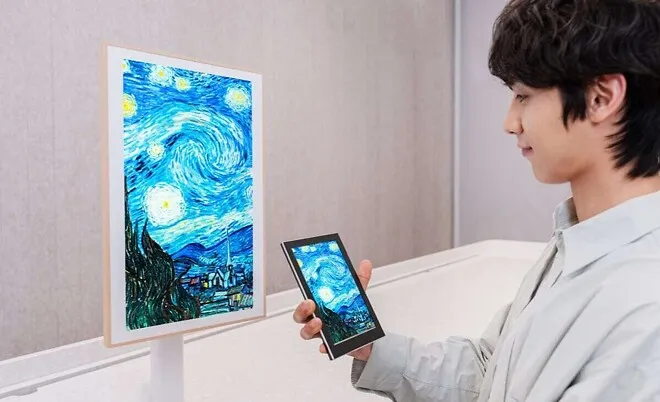
Considered a potential competitor to OLED and QD-OLED, the next-generation EL-QD (also known as NanoLED) display technology continues to advance. New OLED and micro LED panels were also unveiled.
Originally known as QLED but currently used as a marketing name for LCD TVs, this new display technology is now referred to as EL-QD, NanoLED, or QDEL. The final name is yet to be determined.
This technology does not rely on OLEDs or other types of light-emitting diodes. Quantum dots themselves directly convert electrical energy into light and color, potentially enabling the creation of displays with enhanced image quality at a lower cost.
Latest EL-QD Prototype
Samsung Display is showcasing its latest EL-QD prototype at SID Display Week 2026 in Los Angeles this week.
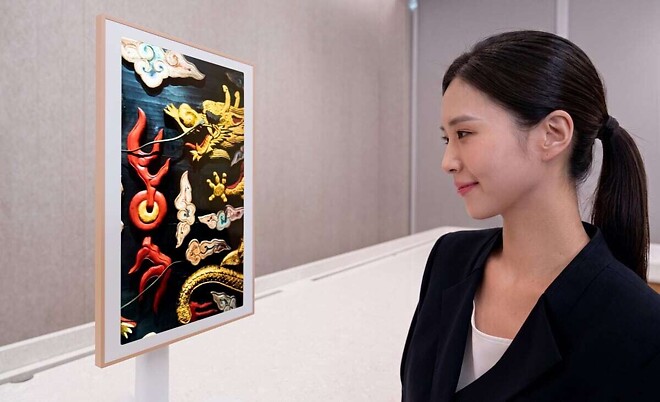
"EL-QD is a next-generation quantum dot display technology where quantum dot pixels directly emit light through electrical signals without using OLEDs, providing both high color accuracy and power efficiency," Samsung Display stated. It added:
"At this exhibition, Samsung Display is showcasing two EL-QD prototypes: an 18-inch panel with a brightness of 500 nits and a 6.5-inch panel with a brightness of 400 nits. Brightness has been improved by 25% and 33%, respectively, compared to last year (from 400 nits to 500 nits and from 300 nits to 400 nits).
The company also noted that energy efficiency has been improved. Samsung Display still refers to these panels as 'prototypes'. Quantum dot specialist Nanosys previously mentioned that NanoLED (EL-QD) could be launched in 2029.
More New Displays
Samsung Display is also showcasing its latest OLED smartphone technology, called 'Flex Chroma Pixel', at SID Display Week. This technology offers a maximum brightness of 3,000 nits and a BT.2020 color gamut coverage of 96%, which contrasts with the 70% level found in most smartphones today.
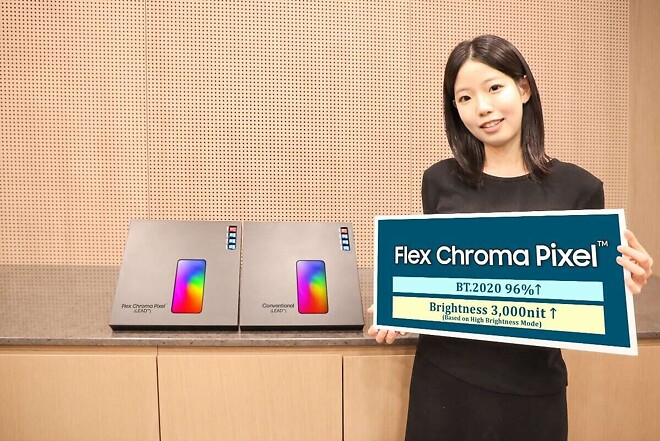
"Samsung Display has applied next-generation emissive materials, phosphorescent sensitization fluorescence (PSF), to enhance the color purity and color reproduction of OLEDs. In addition, Samsung Display's proprietary low-power, high-brightness non-polarized OLED technology, LEAD, has been integrated. This allows for a maximum brightness of 3,000 nits in high brightness mode (HBM) without shortening the lifespan of organic materials," the company explained.

This panel is expected to be incorporated into next-generation flagship smartphones from companies like Samsung Electronics and Apple, further enhancing outdoor visibility and HDR quality by exceeding the DCI-P3 color gamut.
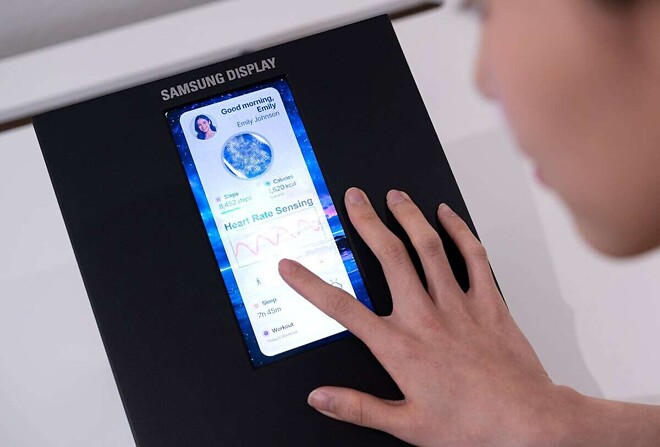
In addition, Samsung Display unveiled a 6.8-inch 500ppi OLED panel for smartphones that incorporates organic photodiodes (OPDs) capable of measuring heart rate and blood pressure when the user touches the screen.
Furthermore, a second-generation stretchable micro LED display with a 67% higher resolution of 200ppi was also showcased. Samsung Display envisions this technology being used in automobiles, for example, as a speedometer screen that can expand and deform according to driving conditions while maintaining sharp text and graphics and providing intuitive visual information.
▶ Source: https://www.flatpanelshd.com/news.php?subaction=showfull&id=1777964273