4/15 Asset markets — U.S. Producer Price Index comes in below expectations lol
# April 15, 2026 Macroeconomic Daily Market Report
## Today's Market at a Glance
With March U.S. Producer Prices (PPI) cooling more than expected, inflation fears were extinguished in a single day.
- 10-year Treasury yield 4.26% (-0.93%) – yields fell as inflation concerns eased
- Dollar Index (DXY) 97.99 (-0.76%) – dollar weakness
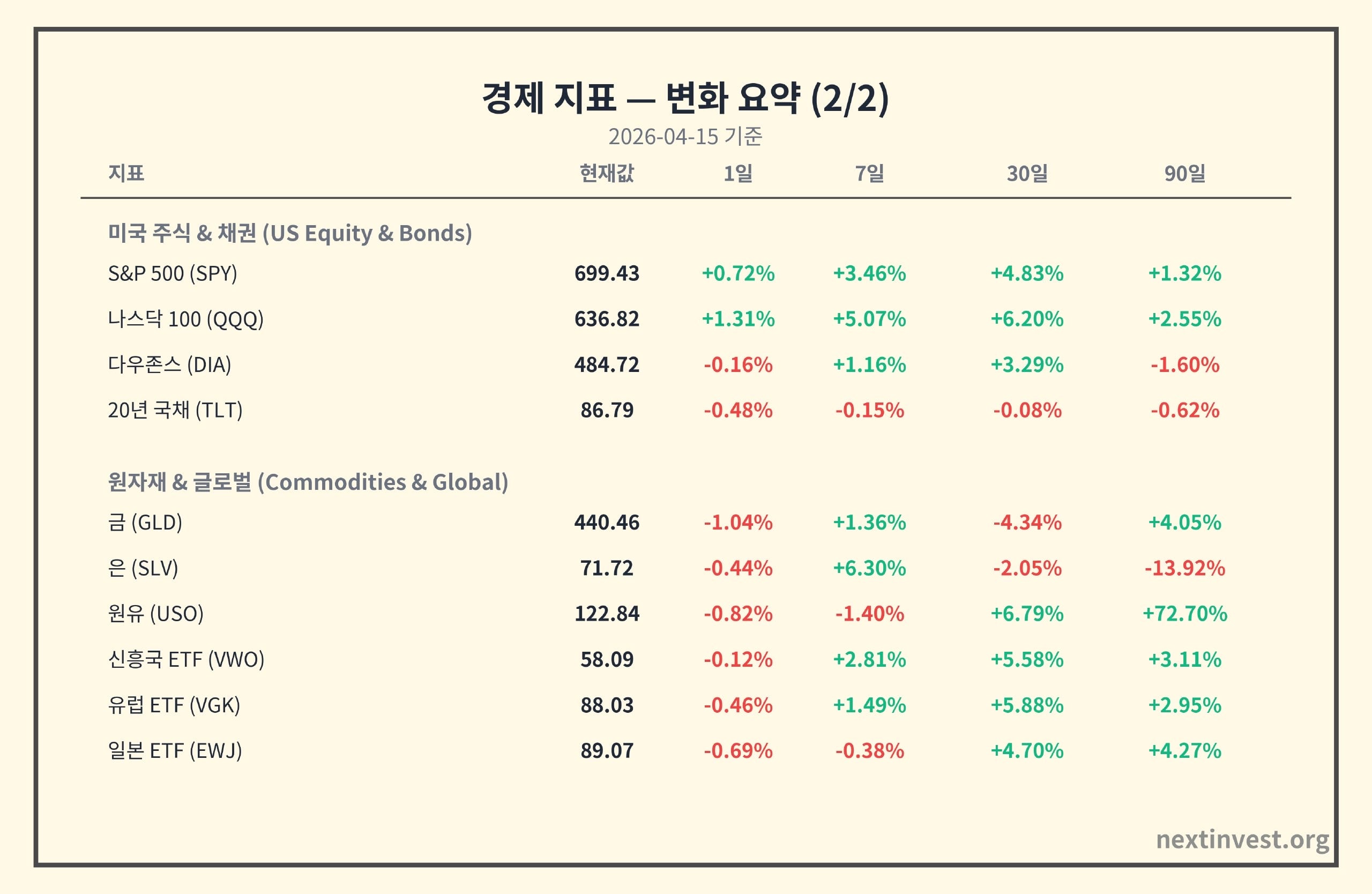
- S&P 500 ETF (SPY) 699.43 (+0.72%) / QQQ +1.31% – tech-led strength, with the S&P and Nasdaq setting fresh record highs【0reddit21】
- Bitcoin $74,674 (+0.68%) – continuing a run of more than 5% gains over seven days【0search4】
- Gold (GLD -1.04%), Silver (SLV -0.44%), long-term Treasuries TLT -0.48% – profit-taking on safe-haven assets that had 'risen too much'
Key news: With March PPI (producer prices) coming in markedly lower than the market expected, the dominant interpretation is that the fear of a 'possible rate hike' at the May FOMC has retreated significantly【0search5】.
> Put simply: it was a day when a sense of relief spread — "price increases at the manufacturing stage have settled down more than expected → consumer prices may also rise less going forward → the Fed may not have to tighten any harder."
---
## 1. Yields and Dollar Fall Together: Inflation Fears Cooled a Notch
### Both the 10-Year Yield and the Real Yield (the yield adjusted for inflation) Fall
- 10-year Treasury yield: 4.26% (1-day -0.93%)
- The 10-year Treasury yield is the interest rate the U.S. government must pay when it borrows money for 10 years. In other words, think of it as "the most fundamental 10-year interest rate."
- 10-year TIPS real yield: 1.89% (1-day -1.56%)
- The TIPS real yield is the 'true return' after subtracting the inflation rate. Think of it as "the interest left in your hands after accounting for inflation."
- 10-year–2-year spread: 0.50 (1-day -3.85%)
- The yield curve spread is the 10-year rate minus the 2-year rate. It's something like a gauge of economic expectations, showing how much higher (or lower) the long-term outlook is compared to the short term.
Over the past 90 days, the 10-year yield had risen +2.65%, so today's decline can be seen as a correction partially unwinding the 'fear of inflation resurgence' that had built up throughout the first quarter.
### Why Did It Fall? – The PPI Surprise
- With March U.S. producer prices (PPI), released this morning, coming in distinctly lower than expected, analysts say the fear that "prices might surge again like in the 1970s" has been dampened somewhat【0search5】.
- PPI is a wholesale price index reflecting what companies pay when they buy raw materials, parts, and so on. Think of it as "the price at the stage before goods are placed on store shelves."
- This indicator coming in lower than expected means that, from a company's standpoint, cost burdens decrease and the pressure passed on to consumer prices may also ease.
> By analogy, it's a picture where costs like flour, packaging, and labor stabilize first, before the price of ramen rises. When costs settle down, the ramen company has less need to raise prices significantly.
### So Why Does It Matter?
- Directly tied to mortgage and student loan rates: When the 10-year yield falls, the rates on long-term fixed-rate loans (mortgages, etc.) are more likely to fall as well.
- The benchmark for valuing stocks, real estate, and Bitcoin: This long-term yield is precisely the 'discount rate' used to calculate asset values in the market. The lower the rate, the higher the present value calculated for tech and growth stocks, especially those whose growth lies far in the future.
---
## 2. Dollar Weakness and Mixed Commodities: 'Safe-Haven' Assets Catch Their Breath
### Dollar Index (DXY) Falls
- DXY 97.99 (1-day -0.76%, 7-day -1.92%)
- The Dollar Index (DXY) is the dollar's 'fitness test score,' comparing the dollar against a basket of major currencies such as the euro, yen, and pound.
After the PPI surprise, the perception that "the Fed may not go any more hawkish (aggressively tightening)" spread, and bets on dollar strength appear to be unwinding.
> Put simply: it's a flow of "U.S. rates seem less likely to rise than thought → there's less reason to buy up the dollar at a premium."
### Gold and Silver Correct, Oil Slips Slightly
- Gold ETF (GLD): 440.46 (-1.04%, down -4.34% over 30 days)
- Silver ETF (SLV): 71.72 (-0.44%, -13.92% over 90 days)
- Oil ETF (USO): 122.84 (-0.82%, +72.7% over 90 days) – catching its breath after surging over the past three months
Over the past few months, gold, silver, and oil had risen sharply due to Middle East geopolitical risk and concerns about reignited inflation, but
- with inflation fears easing, and
- the dollar weakening too,
today was a day when some investors moved toward "let's take profits for now."
> By analogy, it's like buying an expensive raincoat because it looked like it would pour, only for the forecast to suddenly change to 'less rain than expected.' If the raincoat's price has risen too much, more people will end up reselling it secondhand — it's similar to that.
---
## 3. U.S. Stocks: Tech-Led Record Highs, but the Dow Took a Step Back
### Performance by Index
- S&P 500 ETF (SPY): 699.43 (+0.72%, +3.46% over 7 days)
- Nasdaq 100 ETF (QQQ): 636.82 (+1.31%, +5.07% over 7 days)
- Dow ETF (DIA): 484.72 (-0.16%)
On an actual index basis as well, the S&P 500 and Nasdaq each set fresh record highs once again today (4/15)【0reddit20】. However, the Dow has a large weighting of economically sensitive, traditional-industry names, so analysts say it looks relatively less attractive given the 'economic slowdown + easing inflation' combination.
### Why Were Tech Stocks Especially Strong?
- PPI slowdown → reduced likelihood of further Fed tightening → lower long-term yields → favorable for tech stocks, which have a large weighting of future earnings
- In particular, today's articles included analysis that eased cost pressures on the cloud and AI infrastructure side could support Big Tech profit margins【0search5】.
> Because tech stocks are seen not so much as "companies making a lot of money right now" but as "companies that will earn much more 5 to 10 years from now," they have a structure that shines brighter when rates — which erode 'the value of future money' — fall.
### So Why Does It Matter?
- If you're an investor accumulating U.S. equity ETFs (especially the S&P 500 and Nasdaq 100) on a regular installment basis,
- today was a day that clearly showed how a single line of "rate and inflation news" can move the entire index.
- Meanwhile, it was also a day that confirmed that traditional-industry-oriented indices like the Dow rise relatively less, which could be an occasion to rethink the "tech stocks vs. traditional value stocks weighting" in your portfolio.
---
## 4. Bitcoin and Ethereum: Joining the 'Risk-Asset Rally'
- Bitcoin (BTC): $74,674 (1-day +0.68%, 7-day +5.05%)
- Ethereum (ETH): $2,360 (1-day +1.56%, 7-day +7.74%)
According to a separate report, Bitcoin tested resistance near $76,000 intraday before pulling back to the mid-$73,000s, showing a pattern of catching its breath amid strength【0search4】.
### Why Did It Rise?
1. Falling yields and dollar → recovery in risk-asset appetite
- When yields fall and the dollar weakens, the appeal of deposits and Treasuries diminishes, and money flows more easily into relatively riskier assets like stocks and crypto.
2. A subtle difference from the 'digital gold' narrative
- The price of gold corrected today, but Bitcoin rose.
- This can be seen as a sign that, in the short term, investors view Bitcoin as an asset blending "inflation hedge + growth story" and are betting on it somewhat more aggressively.
> By analogy, if gold is an "insurance safe," Bitcoin feels more like "collecting a growth-type coin." It's something you tuck away when you're anxious, but it also has a strongly speculative character, with investors hoping the price will move significantly.
### So Why Does It Matter?
- From a long-term investor's standpoint:
- Today's movement once again confirms that "Bitcoin and Ethereum still move sensitively in response to global liquidity (the abundance of money) and risk-asset appetite."
- From a short-term trader's standpoint:
- Looking at the 7-day and 30-day returns, it appears to be a zone where volatility is increasing after a short-term rise, so it seems like a zone where you need to set clearer stop-loss and take-profit criteria.
---
## 5. Global and Bond ETFs: Temperature Gaps Within a 'U.S.-Centric Rally'
### Long-Term Bonds (TLT): Falling Even as Yields Drop?
- TLT: 86.79 (-0.48%, -0.62% over 90 days)
Normally, when yields fall, the price of a long-term bond ETF should rise, but today TLT fell instead.
There are two possible interpretations:
1. "Already priced in" – expectations of falling yields were rapidly priced in over the past few days, and today may have seen profit-taking.
2. Rotation into stocks – with inflation fears easing, this may be a process of money moving toward higher-yielding stocks and crypto, on the view that "there's no need to seek refuge in bonds."
### Emerging Markets, Europe, and Japan ETFs
- Emerging Markets (VWO): 58.09 (-0.12%, +2.81% over 7 days)
- Europe (VGK): 88.03 (-0.46%, +1.49% over 7 days)
- Japan (EWJ): 89.07 (-0.69%, +4.70% over 30 days)
Unlike U.S. tech stocks, overseas equity market ETFs broadly slipped slightly today.
> In summary: today's risk-asset rally was a "biased rally centered on U.S. IT and growth stocks," while emerging markets, Europe, and Japan took a breather for a day.
---
## 6. What Today's Flow Tells Us: What Matters to Me?
1. Direct impact on loan rates and investment returns
- The decline in the 10-year yield will, over time, affect mortgages, some long-term fixed-rate products, and even the cost of issuing corporate bonds.
- If you're planning to buy a home or thinking about refinancing into a long-term fixed-rate loan, you'll want to watch rate movements closely over the coming weeks.
2. How to manage the tech-stock weighting in your portfolio
- When a combination like today's "easing inflation + falling rates" emerges, tech and growth stocks tend to lead the market.
- However, since they've already risen quite a bit on a 7-day and 30-day basis, it may be safer to approach this from a weighting-adjustment and rebalancing perspective rather than "chasing the rally."
3. Bitcoin and Ethereum are still 'rate-sensitive assets'
- Today's movement reminds us that crypto remains one of the assets most sensitive to global liquidity and risk appetite.
- In other words, it's hard to view it as a fully safe-haven asset just on the strength of the "digital gold" marketing slogan.
4. Review overseas investment and currency-hedging strategies during a period of dollar weakness
- In a zone where the dollar weakens,
- if you already hold a lot of dollar assets, your returns in won terms may decrease, and
- conversely, if you plan to increase your dollar assets going forward, it could become a relatively favorable exchange-rate zone.
---
## Wrap-Up: Today in One Line
"As inflation fears retreated a step on the PPI surprise, yields and the dollar fell, and risk assets like tech stocks and Bitcoin took the spotlight again. In return, it was a day when traditional safe-haven assets like gold, silver, and long-term bonds took a brief rest."
This content is created for informational purposes only and does not constitute a recommendation to invest in any specific security or asset.
Source: https://nextinvest.org/ko