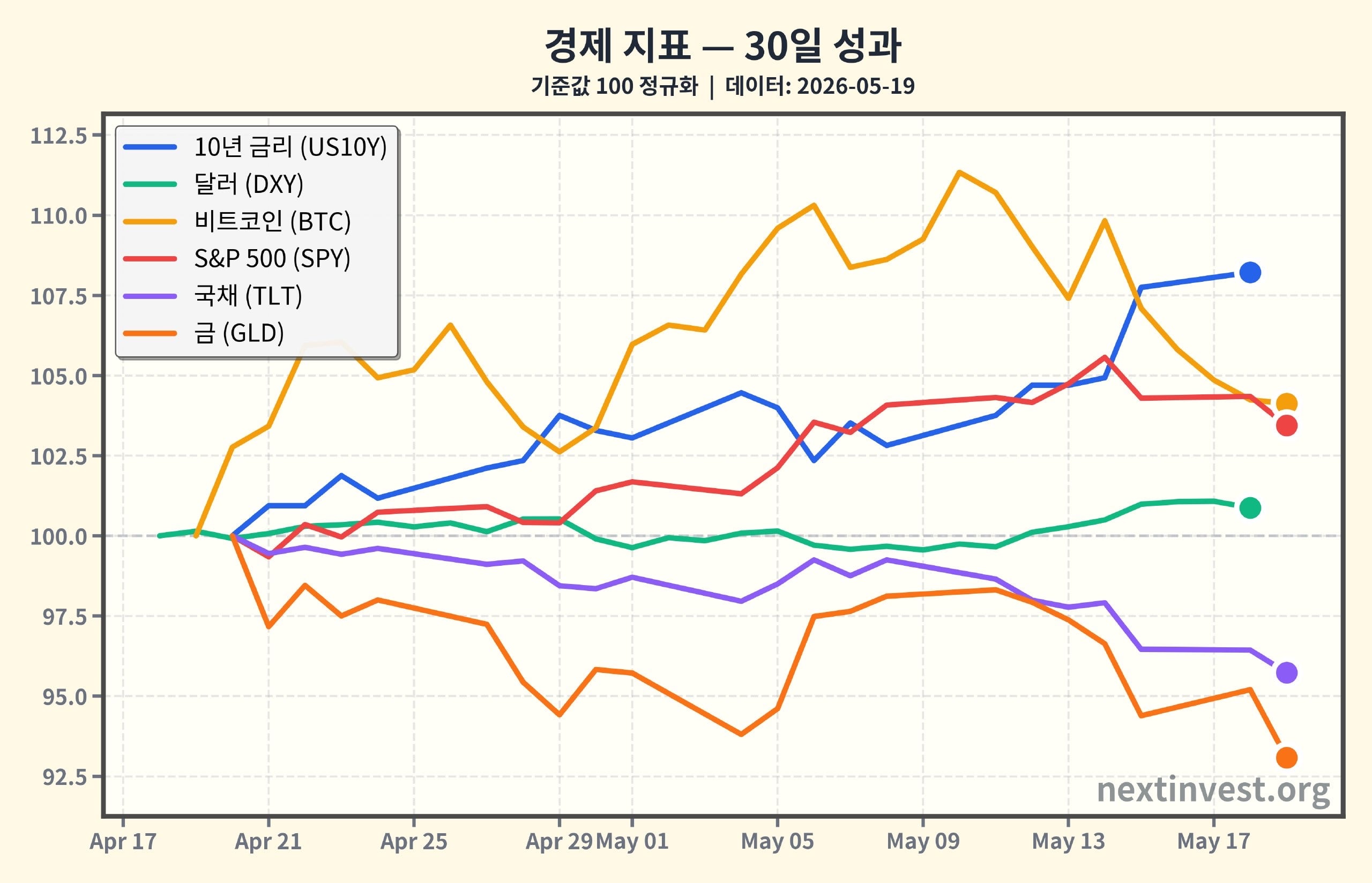
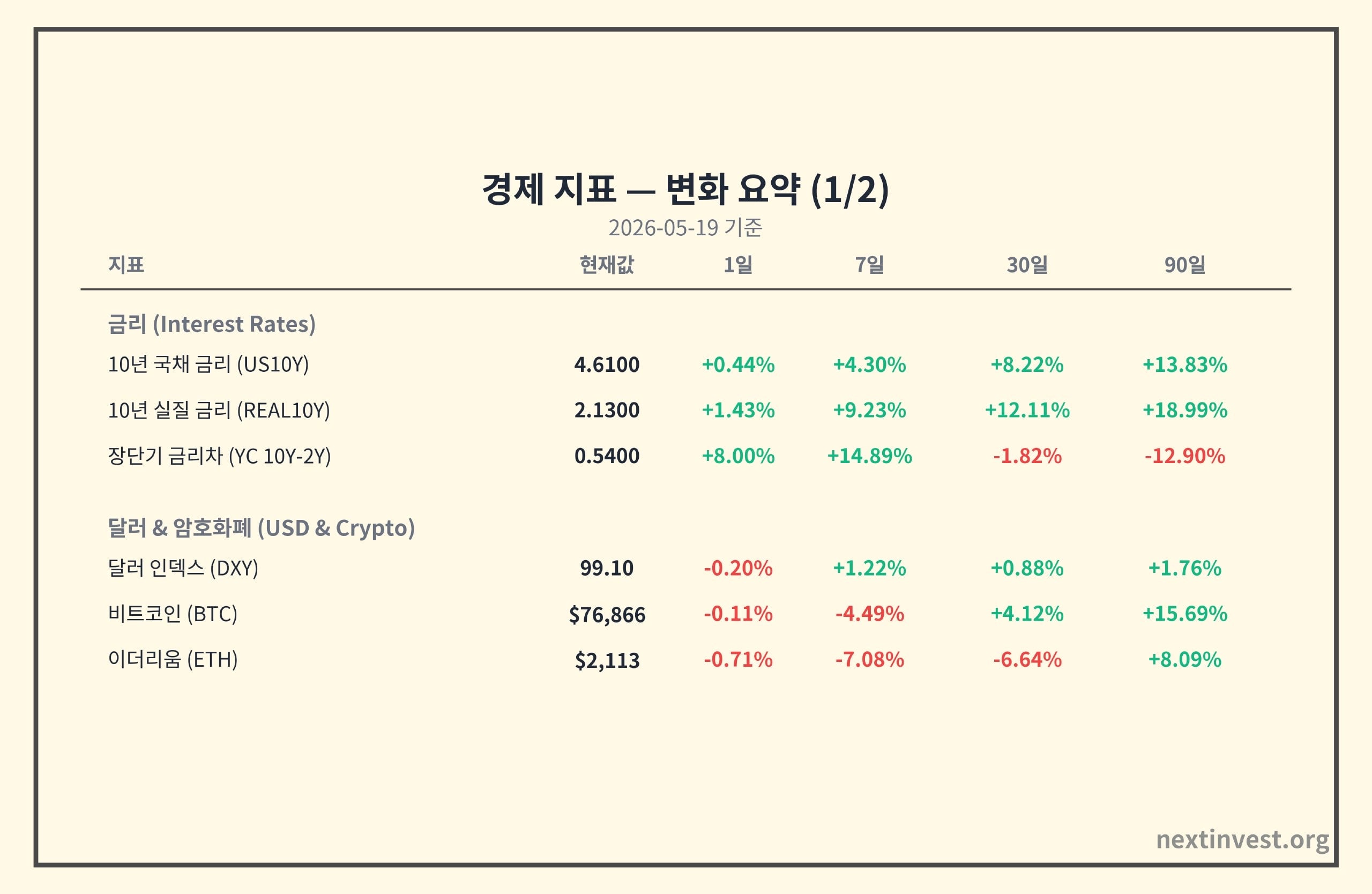
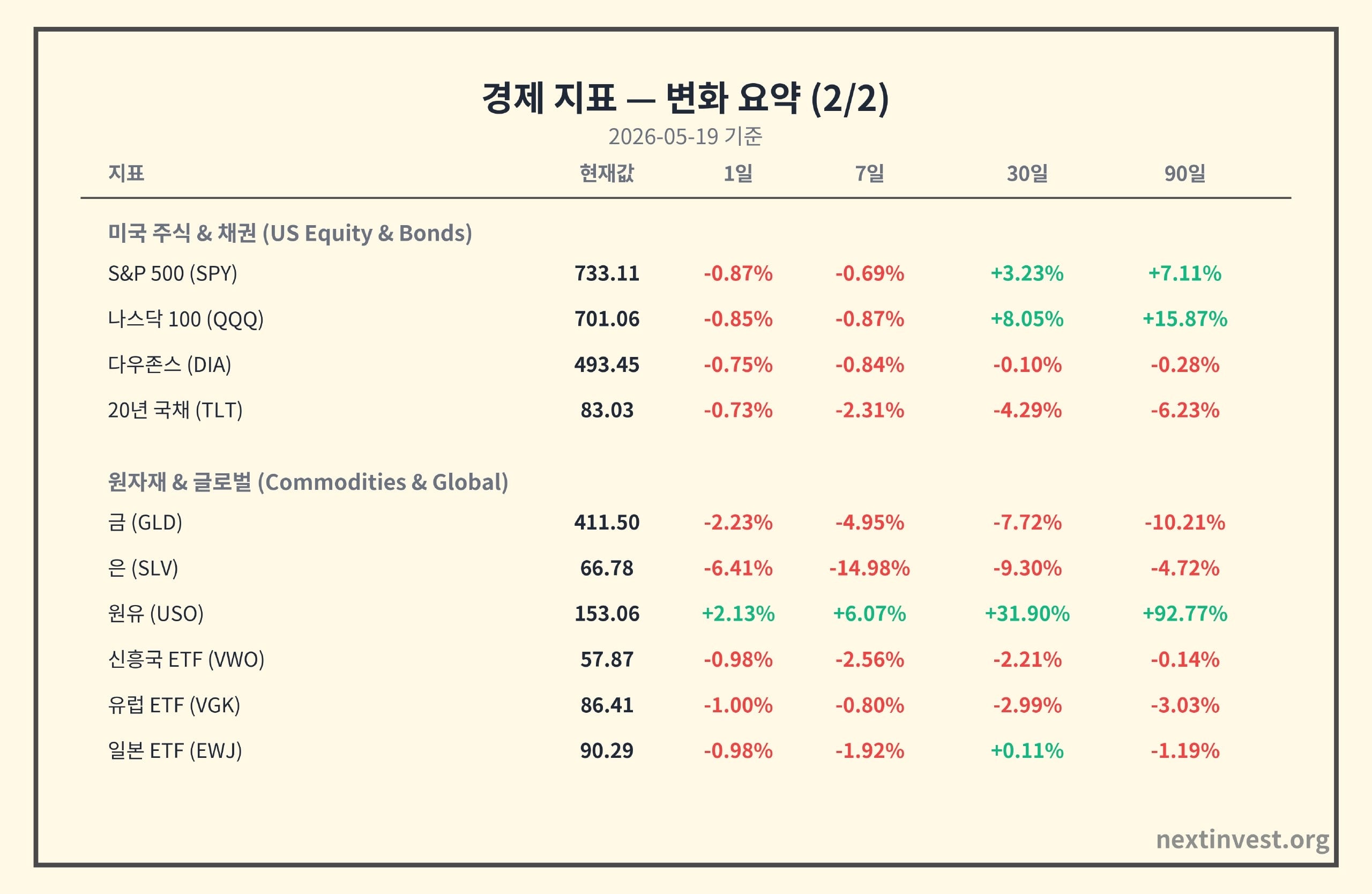
5/19 Asset Market - Long-term Interest Rates Surge, Gold and Silver Plummet
# Today's U.S. Market Daily Report
May 19, 2026 Market Analysis
## 1. What Happened Today?
On May 19 (U.S. Eastern Time closing basis), the U.S. stock market pulled back once again near all-time highs.
- S&P 500: Down approximately -0.7%, fourth consecutive adjustment (apnews.com)
- Nasdaq: Down approximately -0.8%, weakness centered on tech stocks continues (apnews.com)
- Market Sentiment: Overall negative (risk-off), though some sectors like energy and utilities showed gains
Key One-Line Summary:
Tech and growth stocks that have been driving the market up in recent months are taking a breather as they hit headwinds from surging long-term interest rates and inflation concerns, while energy, dividend, and defensive stocks played a relatively protective role today.
---
## 2. Three Forces That Moved the Market Today
### 2-1. Interest Rates and War Risk: Headwinds for Growth Stocks
The biggest backdrop to today's decline is rising U.S. Treasury yields and inflation concerns.
- As long-term interest rates rose again, the structure of discounting the value of companies with high future profits (growth stocks) came into focus. (apnews.com)
- AP News and major research reports indicate that Iran-related war risks and persistent inflation concerns pushed up bond yields and burdened stocks. (apnews.com)
Why Is This Important?
When interest rates rise,
- Companies that rely on future growth (big tech, semiconductors, etc.) are hit harder than those making money well right now.
- Since much of the S&P 500's gains over recent months have been concentrated in a small number of tech stocks, when these undergo a re-evaluation, index-wide volatility also increases. (reddit.com)
### 2-2. Why Did Energy and Dividend Stocks Hold Up?
In contrast, energy (+1.15%) and utilities (+1.07%) posted gains today.
- The energy sector is maintaining profitability expectations as supply risks and geopolitical uncertainty persist amid recent oil price volatility. (apnews.com)
- Utilities and certain dividend stocks (healthcare, REITs, etc.) attract demand as 'defensive assets' as economic slowdown concerns grow, showing relative strength when growth stocks falter.
Important Point:
Looking at the trend over the past 60 trading days,
- Energy: Despite significant volatility, ultimately up over 12%, and has entered a distinct uptrend since early May, aligning with today's strength and direction.
- Utilities: Still down about 5% on a 60-day cumulative basis, but has been narrowing losses and continuing a short-term bounce since early May.
While it might seem like "energy and defensive stocks suddenly got better" looking at just today, from a medium-term perspective, energy is re-rising after a previous adjustment, and utilities are closer to a short-term technical bounce amid base-building.
### 2-3. Pullback in the 'Concentrated' Tech Stock Rally
Another keyword in today's adjustment is 'fatigue from the tech stock rally.'
- The S&P 500 is still up over 7% since the start of the year, and Nasdaq is up over 11%, undergoing adjustment from these elevated levels. (apnews.com)
- According to recent reports, much of the S&P 500's gains this year have come from a small number of large tech stocks (the so-called 'Magnificent 7' and semiconductors). (fxstreet.com)
- Today, these large tech and semiconductor stocks took a simultaneous breather, creating the effect that the entire market appeared to collapse.
What It Means for You:
- If your tech/semiconductor ETF or individual big tech holdings are significant, you should be prepared for expanded short-term volatility.
- For investors holding index ETFs (S&P 500, etc.), it means the pace of index gains may slow if concentration in a few stocks eases.
---
## 3. Sector Overview at a Glance — Connecting Today to Recent Trends
### 3-1. Technology: 'Checkpoint' After a Hot Rally
- Today: Sector return -0.67%. Notable declines in certain stocks like Akamai (AKAM -5.98%), First Solar (FSLR -5%+).
- 7-day trend: After fluctuating slightly, declined again today, with 2 days up and 3 days down over 5 days—a 'consolidation-like adjustment period.'
- 60-day trend: Still the strongest sector with over 20% gains since late February, but in a gentle adjustment phase (-1%+) since May 8.
Why Did It Fall?
1. Growth stock valuations are being re-examined due to rising bond yields and interest rate concerns. (apnews.com)
2. Akamai:
- Today's sharp stock price decline is attributed mainly to the announcement of plans to issue $2.6 billion in convertible notes, with concerns about shareholder dilution when stocks are converted in the future coming into focus. (stockjabber.com)
- Additionally, Moody's maintaining its credit rating but downgrading its outlook also weighed on investor sentiment. (investing.com)
3. First Solar(FSLR):
- Despite positive news such as partnerships with India, today's decline was prominent due to rising long-term interest rates and the high interest rate sensitivity characteristic of the solar sector. (quiverquant.com)
Implications for Investors
- Over the past two months, the technology sector has surged over +20% on a portfolio basis, making it reasonable to view the current period as a "speed adjustment phase."
- However, it would be premature to conclude that the long-term trend has ended due to short-term corrections. We need to observe the process of rebalancing between interest rates, earnings, and AI-related investments.
### 3-2. Energy: Continued Rebound amid Volatility
- Today: Sector return of +1.15%, ranking 1st among 11 sectors.
- EQT, EXE, WMB and others rose 2-4%.
- 7-day trend: Five consecutive trading days of gains (excluding minor adjustments), showing strong momentum since mid-May.
- 60-day trend:
- Until mid-March, there was a sharp +13% surge followed by correction, but after late April, it has rebounded and accumulated returns of +12% to date.
Background Factors
- While oil price volatility is significant, concerns about Middle East geopolitics and supply disruptions, combined with renewed inflation, maintain expectations for energy companies' cash-generation capabilities. (apnews.com)
- During periods of rising interest rates, traditional energy companies with clear cash flows and active dividend payouts and buybacks tend to be relatively re-evaluated compared to growth stocks.
What It Means for You
- If you have already significantly increased energy allocation, this may be a time to consider taking profits and rebalancing (already double-digit returns on a 60-day basis).
- Conversely, if you have little to no energy exposure, it may be worth considering a certain allocation as an inflation and geopolitical risk hedge.
### 3-3. Utilities, Healthcare, and REITs: 'Buffer Zones' in Market Corrections
- Utilities: Today +1.07% gain, unusually strong.
- On a 7-day basis, this represents a rebound from a low point after a sharp decline (-2% range).
- On a 60-day basis, still in the -5% loss range, but recent declines are narrowing.
- Healthcare: Today +0.41% slight gain.
- Generally weak in the 7-day trend, but the magnitude of losses is diminishing.
- Struggled at -7% on a 60-day basis, but the pace of decline has slowed since mid-April.
- REITs (Real Estate): Today +0.13% slight gain.
- Declines of around -1% have continued over 7 days, but showing rebound attempts yesterday and today.
- After significant declines during rate uncertainty in February-March and rebounds in April-May, currently showing sensitive reactions to recent interest rate increases.
Investor Perspective
- For portfolios with high allocations to technology and growth stocks, utilities, healthcare, and REITs can serve as buffers to reduce short-term volatility.
- However, these sectors have also not fully recovered on a 60-day basis in many cases, making them more appropriately viewed as "expensive safe assets" and candidates for staged purchases within the long-term defensive sector rather than fully recovered assets.
### 3-4. Cyclical Stocks (Industrials and Consumer) and Materials: Quiet but Meaningful Weakness
- Industrials: Today -1.42% with significant declines.
- Consistently weak or limited rebounds over 7 days, struggling at -7% on a 60-day basis.
- Consumer Cyclical: Today -0.88%, among the weakest sectors at -12% on a 60-day basis.
- Rebounded until late April, then entered a clear downtrend after April 20th.
- Basic Materials: Today -2.18% with the largest decline, down more than -5% only since mid-May.
What This Tells Us
- The concurrent weakness in cyclical sectors suggests the market is cautious about a stagflation scenario of "growth slowdown + inflation burden."
- From a medium-to-long-term investor's perspective, these sectors have already undergone considerable correction on a 60-day basis, making it a reasonable period to consider selective approaches (focusing on quality stocks and quality ETFs) from a long-term perspective.
---
## 4. Today's Numbers: How Do They Connect to My Portfolio?
### 4-1. For Short-Term Traders
- Increased Volatility: Short-term fluctuations may continue, centered on interest rate-sensitive sectors like technology, semiconductors, and solar.
- Sector Rotation Opportunities: If the relative strength of defensive sectors like energy, utilities, and REITs continues, it is an environment where sector long/short strategies are possible in the short term.
### 4-2. For Long-Term Investors
1. Check Technology Stock Allocation
- On a 60-day basis, the technology sector remains the most advanced sector with over +20%.
- Considering the possibility of corrections like today repeating, it is time to review whether to ease overly concentrated allocation.
2. Re-evaluate the Role of Defensive Sectors
- Utilities, healthcare, and consumer staples have underperformed over the past 2-3 months, but serve as portfolio shields when markets fluctuate like today.
- For investors seeking long-term dividends and volatility buffering, there is a case for viewing this period as a staged buying opportunity amid short-term headwinds.
3. Leverage Correction in Cyclical and Materials Sectors
- Industrials, materials, and consumer cyclical sectors have already undergone significant correction on a 60-day basis.
- However, as additional correction cannot be ruled out if economic slowdown risks materialize, a long-term diversified buying perspective is more appropriate than trying to catch short-term lows.
---
## 5. Final Summary — Today's Keywords
1. A day when "interest rates and war risks" put a brake on the rally in technology and growth stocks
2. Energy, utilities, and healthcare serving as relative safe havens amid inflation and economic concerns
3. Based on the past 60 trading days, the trend of strength in technology and energy, and weakness in cyclical consumption, industrial goods, and healthcare continues. Today was a day closer to adjusting and fine-tuning this flow.
For the time being, the market's focus is likely to be on (1) interest rate and inflation trajectory, (2) the sustainability of performance in AI and semiconductor technology-driven stocks, and (3) the potential for geopolitical risk escalation.
When checking your portfolio,
- "What sector do the stocks and ETFs I hold belong to?"
- "Has that sector led the market or lagged behind in the past two months?" are particularly useful today.
This content is for informational purposes only and does not constitute investment advice for any specific security or asset.
Source: https://nextinvest.org/ko
Free to share ^^