6/18 US Stock Market - Fed Shock Overcomes, Tech Stocks Rebound, Energy Continues to Slump
# June 18, 2026 Market Analysis
## 1. A Glance at Today's Market
The US stock market quickly rebounded from the Fed shock.
- S&P 500: +1.1% increase
- Nasdaq Composite: +1.9% surge
- Dow Jones: +0.1% slight increase (apnews.com)
Although growth stocks were significantly shaken yesterday (June 17th) by the hawkish Fed message, investors digested it today (June 18th) and resumed buying tech and growth stocks. (newsquawk.com)
- Today's market sentiment was 'slightly negative,' but,
- Indices were closer to a 'risk-on rebound trend' driven by tech and consumer cyclical stocks.
What it means for you:
- The prevailing interpretation seems to be that "the Fed will maintain a tightening stance, but not enough to crash the market immediately."
- However, with interest rate hikes still possible, it's more prudent to view this rebound as a 'flash rebound after a tech stock discount event' rather than the start of a new rally.
---
## 2. Sector Flows: Who Won and Who Lost
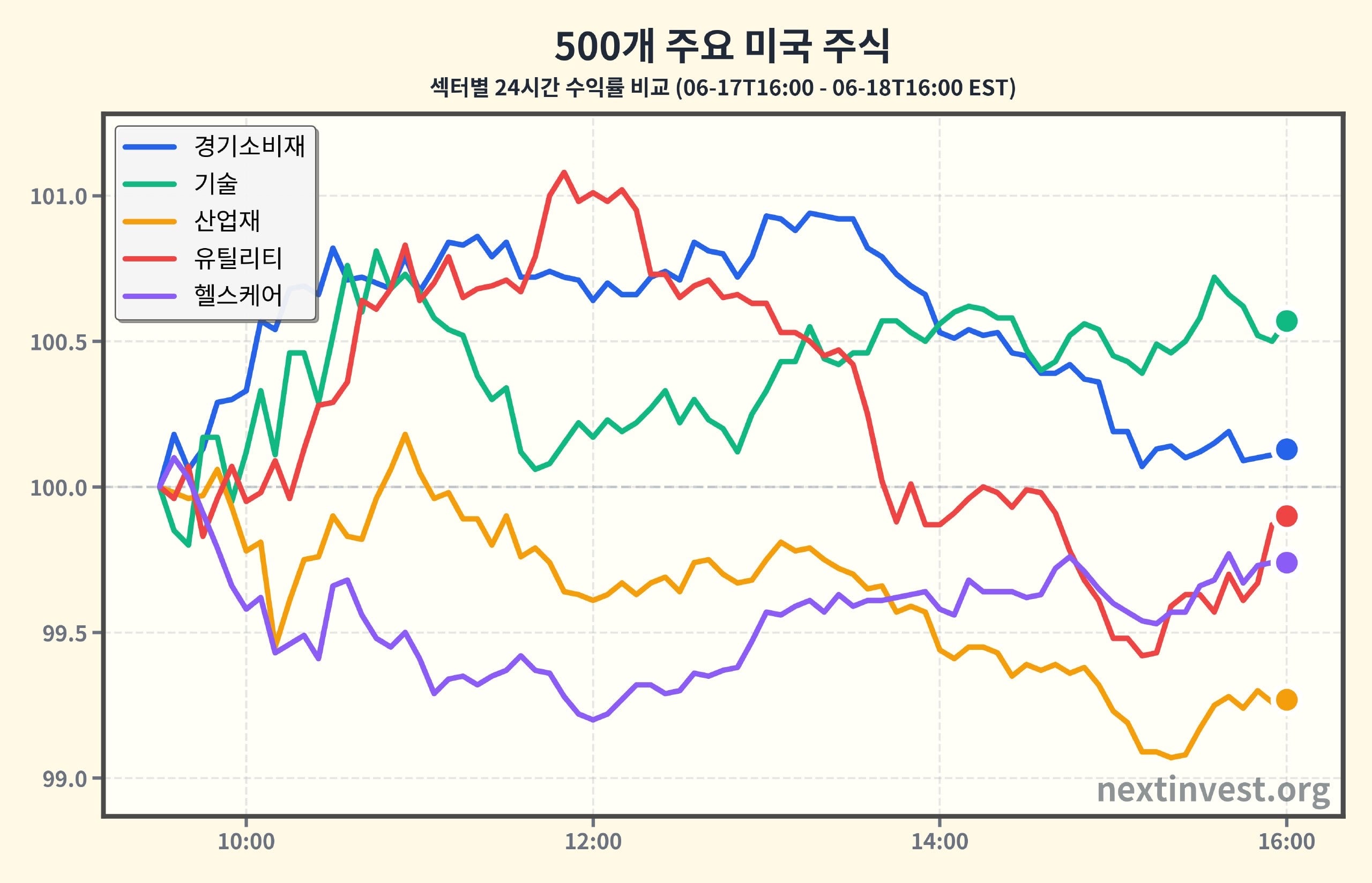
Sector performance over the past 24 hours is as follows.
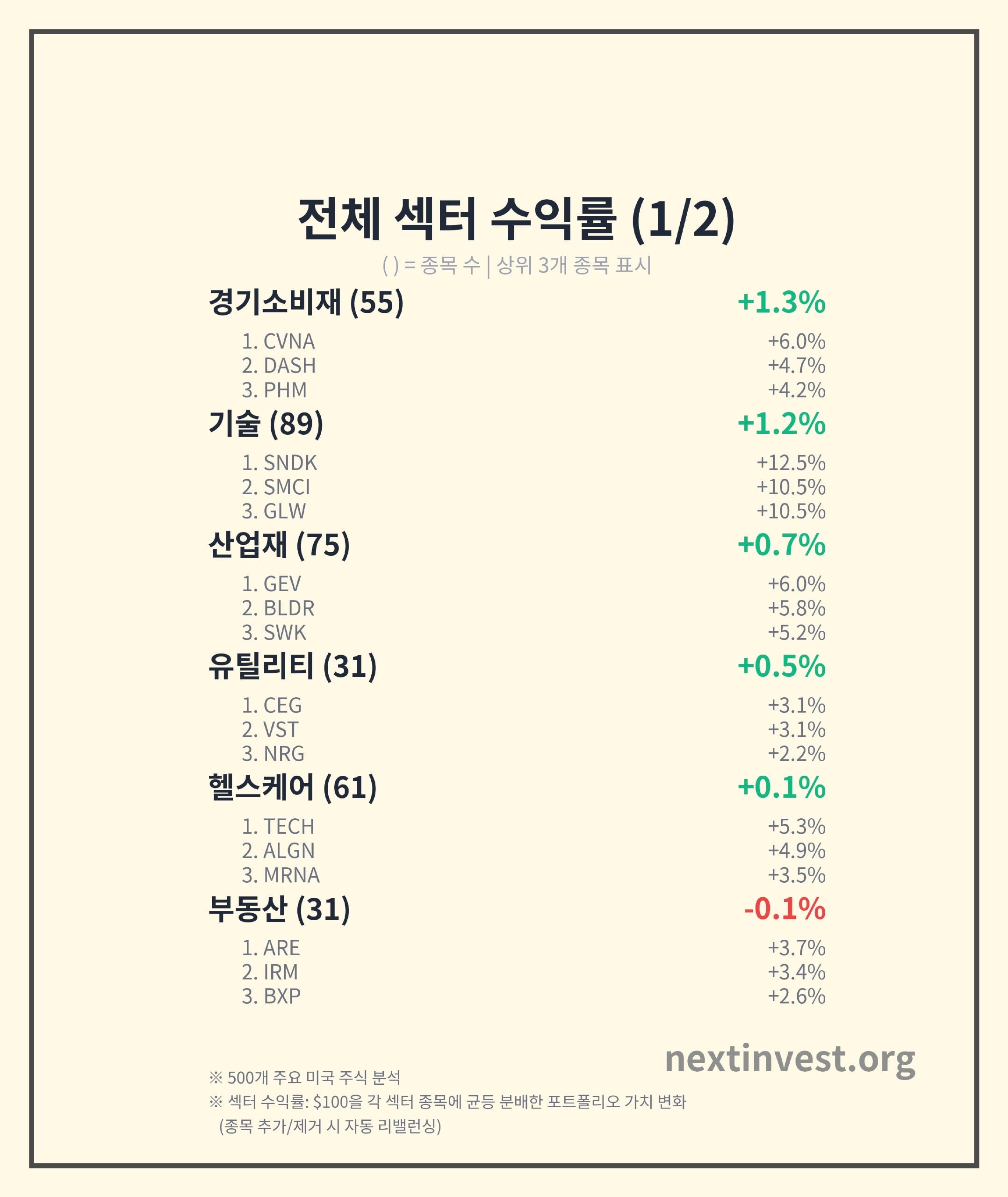
- Rising Sectors (5/11): Consumer Cyclical, Technology, Industrials, Utilities, Healthcare
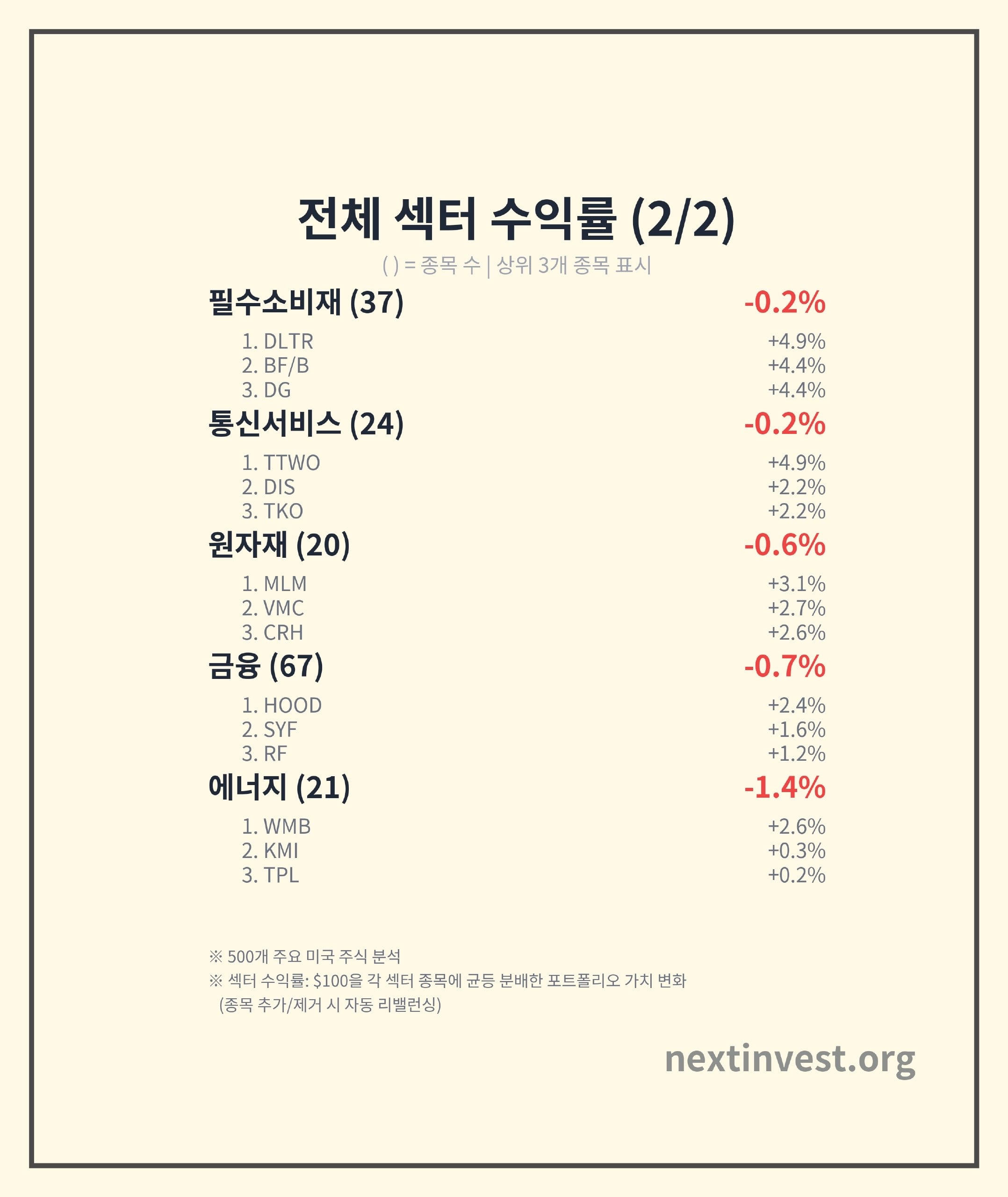
- Falling Sectors (6/11): Financials, Communication Services, Consumer Staples, Real Estate, Materials, Energy
- Leader: Consumer Cyclical +1.29%
- Laggard: Energy -1.43%
Looking at the 7-day return pattern:
- Technology and Consumer Cyclical: Repeated ups and downs throughout this week, but overall trending upwards
- Energy: Has been declining almost daily since June 12th, with four consecutive days of negative returns until today.
Overlaying the 60-day trend (sector portfolio analysis):
- Technology: +33% increase since late March, a slight rebound since early June after a correction (up +3.33% in this period)
- Energy: -10.8% the only double-digit decline since late March, down -10.86% since May 18th
In essence, today's trend reaffirms the larger picture of "tech strength and structural weakness in energy" that has been evident for the past few months.
---
## 3. Tech Stocks: Rebound After Fed Shock 'Bargain Sale'
### 3-1. What Happened Today?
The technology sector led the market today with a +1.20% increase.
- Considering that yesterday's Fed decision to freeze interest rates while hinting at further hikes by year-end significantly shook growth stocks,
- Today's rebound can be attributed to "buying the dip" after a perceived excessive decline. (newsquawk.com)
There were extreme highs and lows within the sector.
- Strong Performers:
- Sandisk (SNDK): +12.47%
- Super Micro Computer (SMCI): +10.50%
- Corning (GLW): +10.46%
- Weak Performers:
- Accenture (ACN): -17.97%
- EPAM Systems (EPAM): -12.61%
- Cognizant (CTSH): -10.49%
SMCI·SNDK·GLW are all classified as investment beneficiaries in AI infrastructure and data centers. Today, the market expectation that "the AI facility investment cycle is still ongoing" is strong. This is also supported by reports and market comments that buying has been flowing into semiconductor and AI-related stocks throughout the week.
On the other hand, IT consulting/service companies such as ACN·EPAM·CTSH have faced concerns about the Fed's hawkish stance and the possibility of a slowdown in corporate IT budgets and digital transformation projects. Some analysts have already warned that profit-taking could occur in stocks with high valuations.
### 3-2. Looking at the flow over the past week and two months
- Last 7 days: Tech stocks rose +1.05% on June 12th and +2.09% on June 15th, followed by a consecutive decline of -1.83% and -1.40% on the 16th and 17th, respectively, and rebounded +1.20% today.
- Last 2 months: From 100 on March 25th to 133.30 today, a sharp rise of +33.3%. After a slight adjustment (-6%) in mid-May, it quickly rallied again in early June.
Summary:
- Short term (7 days): Recovering the momentum that was broken by the Fed shock the previous day
- Medium term (60 days): 'Noise' adjustment within a still strong upward trend
Meaning for investors
- Tech stocks have already risen significantly, so volatility is increasing due to interest rate and earnings news.
- AI and semiconductor related stocks still have valid growth stories, but prices are high, so ±10% daily movements are natural.
---
## 4. Consumer Cyclical: 'Consumption is still resilient' despite interest rate burden
The Consumer Cyclical sector led the 11 sectors today with a +1.29% gain.
- Representative stocks:
- Carvana (CVNA): +5.95%
- DoorDash (DASH): +4.71%
- PulteGroup (PHM): +4.17%
These stocks are commonly highly sensitive to US consumption and interest rates.
- Used cars, delivery, housing, etc. are all areas directly affected by the economy and interest rates,
- Today's rise reflects expectations that "the Fed may be somewhat hawkish, but it will not tighten enough to trigger an immediate economic downturn."
Recent research also suggests that the risk of consumption slowing down is increasing, but data remains relatively resilient until the second quarter.
### Short-term and medium-term trends
- Over 7 days:
- +1.03% on June 15th, +0.10% on June 16th, followed by a sharp drop of -2.18% on June 17th, and partial recovery today with +1.29%
- Over 60 days:
- The total return rate since the end of March is only +2.82%, but
- A gentle upward trend (+4.30%) has continued since May 21st.
In other words, the picture is that "although there is a burden of energy and raw materials, consumption itself is still holding up."
Meaning for you
- Fear regarding consumer-related stocks such as travel, dining out, and online services has eased somewhat compared to last month.
- However, keep in mind that this sector is likely to be the first hit if the Fed raises interest rates further.
---
## 5. Energy: The sector pressed down by oil prices, demand, and policy all at once
The energy sector was the worst performer today with -1.43%.
- Sector stock examples:
- Williams (WMB): +2.62% (Natural gas and pipeline focused)
- Kinder Morgan (KMI): +0.29%
- Texas Pacific Land (TPL): +0.18%
While the index saw a significant decline, infrastructure and pipeline focused defensive stocks performed relatively well.
Two factors are converging in the bigger picture.
1. Oil price and Middle East risk easing
- The recent announcement of an agreement between the US and Iran to end the war and reopen the Strait of Hormuz has significantly reduced supply disruption concerns.
- This acts as a factor pushing down crude oil prices. (apnews.com)
2. Global demand slowdown concerns
- Some investment banks have lowered their Brent crude oil price targets, citing a slowdown in consumption in the US and Europe, particularly forecasting economic weakness in the second half of 2026. (za.investing.com)
These two factors combined have resulted in energy stocks experiencing a "war and supply anxiety premium decline" over the past two months.
- March 25th at 100 to today at 89.19, a -10.81% decline
- Particularly since May 18th, there has been no trend reversal and a -10.86% decline
- A continuous decline over the past 7 days, with June 15th at -3.25%, June 17th at -1.19%, and today at -1.43%
What it means for you
- While there may be short-term rebound potential, the strategy of viewing energy stocks based on the premise that oil prices will continue to soar as before is already risky.
- Instead, a more defensive approach focused on infrastructure/midstream companies with stable dividends and cash flow is becoming increasingly prevalent.
---
## 6. Finance, Communication, Consumer Staples: Quiet Adjustments
Today, finance, communication services, consumer staples, real estate, and materials all experienced slight declines.
- Finance (-0.73%):
- While the possibility of further Fed rate hikes could help margins in the long term for banks,
- it also raises concerns about slowing loan demand and increased default risk.
- Over a 60-day period, it has outperformed with +9.72% and remains in an upward trend (+5.34%) since June 3rd.
- Communication Services (-0.16%):
- Some large media, gaming, and entertainment companies (TTWO, DIS, TKO) performed well today,
- but overall, the sector has been in a downward trend (-7.35%) since June.
- Consumer Staples (-0.16%):
- While its defensive nature prevented it from a significant decline,
- it has entered an adjustment phase (-3.43%) since June 12th.
In summary, today was:
- Less about "major news" and
- More about a period of consolidation in sectors that appeared expensive, given existing concerns about interest rates, consumption, and valuations.
---
## 7. Mid-Term Trends: Where is Structural Strength?
Looking at the total sector returns over a 60-day (approximately 3-month) period:
- Strong Sectors:
- Technology: +33.30%
- Real Estate: +10.22% (recently in an adjustment phase)
- Finance: +9.72%
- Industrials: +7.11%
- Neutral to Weak Sectors:
- Materials: +3.82% (recently in a slight decline)
- Healthcare: +3.50% (increased volatility in the past week)
- Consumer Discretionary: +2.82%
- Consumer Staples: +1.94%
- Utilities: +0.13%
- Lagging Sectors:
- Communication Services: -1.32%
- Energy: -10.81%
Big Picture Message:
- Sectors directly connected to AI and digital transformation (technology, some industrials) are structurally strong,
- Traditional cyclical and commodity-sensitive sectors (energy, some materials) continue to face structural headwinds.
---
## 8. How Should I View My Portfolio?
Finally, here are some practical portfolio checkpoints based on today's news.
1. If your technology exposure is already high
- Today's rebound is welcome, but
- It may be time to consider some profit-taking and diversification rather than piling into a sector that has risen +33% over the past three months.
2. If you hold energy stocks
- A significant portion of the recent decline is due to structural changes driven by the unwinding of war risk premiums and concerns about slowing demand.
- Rather than pinning hopes on a short-term rebound, it's important to re-evaluate your reasons for holding these stocks, focusing on dividends and cash flow.
3. If you are interested in consumer-related stocks
- Consumption hasn't plummeted sharply yet, but scenarios of a slowdown in late-year and next year economic growth are increasingly being discussed.
- A strategy focused on selecting high-quality brands with strong cash flow appears crucial.
4. If you hold interest rate-sensitive assets (real estate, dividend stocks, growth stocks) together
- The Federal Reserve's signal that "giant steps are off the table for now, but tightening will continue"
- Increases short-term volatility for these assets.
- It's advisable to check the balance between sectors and styles in your portfolio so that it doesn't move uniformly in response to interest rate news.
---
## 9. Summary: Today's One-Line Takeaway
- Despite the Fed's hawkish message, the market is betting on "growth not dead yet" and buying up technology and consumer sectors.
- Energy and some cyclical sectors, on the other hand, continued their weakness, reaffirming structural headwinds.
Rather than chasing short-term rallies, it's more meaningful to assess which sectors are structurally losing strength and which sectors will have valid stories three months or a year from now.
This content is for informational purposes only and does not constitute investment advice on any specific security or asset.
Source: https://nextinvest.org/ko
Feel free to share ^^