
Since this is a translation of an overseas article, there may be mistranslations.
https://hothardware.com/news/snapdragon-8-elite-extreme-gen-6-release
Snapdragon 8 Elite Extreme Gen 6 Supports Neural Fusion Gaming and Wi-Fi 8 Up to 5GHz

Qualcomm unveiled two new members of the Snapdragon 8 Elite lineup at today's Snapdragon Summit event, launching next-generation flagship smartphone silicon. Both the Snapdragon 8 Elite Gen 6 and the top-of-the-line Snapdragon 8 Elite Extreme Gen 6 are manufactured on an unspecified 2nm process and feature a new generation of Qualcomm custom Orion CPU, Adreno GPU, Hexagon NPU, Spectra ISP, and advanced connectivity hardware.
While both chips are very similar at the CPU and platform level, the Extreme model differentiates itself with a more powerful GPU and expanded multimedia capabilities. Both chips feature an 8-core Orion CPU consisting of two prime cores operating up to 5GHz and six performance cores operating up to 4GHz, and offer 16MB of new Qualcomm Orion Flex Cache. Qualcomm describes its 5GHz Orion design as the first mobile CPU to reach that clock speed.
Orion CPU Reaches 5GHz
The Orion CPU retains the basic two prime and six performance core configuration used in previous Snapdragon 8 Elite processors, but Qualcomm has redesigned the CPU subsystem around a new cache architecture called Flex Cache, which provides a dynamic allocation shared cache pool accessible by heterogeneous CPU cores.
Qualcomm explains that instead of being limited by fixed cache allocations, prime cores can now utilize the entire cache when needed. This allows for larger workloads to remain in the CPU cache without resorting to external memory, reducing latency and memory traffic.
Both the Snapdragon 8 Elite Gen 6 and Elite Extreme Gen 6 feature 16MB of Orion Flex Cache. The Extreme model's CPU is not simply a faster version of the standard Gen 6; both models are specified with the same maximum CPU frequency and cache capacity. Additionally, these chips support up to 24GB memory configurations with LPDDR5X and LPDDR6 memory at speeds up to 5,300MHz (10.6Gbps DDR) and also support UFS 5.0 storage.
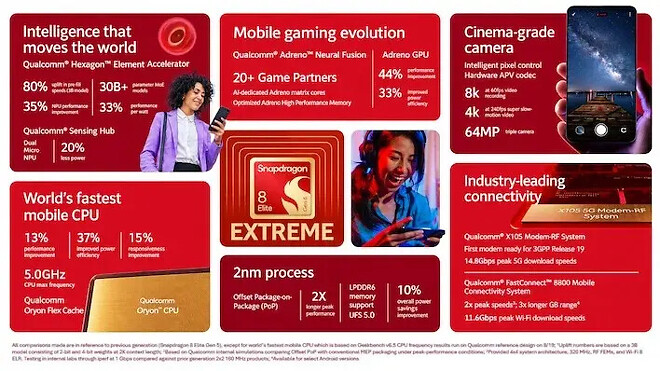
While Qualcomm did not specify the memory bus width or resulting peak memory bandwidth for both processors, it did state that CPU performance improved by 10% and 13% over the previous generation for the Elite and Elite Extreme, respectively. These gains are in line with expectations from a slight clock increase and cache improvements. More impressive is the efficiency improvement, as Qualcomm claims CPU power efficiency has increased by 37% compared to the previous generation. This is largely due to the move to the 2nm process but remains a very impressive result.
Hexagon NPU Targeting Agent AI
Qualcomm is placing a lot of emphasis on agent AI, where AI systems process multiple steps, tools, and tasks beyond simple single-prompt response generation, in this new generation. The revised Hexagon NPU features 12 scalar units, 8 vector units, and 1 tensor unit, along with new element accelerators specifically designed for transformer workloads. Qualcomm also highlights key features such as Hexagon Direct Link, micro-tile inferencing, and 64-bit memory virtualization.
Qualcomm has not explicitly stated the absolute memory size of the new NPU, but it has revealed that it provides a shared memory subsystem that is 50% larger than the previous generation. The expanded local memory appears to be designed to keep model states, activations, and intermediate tensors closer to the NPU, thereby reducing the number of transfers to external system memory. Qualcomm explains that the resulting architecture is designed for longer context windows, concurrent workloads, and low-latency action loops where agents can repeatedly perform inference, call tools, process results, and continue tasks.
Furthermore, Qualcomm is positioning this NPU to enable the execution of significantly larger on-device models. The platform claims to be capable of running MoE (Mixture-of-Experts) models with over 30 billion parameters, and as an example, it states that approximately 3 billion routed parameters are activated for each token generation step. It's important not to interpret this claim as equivalent to running a dense model of 30 billion parameters with the full operational cost, as MoE models do not execute all parameters for every token.

For INT4 models, Qualcomm claims up to 50% higher prefill performance along with faster decoding, enhanced speculative decoding, and a higher tokens per second rate. As part of its efforts to support a wide range of local AI model categories, it emphasizes the broad precision range from INT2 to FP16 (including mixed precision).
The Hexagon NPU is not the only AI processor within the platform. Qualcomm's new Sensing Hub includes a dual micro NPU, designed to process all types of sensor information while maintaining low power consumption. Qualcomm states that the new micro NPU supports models with less than 20 billion parameters and provides 85% higher performance and 20% better efficiency. The Sensing Hub also supports Qualcomm's Personal Scribes and personalized knowledge graph generation. Excluding privacy concerns, this sounds remarkably similar to a mobile version of Windows 11 Copilot.
Adding Dedicated AI Hardware for Neural Fusion to Adreno
The most significant improvements between generations and the biggest architectural differences between the two Snapdragon 8 Elite 6th generation processors are all found on the graphics side. While the standard Snapdragon 8 Elite 6th generation utilizes a next-generation Adreno GPU with Qualcomm's high-performance memory architecture, the Elite Extreme 6th generation adds dedicated Adreno Matrix cores. Qualcomm describes the Matrix cores as AI-dedicated GPU cores designed to directly execute advanced AI models within the graphics pipeline, similar to NVIDIA's Tensor Cores.
These Matrix cores form the foundation of Qualcomm's new Adreno Neural Fusion technology. Neural Fusion combines AI processing to directly perform super resolution and frame generation within the graphics pipeline. This is directly analogous to NVIDIA's DLSS or Intel's XeSS, making it very familiar to the public. Qualcomm makes bold claims about the quality and performance of Neural Fusion and we look forward to testing it directly. Notably, this technology is supported through Unity, Unreal Engine, and other development environments, allowing developers to integrate its functionality without creating separate rendering pipelines.
The GPU in the Extreme model includes 18MB of Adreno High-Performance Memory (HPM) in its entirety. Qualcomm describes HPM as a low-latency memory structure tightly integrated with the GPU, keeping tiles, frame buffers, and computing data local to the graphics subsystem instead of repeatedly transferring them through system memory. The new Adreno architecture utilizes three GPU slices, and Qualcomm states that the combination of local memory and dedicated Matrix cores is designed to reduce both latency and power consumption.

In terms of performance, the chip manufacturer claims that the GPU performance of the Elite and Elite Extreme models has improved by 35% and 44%, respectively, compared to the Snapdragon 8 Elite 5th generation. This is accompanied by an impressive 40% improvement in GPU power efficiency compared to the previous generation. This means that the Snapdragon 8 Elite 6th generation actually consumes less power, while the Extreme model uses slightly more power due to the added silicon volume, but it remains within expectations.
Furthermore, the Elite Extreme 6th generation adds support for advanced graphics optimization in Unreal Engine 5 with new MegaLight features, including hardware acceleration ray tracing for Lumen Global Illumination and Nanite virtualized geometry. The standard 6th generation model retains support for these later graphics technologies, but it appears that the Extreme model's Neural Fusion feature set and MegaLight support are not available.
Spectra Takes Mobile Video Technology to New Heights
Both processors feature Qualcomm Spectra image signal processors with a triple 20-bit AI ISP, Elite Color Engine for real-time 3D LUT support, and the latest HDR sensor technology. The image pipeline is said to support up to 64 megapixel triple camera operation without a shutter lag, up to 180 million pixel single camera operation without a shutter lag, and still image capture of up to 320 million pixels.
The ISP also provides significantly more AI processing capabilities. Qualcomm specifies 16 bits of AI data per pixel, enhanced AI video segmentation at 4K60, and real-time AI skin and sky tone adjustment at 4K60. The system can perform AI-assisted noise reduction, including Bayer multiframe processing, and supports 4K60 ultra-low light video capture.

The Extreme model significantly expands the video capabilities of the platform. While the Snapdragon 8 Elite 6th generation supports 8K video recording at 30 frames per second and 4K slow motion capture at 120 frames per second, the Elite Extreme 6th generation pushes these to 8K60 and 4K240 respectively. The Extreme model also adds support for advanced professional video codecs developed through a long-standing close collaboration with Samsung.
Spectra ISP works closely with Hexagon to provide significantly more granular AI information during image processing. Qualcomm describes this as providing up to 256 times more granular AI data per pixel, although the exact criteria for this comparison are not clear. It is estimated that the precision of AI tag data has changed from 8 bits (256 values) to 16 bits (65,536 values), but it is not confirmed.
A New Connectivity for the 5G Advanced Era
Both Snapdragon 8 Elite 6th generation platforms integrate Qualcomm X105 5G modem-RF system, which supports peak downlink speeds of 14.8Gbps and peak uplink speeds of 4.2Gbps. This represents an approximately 18% faster downlink speed and 14% faster uplink speed compared to the previous generation X85 modem. The X105 supports 5G Advanced, standalone and non-standalone modes, millimeter wave and sub-6GHz connectivity, carrier aggregation with up to 8 millimeter wave carriers, up to 500MHz downlink bandwidth (25% increase over the previous generation), 4-layer uplink carrier aggregation, 1024-QAM in sub-6GHz, and a 6 antenna receive configuration.

Qualcomm also stated that the X105 is hardware ready for 3GPP Release 19 and supports both NB-NTN and NR-NTN, providing satellite connectivity paths using cellular standards. The integrated 5th generation Qualcomm 5G AI processor provides additional AI-based network optimization, and the modem supports global 5G bands and Qualcomm's Turbo DSDA multi-SIM technology.
The wireless connectivity subsystem received a significant upgrade through Qualcomm FastConnect 8800. The new system uses a 4x4 design and simultaneous multi-link operation to support peak PHY speeds of Wi-Fi 8 and 11.6Gbps. Additionally, FastConnect 8800 integrates Bluetooth 6.0, Bluetooth channel sounding, Qualcomm's high-speed data processing technology, ultra-wideband, and Thread 1.4 for exceptional versatility. Qualcomm positions these technologies as part of a broader effort to enable smartphones to recognize their surroundings and interact with surrounding devices, rather than simply providing higher wireless throughput.
Two Flagships, One New Platform
The Snapdragon 8 Elite 6th generation family is about more than just a dramatic increase in CPU speed. It represents a wide range of improvements across the entire smartphone SoC. The new Orion CPU reaches up to 5.0GHz, delivering up to 10% higher performance in the standard generation and 13% higher performance in the Extreme generation, while Qualcomm claims significantly better power efficiency (37% for both models). In the Extreme model, other areas see larger gains, with the Adreno GPU improving by up to 44% and the Hexagon NPU by up to 35%.
These performance splits explain why Qualcomm is offering two flagship platforms. The standard Snapdragon 8 Elite 6th generation brings new CPU, NPU, connectivity and graphics architecture to a wider range of premium smartphones, while the Extreme model adds specialized graphics AI hardware, additional high-performance GPU memory, Neural Fusion, and higher levels of media functionality that many users may not need.

Motorola is providing the first concrete example of this strategy with the "Motorola Signature 27," which it plans to launch as one of the first smartphones powered by the Snapdragon 8 Elite Extreme Gen 6. This device combines Qualcomm's top-tier mobile silicon with a premium multi-camera system including a 50MP Sony LYTIA 910 main sensor and a 200MP periscope telephoto lens, 7 years of operating system upgrades, a new Bang & Olufsen audio partnership, and an upgraded ArcticMesh cooling system that is heavily emphasized in the press release, suggesting that the new chip could generate significant heat.
As a result, the most important advancements in this Snapdragon generation are not immediately apparent from specifications or technical datasheets. Qualcomm aimed to significantly reduce power consumption while increasing CPU, GPU, and AI performance. It has also added more specialized hardware throughout the SoC to keep data processing close to the engine. The upcoming flagship phone generation will be the ultimate measure of how much this silicon can transform real-world performance, battery life, camera quality, and gaming experiences.
▶ Source: https://hothardware.com/news/snapdragon-8-elite-extreme-gen-6-release