I wrote this post to explain again why I created the household accounting book.
There are always walls we run into when using existing household accounting apps or my data services. Data linking is cumbersome, the details of the lifestyle I really want are not reflected, and most importantly, it cannot fully capture the "real flow of money".
Especially whether you're a single-person household, dual-income earners, or a business owner, our assets don't just roll in a single bank account statement. Corporate cards, self-employed expenses, personal check cards, local currency and traditional market receipts... In the complex web of funds, simple expense records don't provide any solutions.
To solve this problem directly, I am planning and developing a new dimension 2027 Household Accounting Simulator.
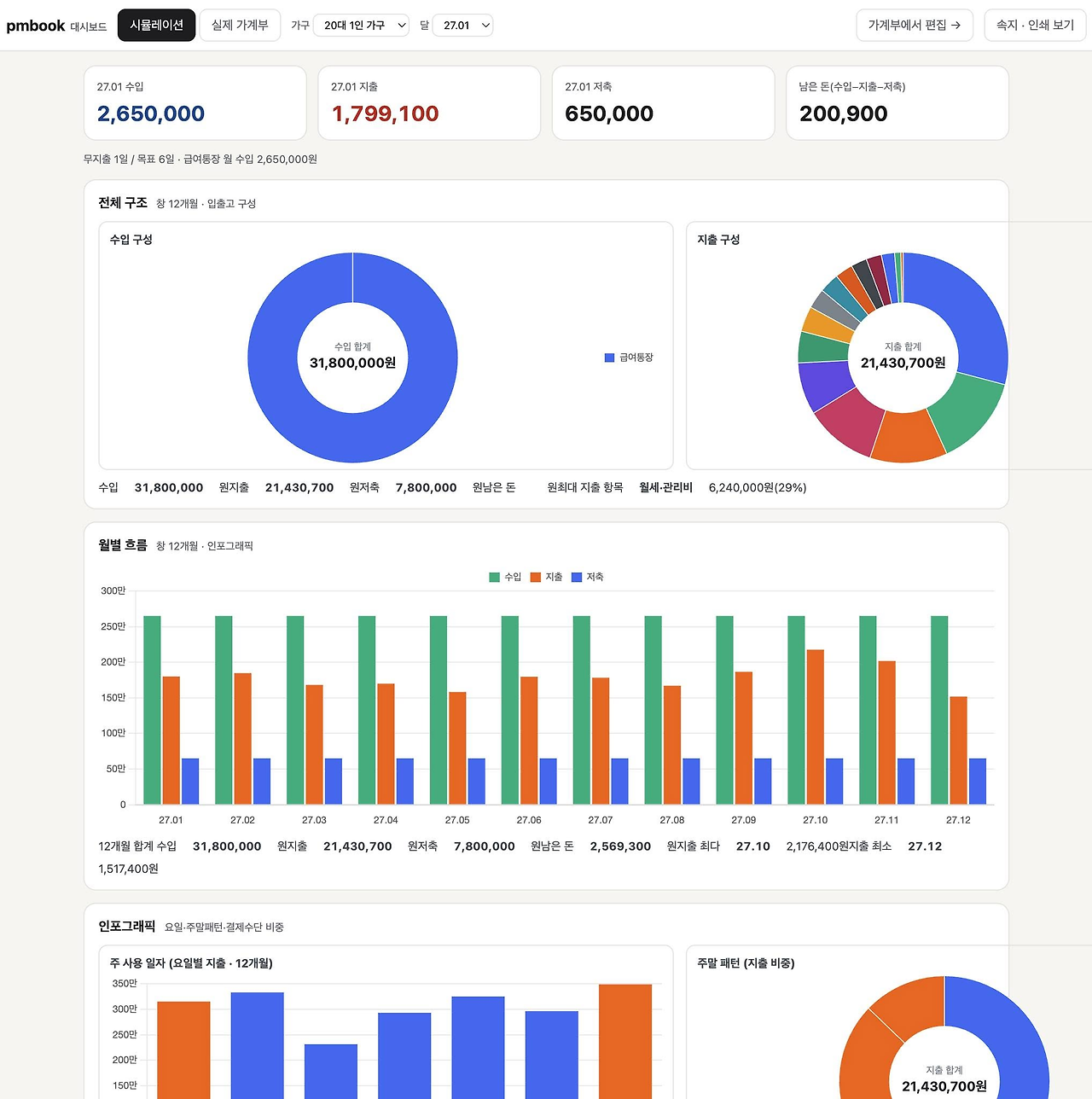
Key Development Points
Lifestyle Customized Design: Beyond simple age division, it reflects the actual lifestyle such as pets, exercise routines, weekly/nightly work patterns.
Separate & Integrated Management of Complex Ledgers: You can freely separate and operate accounts for corporations, self-employed individuals, and pure personal expenses.
Comprehensive Payment Method Coverage: From credit cards and check cards to cash, various payments, points, and gift certificates, it summarizes the complex sources of funds at a glance.
Smart Data Linking: Instead of cumbersome my data procedures, you can easily collect data based on email statements and support Mac/Win cross platforms.
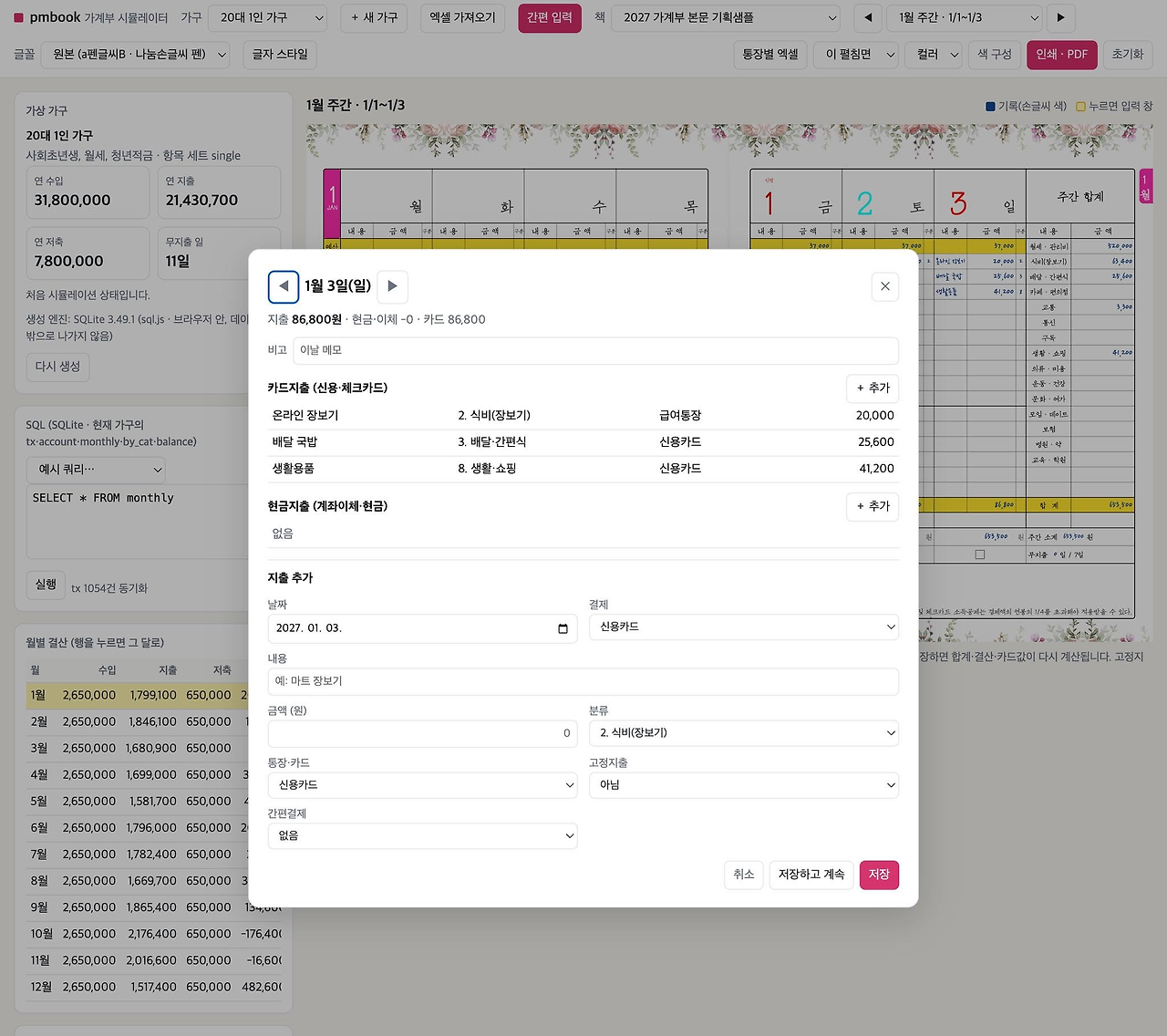
1:1 Matching of Digital and Analog: The data on the screen is 100% matched with the actual paper household account book, so you can maintain the feeling of directly writing and recording with POD printing or a printer.
10-Year Asset Design & Tax Optimization Simulation: By allocating individual and family consumption like Tetris, you can optimize year-end tax settlement and deductions, and simulate the cash flow for the next 10 years.
Household accounting is no longer a simple expense record that individuals write alone. It should be a financial design platform that designs the future of a family and a control tower that coordinates complex taxes and expenses in reality.
Mom's Record Household Account Book, and a Simulator Determining a Family's Future
1. Problem Definition: Why do household accounting books fail to last past January?
Anyone who has tried keeping a household account book in South Korea has probably had a similar experience. At the beginning of the year, they enthusiastically buy a pretty diary or install the latest my data household accounting app, but they stop after just two months.
The reason is simple. Until now, household accounting books have only forced "recording (Past)" and failed to show "design (Future)".
Fatigue of Receipt Tracking: Manually entering individual expenses like 4,500 won for coffee and 38,000 won for groceries doesn't provide an answer to "How should I live tomorrow?", only leaving behind reflection and guilt.
Unrealistic Data Linking: Scraping or my data may seem convenient, but it blindly retrieves approved transactions without filtering the context behind payment methods (separation of corporate/personal expenses, cash and points, gift certificates, Zero Pay, etc.), ultimately leading to double work as people have to manually sort them out.
Ignoring Family Complexity: Unlike the simple expenses of a single-person household, the cash flow of a 4050 family is comparable to that of a large corporation. There's a web of interconnected issues involving Dad's corporate card for his business, Mom's household expenses, children's academy fees, support for both parents, tax optimization, and year-end settlement.
For Moms to become the actual CFO (Chief Financial Officer) of a family, they need a "control tower" that separates corporations from households and looks 10 years ahead, not just a simple expense record.
2. Paradigm Shift: From 'Recording Tool' to 'Life Simulator'
The 2027 Household Accounting Project completely redefines the concept of household accounting.
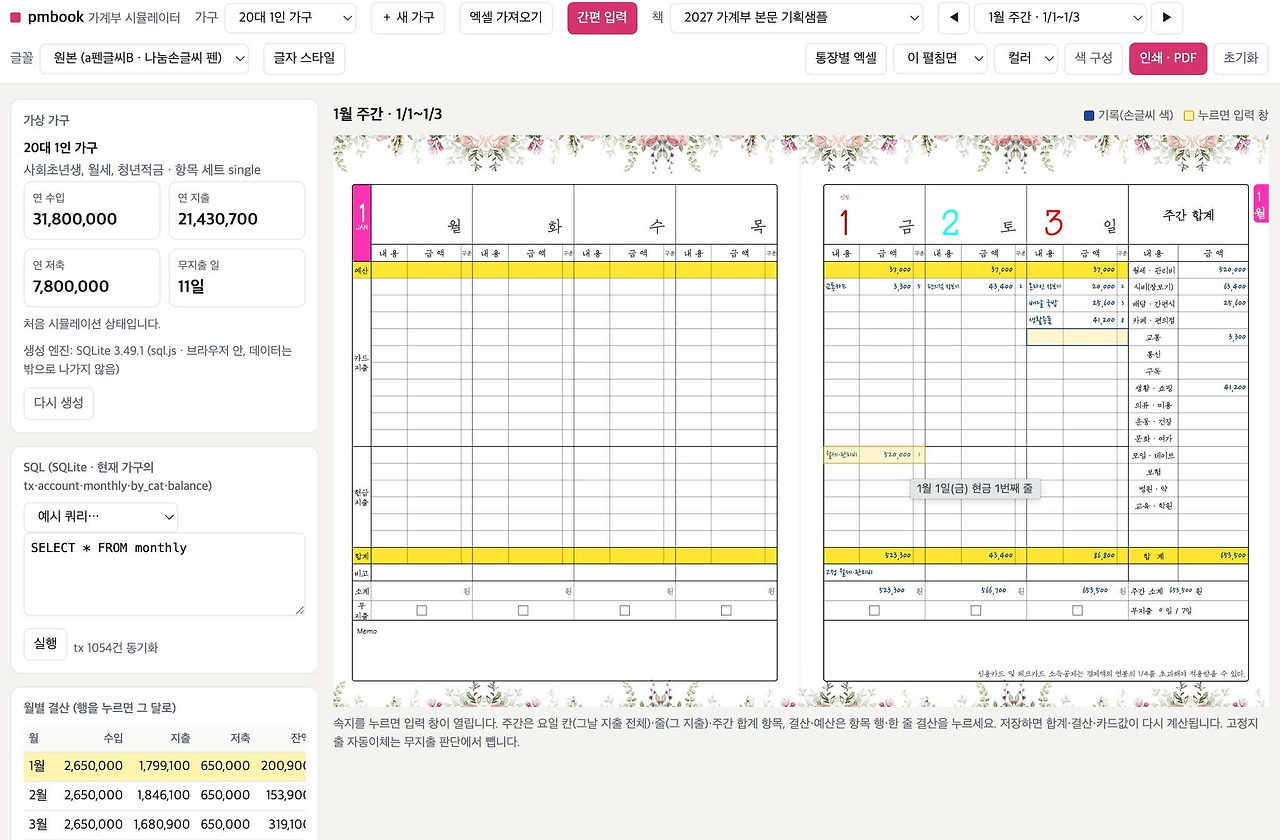
"A household accounting book should not be a diary for reflecting on the past, but a blueprint for simulating our family's next 10 years."
Like a dashboard on the screen (monthly income of 2,650,000 won, annual expenses of 21,430,700 won, savings of 7,800,000 won), the meaning of the remaining 200,000 won each month is not just a simple balance. This small surplus should be visualized in real-time how it interacts with housing loan repayment, college tuition for children, and retirement funds for parents in 5 or 10 years, so that consumption priorities can finally be determined.
3. Core Architecture and Solutions
① Organic Separation and Integration of Corporations, Individual Sole Proprietorships, and Household Budgets
The biggest concern for self-employed individuals, corporate executives, and freelancer households is 'mixing business money and household money.'
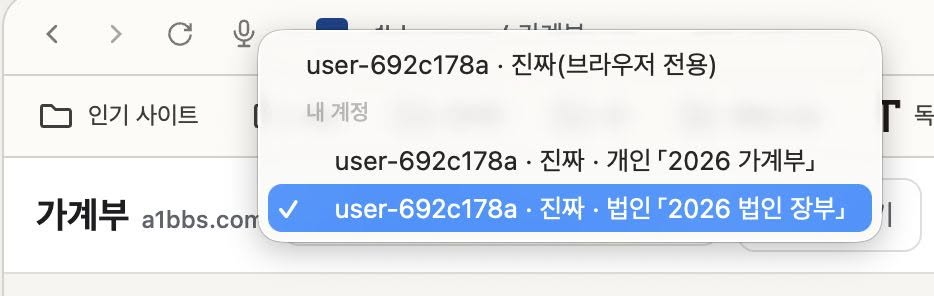
With a single account switch, you can strictly separate and operate corporate books and personal household budgets, while simultaneously summing them into one unified view for simulating the household's overall cash flow.
② Lifestyle Pattern-Based Templates
Spending structures vary completely depending on lifestyle habits: 20-year-old single households, 40-year-old four-person households, pet-owning households, shift/night-shift worker households, and so on.
Categories are automatically optimized to match age and lifestyle patterns, so there's no need to waste energy entering unnecessary items.
③ Payment Methods Designed Like Fitting Tetris Blocks & Tax and Year-End Settlement Optimization
Credit cards, debit cards, bank transfers, cash receipts, local currency, point payments, and more.
Rather than simply 'how much was spent,' the system simulates how to distribute payment methods with different deduction rates—like fitting Tetris blocks—to maximize year-end tax refunds and capture tax savings benefits.
4. Family's Future Completed at Mom's Fingertips
When mom picks up a pen or opens a tablet to enter numbers, it's not merely confirming expenses.
"If we adjust this year's spending structure by 5%, how much operating capital buffer will dad's company have in 3 years?"
"If we maintain the current savings rate, how will our household's net asset trajectory change 7 years from now when our child enters high school?"
A household budget doesn't end on a desk; instead, it becomes the most realistic and powerful tool for weaving a 10-year safety net for an entire family. That's exactly why we're creating 'Mom's Record Household Budget Simulator.'
It's a 4 core persona by life stage and 60-year financial and life simulation model designed by combining the human life cycle (birth, aging, illness, death) and the cyclical flow of the 60 Heavenly Stems and Earthly Branches (4 pairs of 15 years each, totaling 60 years of adulthood and completion).
Introducing ERP concepts to household budgets: Adopting individual systems from the past 20 years into homes
When the core architecture of enterprise ERP (Enterprise Resource Planning) is transplanted into household budgets, it transcends a simple expense ledger to become a 'mini ERP for homes (Household Resource Planning)' and a powerful asset simulator.
This is a design plan that maps ERP's core modules (FI financial accounting, CO management accounting, MM material and inventory management, HR/SD resource allocation) to the 2027 household budget architecture.
1. ERP ↔ Household Budget Module Mapping Architecture
[ ERP Enterprise Modules ] [ Home ERP (2027 Household Budget) ] 1. Multi-Company (Multi-Company) ───> Corporation, Individual Sole Proprietor, Pure Household Separate/Integrated View 2. FI (Financial Accounting / External Audit & Tax) ───> Voucher-Based Payments (Card/Cash/Tax Invoice) & Year-End Settlement Optimization 3. CO (Management Accounting / Cost Analysis) ───> Cost Center Analysis by Family Member and Purpose 4. MM (Material & Inventory / Depreciation) ───> Durable Asset Depreciation & Refrigerator/Daily Supplies Inventory Waste Prevention 5. Rolling Forecast (Management Forecast) ───> 10-60 Year Life Cycle Cash Flow Runway Simulation
2. Detailed Design and Implementation Method
① Multi-Entity (Corporation, Individual Sole Proprietor, Household Multi-Tenant)
ERP Concept: Within a single ERP system, separate the books of holding companies, subsidiaries, and overseas corporations while producing consolidated financial statements.
Household Budget Application: Completely separate [Corporate Books] / [Individual Sole Proprietor Books] / [Household Budget] via toggle at the top. Inter-company Transfer Processing: Flow where the corporate representative (dad) draws dividends and salaries from the corporation to the household, or puts household funds into corporate temporary loans are automatically offset as 'fund transfers' without double-counting. Mom defends against company risks transferring to the household by viewing the household's overall 'consolidated profit & loss/cash flow view.'
② Cost Center & Profit Center (Management Accounting-Based Expense Control)
ERP Concept: Allocate budgets by department and project, and control variance by comparing against actual expenditures.
Household Budget Application: Instead of expense items (food, transportation), classify by 'beneficiary (Cost Center)' center: CC-01 Child A (Learning/Childcare) CC-02 Pet (Food/Vet/Care) CC-03 Dad (Self-Development/Sales) CC-04 Shared (Housing/Food/Telecommunications) Assign codes to specific projects (e.g., PJ-2027 Moving, PJ-Dental Correction) so temporary large expenses don't distort monthly operating costs, using management accounting-style separate aggregation.
③ Tax Engine (Tax Optimizer & Tetris Payment Routing)
ERP Concept: VAT input tax credit, expense recognition limits, corporate tax reduction optimization.
Household budget application: Payment method routing: Real-time tracking of whether the credit card income deduction threshold (25% of total salary) is reached. Before reaching 25%: Priority allocation of credit cards for benefit picking. After reaching 25%: Automatic guidance of payment methods to check cards with high deduction rates (30%), traditional markets and public transportation (40%), and cash receipts. For business owners, filtering of eligible supporting documents (tax invoices, business cards) and regular household expenses at the tagging stage.
④ Capex & Depreciation (Capital Expenditure for Durable Goods)
ERP concept: When purchasing a 10 million won machine, it is processed as depreciation over a 5-year useful life rather than as a current month expense.
Household budget application: When large expenses such as car purchases, MacBook/home appliance replacements, or interior renovations occur, support for "useful life amortization split" simulation rather than ending the month with a deficit. Each month, distinguishing actual household operational costs (Opex) from asset-related expenditures (Capex) to accurately understand household financial health without distortion.
⑤ Rolling Forecast (10-year Runway Simulator)
ERP concept: Immediately after confirming past results, update remaining quarter and next year's financial forecasts in a rolling manner.
Household budget application: When last month's expense data is finalized, it is linked to the 60-year life cycle table to automatically recalculate the net asset curve for the next 12 months and 10 years ahead. Immediately confirm: "If the current surplus of 200,000 won continues, by how many months will the runway (debt repayment completion point, retirement possible point) be shortened?"
3. User Screen and Output (POD) Workflow
Data ingest (Raw Data): Without API error stress, parse email invoice/card approval mail text and automatically post journal entries in ERP journal voucher format.
ERP journal approval (Mom's review): Verify corporate/personal expense misclassification ➔ Verify Cost Center tag ➔ Close in 1 minute (Month-end Close).
Dashboard & Simulation: Display current month's income statement (P&L), cash flow statement (Cash Flow), 10-year runway forecast graph.
Analog POD printing: Render and print the same precise grid layout as the ERP closing report in actual paper household ledger format (A5/B5) at 1:1 scale. Mom confirms next month's budget limits by cost center in pen on paper.
I have been consistently creating paper-designed household budgets for the past 16 years.