Sunday, September 13, 2026
On Sunday, we wrap up the week.
This week, daily limit-up stocks in AI component companies changed every day from Tuesday's optical telecommunications to Friday's capacitors and security, and the Kospi rose above 7,000 and then fell to 6,909.
Daily limit-up stocks changed every day from Tuesday to Friday
On Tuesday, Light & Electronics, selected for the Ministry of Science and ICT's optical communications component commercialization project, hit the daily limit. On Wednesday, after Corning signed a long-term contract with Verizon for 80 million miles of optical fiber and Amazon Web Services and Qualcomm announced they would jointly develop optical connection technology in a $60 billion partnership, Lumentum rose 11% and Corning rose 8% in the U.S., and domestically, Mercury, an optical communications equipment company, and Ouriro, which makes photodetectors, hit the daily limit, and RF Materials rose 22.6%. On the same day, Bumhan Fuel Cell also hit the daily limit due to expectations of demand for fuel cells for U.S. data centers.
On Thursday, Alpha Chips hit the daily limit on news that affiliated company POSTECH will ramp up its optical semiconductor component business, and TS&E, which supplies probe cards for 6th generation high-bandwidth memory to Samsung Electronics and SK Hynix, rose 14.2% to a 52-week high on Taiwan-based reports that Nvidia preempted production capacity for probe cards and test sockets used to test artificial intelligence chips by paying premium prices.
On Friday, when Samsung Electronics fell 3.53% and SK Hynix fell 2.21%, the daily limit came from capacitors and security. When Murata, the No. 1 multilayer ceramic capacitor manufacturer, announced it would discontinue some product numbers, Amotech hit the daily limit and Samhwa Capacitor rose 18.8%. The previous evening, there was a report that a domestic energy storage company was offered a capacitor supply price double the existing rate. On the same day, when Jensen Huang, Nvidia's CEO, pointed to cybersecurity as the next big market for artificial intelligence at the Goldman Sachs conference, Xgate and Sands Lab and SP Soft hit the daily limit and Alpha Chips hit the daily limit for the second day. On that day, the word cybersecurity was mentioned more than ten times as much as the previous day on the channel.
The U.S. was the same, with four of the top five S&P 500 weekly gainers being wireless chips, optical communications, and servers. On the memory side, there were reports that securities companies estimated Samsung Electronics and SK Hynix's inventory at less than 10 days and that some customers were asking to extend long-term contract periods to five years or more, and Samsung Electronics Chairman Lee Jae-yong disclosed that he would purchase Samsung Electronics shares worth approximately 1.9 trillion won at over-the-counter prices from Honorary Director Hong Ra-hee.
Kospi exceeded 7,000 and closed at 6,909
On Monday, Kospi rose 4.61% and closed at 6,995.39, and on Tuesday, it rose to 7,171.52 intraday but fell to 6,954.52 on news of attacks on Saudi oil facilities. On Wednesday, it closed above 7,000 for the first time since July 23 at 7,051.64, and on Thursday, it was pushed down to 6,898 intraday but held at 7,033.92. On Friday, it fell to 6,802.50 intraday and closed at 6,909.91, up 3.33% for the week compared to last Friday's 6,687.21.
Individuals sold 6.8212 trillion won on Monday, 3.1086 trillion won on Tuesday, and 2.2876 trillion won on Wednesday, putting 12.2174 trillion won on the market over four days, and foreigners, institutions, and other corporations classified as treasury stock purchases bought those shares. From Thursday onwards, individuals bought 2.2459 trillion won over two days while foreigners sold 4.7735 trillion won.
The reasons for the declines were oil prices and interest rates. Wednesday night, Brent crude oil exceeded $100 for the first time since the end of July, and Thursday night, West Texas crude oil also exceeded $100 for the first time since May at $102.48. The U.S. 10-year Treasury yield exceeded 4.85% on Wednesday night when the Treasury set the size of its bond buyback at $6 billion, below expectations, marking the highest in three years, and rose to 4.99% intraday on Friday, the highest since November 2023. With producer prices and expected inflation exceeding expectations, the probability of a Fed rate hike in September rose from the 60% range on Monday to 85-90% by Friday. Nevertheless, the New York stock market rebounded for the first time in four trading days on Friday as oil prices fell on the Houthis' maritime safety announcement, and for the week, the Dow fell 1.6%, S&P 500 fell 0.8%, and Nasdaq fell 0.7%.
Stories about building power plants in the U.S. continued throughout the week
The words that increased the most on the channel compared to last week were nuclear power plants, followed by U.S. investment. On Monday, an exclusive report emerged that Elon Musk's xAI would build a combined-cycle power plant supplying electricity to the Memphis area AI infrastructure using Doosan Enerbility equipment, and the same day was followed by a report that the government's first U.S. investment project was confirmed as a 6.3-gigawatt combined-cycle gas power plant in Encinal, Texas. This is capacity equivalent to around six nuclear power plants. On Tuesday, on a report that construction of eight nuclear power plants locally in the U.S. was being actively reviewed as part of $350 billion in U.S. investment, Korea Hydro & Nuclear Power rose 16.6%, Orbvit rose 29.8%, and Daewoo E&C rose 8.5% on a day when Kospi fell.
On Wednesday, Doosan Fuel Cell rose 19.0% on a 501.4 billion won contract to supply fuel cells to U.S. data centers, and stories circulated that fuel cell demand is rising because gas turbines are hard to source. On Thursday, HD Hyundai Heavy Industries disclosed it would invest 833.6 billion won in high-capacity power generation engine production capacity and 238.6 billion won in a small modular reactor primary equipment factory.
Things said over the weekend
The most widely circulated post was from Dario Amodei, CEO of Anthropic, writing that the industry needs to intentionally slow down the pace of performance improvements in new models. Sam Altman, CEO of OpenAI, responded that he agreed, Elon Musk said Dario was right, and David Sacks, chairman of the President's Council of Advisors on Science and Technology, countered that they were trying to solidify the two companies' monopoly. Reports also circulated that Leopold Aschenbrenner's hedge fund, whose assets under management fell from $4.5 billion to approximately $1 billion due to a July crash, purchased SK Hynix, SanDisk, AMD, and Oracle options worth hundreds of millions of dollars.
President Trump said that the Iran war would end after the November midterm elections and that oil prices would fall sharply. The UK Maritime Trade Organization announced on Sunday morning (Korean time) that a vessel passing through the Strait of Hormuz was hit by a projectile of unknown origin, and while Iran and Oman are expected to soon announce an agreement on a temporary route, they maintain that this is not a full reopening of the strait. Next week, the Fed results will be announced at 3 am on the 17th, and the Bank of Japan is expected to raise interest rates on the 18th. From the 14th, the Korea Exchange after-market will open, and all stocks will be traded until 8 pm. The Chuseok holiday begins on the 24th.
One Week in the US
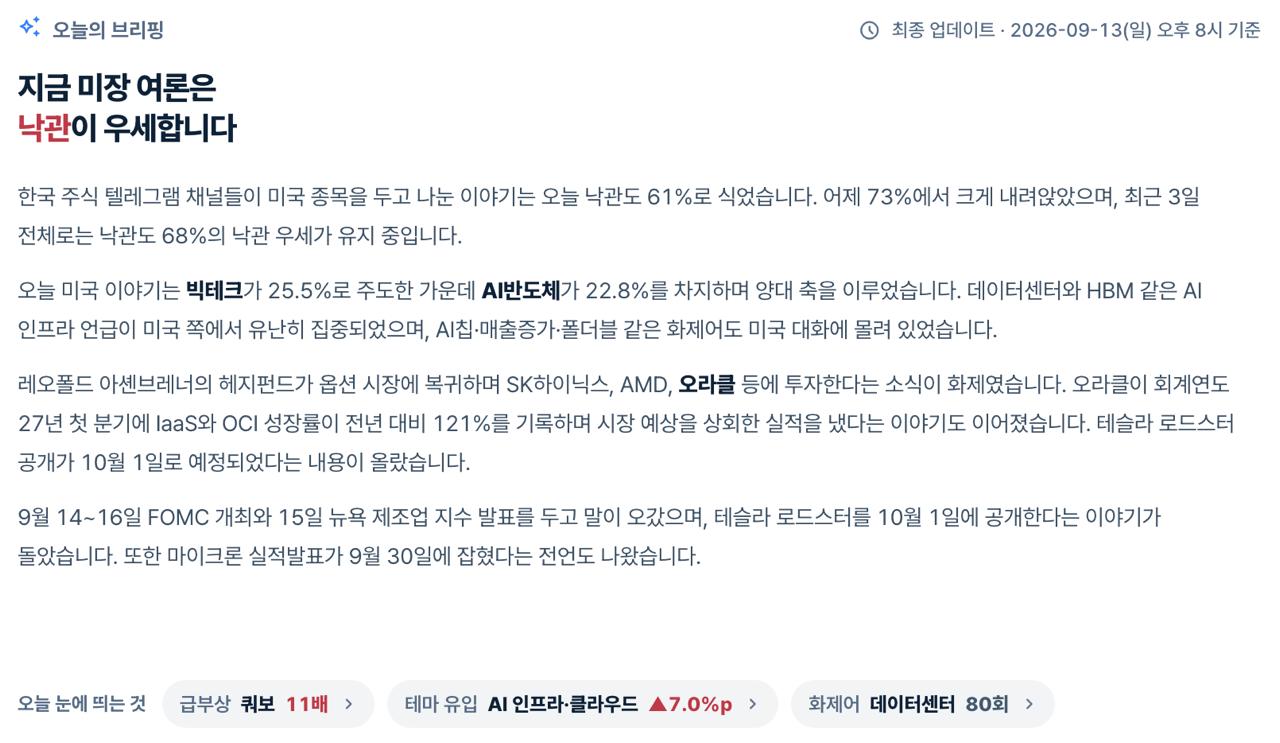
Among US stocks, Nvidia was the most talked about for five days. On Thursday, TSMC and Apple took its place, and on Sunday, Oracle did. Thursday was the day Apple unveiled its first foldable iPhone Duo for $1,999 and TSMC announced monthly record sales of NT$514.8 billion in August. Oracle's quarterly revenue increased by 30% to $19.3 billion, and it delivered more than 300,000 GPUs in a single quarter, three times the previous quarter.
Nvidia is reportedly negotiating a deal to invest up to $10 billion in Antropic's IPO, according to Reuters. Jensen Huang said that AI infrastructure investments of $3 trillion to $4 trillion will become a reality by 2030. Oil prices rose for the week, with West Texas Intermediate crude oil rising nearly 10% and Brent crude oil rising 8.7%, marking the biggest weekly gain since July.
Themes
Domestically, semiconductors remained in first place throughout the week. The second place changed daily: bio on Monday, nuclear power on Tuesday, electrical equipment and wires on Wednesday, shipbuilding on Thursday, and bio again on Friday. In US discussions, AI semiconductors were in first place for five days, with big tech only leading on Sunday. AI infrastructure and cloud computing took second place on Friday after Oracle's earnings release.
Data Included in This Article
Item | Quantity |
|---|
Collection Channels | 320 |
Collected Messages | 31,207 |
Domestic Issue Keywords | 14,261 |
Domestic Theme Aggregation | 26 Themes |
US Theme Aggregation | 16 Themes |
Source: hatzze.fun/kadera
※ The mention volume and aggregation are expressions that indicate how much something is being mentioned, and are for entertainment and reference purposes only, not buy or sell signals. This does not verify the truth of rumors.
▶ Original Source: https://hatzze.fun/