From Monday, August 31, 2026 to Sunday, September 6, 2026
We collect and organize daily conversations from the stock Telegram channel. On Sundays, we wrap up the week.
This week, memory semiconductors were the backbone of the story from beginning to end, and oil prices and interest rates shook things up in between.
SK Hynix jumped 8% in a week of lost market share
Monday's channel was filled with talk of memory supply-demand imbalances and rising price forecasts. On Wednesday, SK Hynix released its progress update on the 4 trillion won share buyback announced last month. Of the announced 24.07 million shares, it purchased 5.2 million shares, completing 21.6%, with an estimated 650,000 shares purchased daily over 8 trading days, putting the completion date at October 16. The total amount spent was approximately 8.782 trillion won.
On Thursday, news circulated that Korea Electric Power suggested Samsung Electronics and SK Hynix pay 25 trillion won in advance for five years of future electricity bills. Samsung Electronics would pay 20 trillion won and SK Hynix would pay 5 trillion won. With debt exceeding 210 trillion won, Korea Electric Power plans to build power grids for Yongin and Honam semiconductor clusters without issuing additional government bonds, while the two companies receive power for their new factories on time and pay interest higher than government bonds.
On Friday, Counterpoint Research released second-quarter high-bandwidth memory market share data. SK Hynix maintained first place with 50% market share by revenue but declined from 58% in the first quarter and 64% in the same quarter last year, losing 14 percentage points over the year. Samsung Electronics increased from 21% to 33%. In the overall DRAM market, China's ChangXin Memory rose from 8% to 10%.
Then on Saturday morning, when the US stock market fell, only memory stocks rose. SK Hynix American Depositary Receipts rose 8.14%, Micron rose 6.10%, and SanDisk rose 11.90%. The catalyst was OpenAI's new model, Astra. With strong performance figures, expectations mounted for increased investment in AI inference infrastructure, and UBS projected memory sales would reach $955 billion this year, up 315% from last year.
Tankers were hit, but oil prices fell within a day
Early Wednesday, two massive tankers were hit in the Strait of Hormuz, and the Financial Times reported that one of them was owned by South Korean shipping company Jang Geum Sang. Brent crude rose to $92.24 per barrel while gold fell below $4,400 per ounce. Reports emerged that Trump administration officials were considering limited strikes to prevent Iran's radar and missile reconstruction, with one US official calling this approach "mowing the lawn."
On Thursday, oil prices returned to $90.7 per barrel, and US 10-year Treasury yields, which had exceeded 4.8% at one point, fell to the 4.7% range. On Friday, Federal Reserve Governor Waller indicated support for holding rates steady, following New York Federal Reserve President Williams the previous day, and the probability of a 25 basis point rate hike in September fell from the 60% range to 50%.
Early Saturday, when US August non-farm employment increased by 162,000, three times the expected 55,000, the probability rose back to 53%. However, concerns were raised that 101,000 of the increase was concentrated in food service, bars, and local government education, and the unemployment rate rose slightly from 4.090% to 4.141%. President Trump said employment far exceeded all expectations by two to three times and urged rate cuts instead, adding that if rates aren't cut, he would halt trade with countries running trade deficits. Reports indicated the South Korean government was considering dispatching maritime patrol aircraft and unmanned submarines as capabilities to the Strait of Hormuz.
Alteogens signed a 4 trillion won contract without disclosing the product
Monday was filled with news that Alteogen would receive sales milestones from partner MSD, and Thursday brought news of an exclusive option and license agreement with Novartis. If all options are exercised and development and commercialization conditions are met, the total could reach maximum $3.223 billion, approximately 4.4165 trillion won. The specific product category was not disclosed. This was the fourth technology export this year, with circulating reports noting cumulative contract size of 16 trillion won, 10 partner companies, and 31 product items.
There were also lawsuits and controversies. Mediox released a public notice listing the claimed amount in its strain lawsuit against Dae Woong Pharmaceutical at 500.1 billion won, and the channel interpreted this as a tenfold increase in claims. APR saw reports of carcinogenic substance detection in cosmetic products from Singapore, followed by a subsequent report the next day confirming the detected product was counterfeit.
Conversations over the weekend
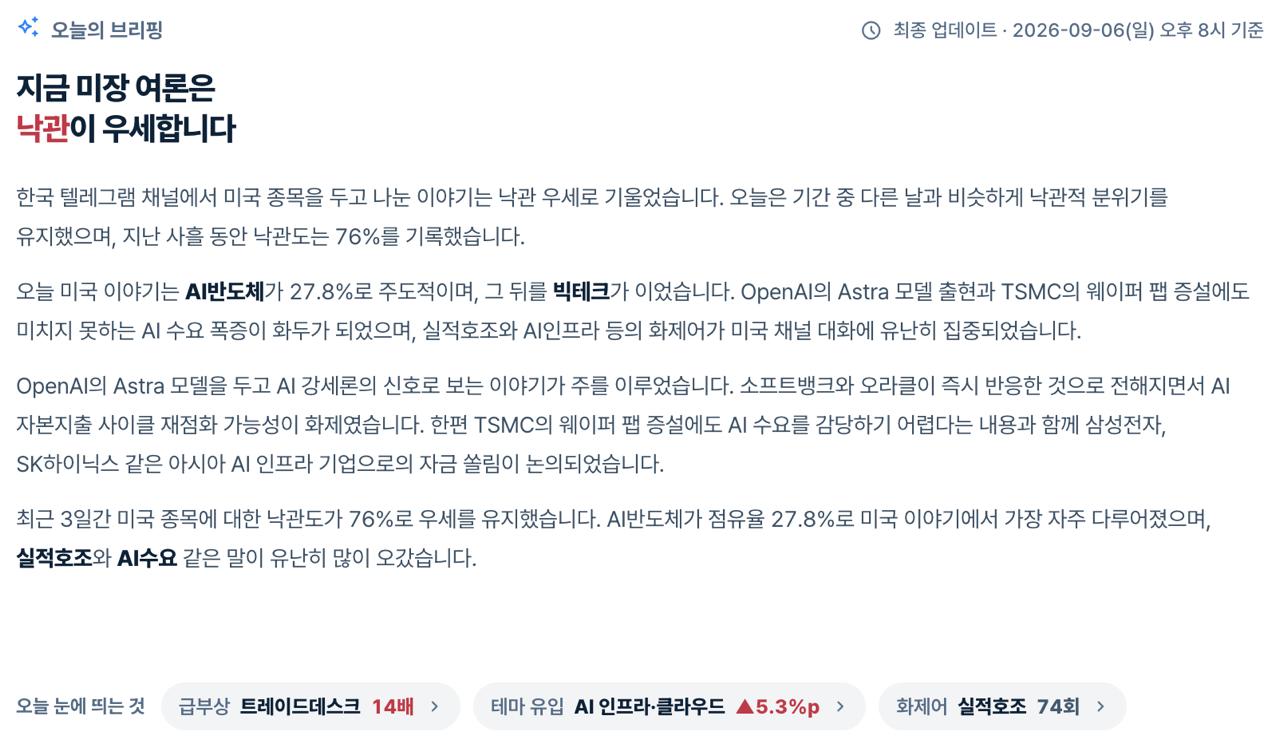
The biggest topic on the weekend channel was OpenAI's Astra. A widely circulated article noted that Goldman Sachs' trading desk head called the model "what AI bulls have been waiting for," and reports followed that SoftBank, which invested in OpenAI, rose over 10% immediately after the announcement. An article also circulated stating that TSMC's Co-Chief Operating Officer Houo Yung-ching said the company is building 20 wafer fabs but still cannot keep up with AI demand.
Russia's President Putin was scheduled to meet with US special envoy Witkoff and Kushner on Saturday, and reports indicated the US delegation ordered a halt to Kyiv airstrikes for the next four days. Upcoming items for next week included Apple's new product event with foldable iPhone reveal, September 10 simultaneous expiration of US producer prices and domestic futures and options, September 11 US consumer prices, and September 16 Federal Reserve meeting.
One week on the US side
Among US stocks, Nvidia was the most mentioned every day, with Broadcom taking its place only on Thursday. Broadcom presented an artificial intelligence semiconductor sales target of about $58 billion for the 2026 fiscal year and about $230 billion for 2028, a fourfold increase in two years, and said that the volume for 2027 and 2028 has already been secured. Dell rose 15.8% following the announcement of cumulative AI orders reaching $100 billion.
Nvidia announced its acquisition of Hugging Face for $1.293 billion, and this news led to Robotis, a company that supplies actuators to robots under Hugging Face, in Korea. Tesla followed with the unveiling of Cybertruck and the announcement of the general opening of robotaxis, and Anthropic's listing was reportedly postponed to mid-November, just before the US midterm elections, according to Reuters.
Themes
In Korea, semiconductors remained in first place throughout the week. Second place was occupied by secondary batteries on Monday and switched to bio from Tuesday to Friday. Robots rose to fifth place on Friday.
In the US story, AI semiconductors took first place, followed by big tech.
Data included in this article
Item | Quantity |
|---|
Collection Channels | 317 |
Collected Messages | 31,573 |
Domestic Issue Keywords | 559 types (weekly total) |
Domestic Theme Aggregation | 26 themes |
US Theme Aggregation | 16 themes |
Source: hatzze.fun/kadera
※ The amount of mention and aggregation only indicates how much is being mentioned, and is for entertainment and reference purposes only, not buy or sell signals. This does not guarantee the truthfulness of rumors.
▶ Original source: https://hatzze.fun/