
Since this is a translation of an overseas article, there may be some mistranslations.
https://hothardware.com/news/nvidia-dlss-5-neural-rendering-launch-thursday
NVIDIA DLSS 5 Officially Launches: Debuts Thursday with NBA 2K27
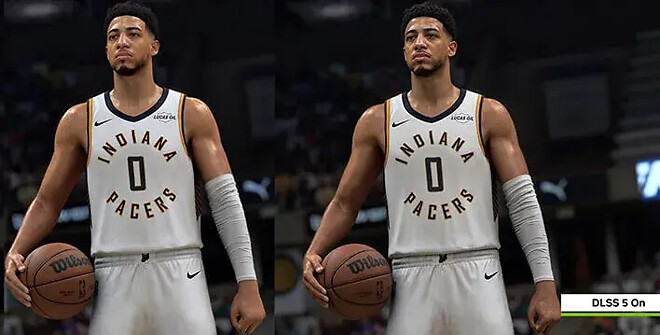
Since DLSS 5 was unveiled at GTC 2026 last March, the response has been mixed to say the least. Some users showered it with praise, eagerly anticipating the next leap forward in graphical fidelity. Others were sharply critical, and some of their criticisms were valid. Of course, no one should form a true opinion before experiencing and testing the technology firsthand, and that opportunity will soon arrive as DLSS 5 launches this coming Thursday, September 3rd, alongside NBA 2K27.
NVIDIA showcased DLSS 5 again at SIGGRAPH 2026 last June, sharing more detailed information about the new graphics technology. However, the demonstration itself was fundamentally similar to what had been shown before. This led to questions about whether the state of DLSS 5 upon its official release would be significantly different. The answer is largely "yes." The technology launching this week shares a lineage with what was demonstrated in March but benefits from six months of focused optimization work.

So, what exactly is DLSS 5? Now that we know considerably more, let's explain.
NVIDIA DLSS 5 Neural Rendering Key Summary
NVIDIA calls DLSS 5 a breakthrough in real-time rendering and photorealism. The company refers to it as "3D guided neural rendering" and boldly claims that it represents the future of graphics technology. We're not yet ready to evaluate such a claim, and we won't have access to independent third-party testing until at least Thursday. Instead, let's examine NVIDIA's updates and discuss the technology.
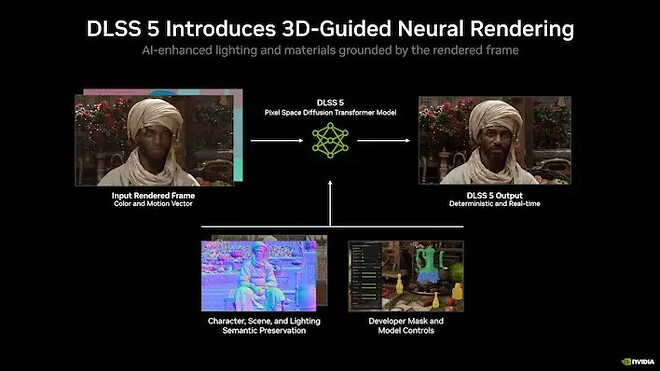
Fundamentally, DLSS 5 is a diffusion transformer model designed to "make real-time rendering look more realistic." It's not just a filter but a highly specialized version of a video generation model specifically optimized to enhance the fine details of 3D video game graphics.
As NVIDIA's Edward Lee explained at SIGGRAPH, DLSS 5 inherits extensive world knowledge from its underlying, much larger model, enabling it to understand scenes more deeply. While specialization results in the loss of versatility and the inability to generate new media from text prompts, it gains the ability to operate in real time.
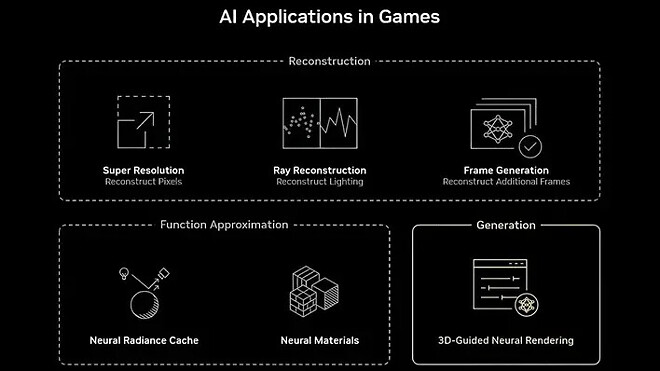
To put it simply, it's an AI model that turns images into images. However, it's not as simple as taking a completed output buffer and feeding it into Stable Diffusion or a similar program. First of all, this model is deeply specialized. It's also much smarter than things like Stable Diffusion.
While forward-thinking hackers have proven that it can work with relatively little input data, it can accept a variety of inputs beyond just a completed color buffer. This includes what appears to be an overall G-buffer. A G-buffer is a collection of 2D texture layers that store values such as albedo (base color), surface normals, depth information, roughness and metallicness, and motion vectors.
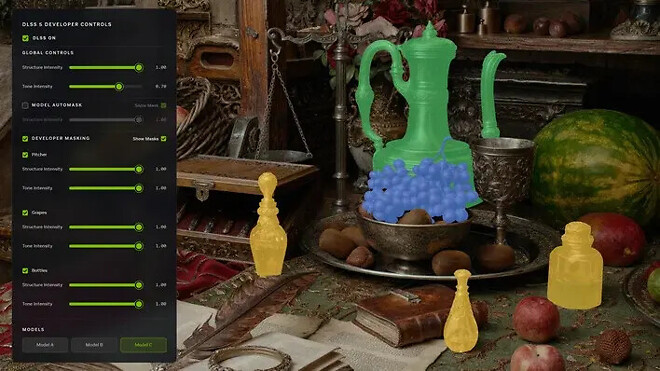
That's not all it can do. DLSS 5 supports several other control functions, both on the engine side and on the model side, along with engine-side inputs.
Engine-side inputs include developer masking, which allows developers to define objects within a scene for DLSS 5 to treat differently from the surrounding environment, and two scene controls called Structure Intensity and Tone Intensity.
Developers can fine-tune how DLSS 5 processes a scene by carefully defining masks and setting intensity values. Structure Intensity affects high-frequency details for better ambient occlusion and reflections, while Tone Intensity affects low-frequency details, influencing lighting and contrast.
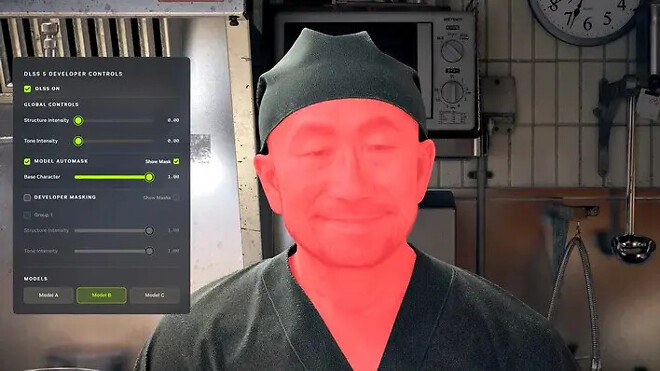
On the model side, developers can choose from three different models, each with slightly different appearances and optimized for various types of scenes. It's unclear how this connects to the seven presets discovered by modders within the leaked DLL of NBA 2K27.
Developers can also use a feature called "Model Automask," which automatically detects characters in a scene and allows developers to adjust the intensity of DLSS 5 effects for specific characters. It seems to work well, but it would be nice if NVIDIA demonstrated this in scenes with more than one character.
DLSS 5's Three Biggest Challenges
All of these fine-tuning and configuration options were added to DLSS 5's neural rendering to address one of the biggest concerns facing this technology: preserving artistic intent. According to NVIDIA, DLSS 5 is deterministic, meaning it always produces the same results. However, if the model isn't trained and configured correctly, it can alter a scene too much, removing important details or adding them where they shouldn't be. NVIDIA aimed for DLSS 5 to modify images in a way that "doesn't change the story," keeping characters recognizable and faithful to the original creator's vision.
Whether NVIDIA succeeded in achieving that goal remains to be seen, but it was only one of three challenges. The second concerned temporal stability. NVIDIA states that existing AI video models struggle with maintaining continuity from previous frames when generating frames sequentially. That obviously wouldn't work when running in real time. Video games require response times measured in tens of milliseconds for a responsive feel. The solution was to specifically train the model to operate frame-by-frame, just like a regular image diffuser.
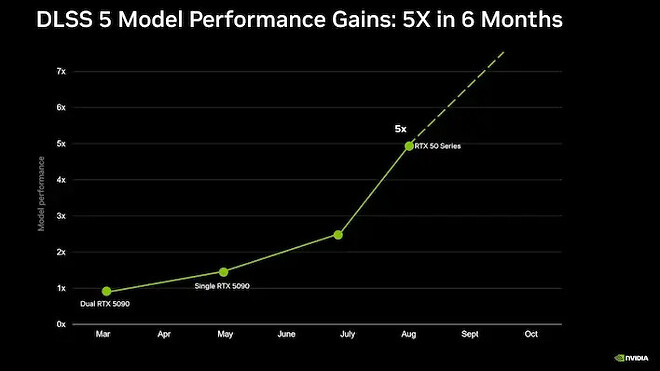
Finally, the third challenge was performance. As you may recall, Nvidia's demo at the last GTC ran on a pair of GeForce RTX 5090 cards, with one card rendering the game and the other running the DLSS 5 model. Despite Nvidia's claim that the steep hardware requirements were an experimental result, the technology received widespread criticism due to these requirements. As it turns out, their claim was true. Nvidia not only made the game work on a single GPU but also optimized it to run on relatively modest graphics cards like the GeForce RTX 5060.
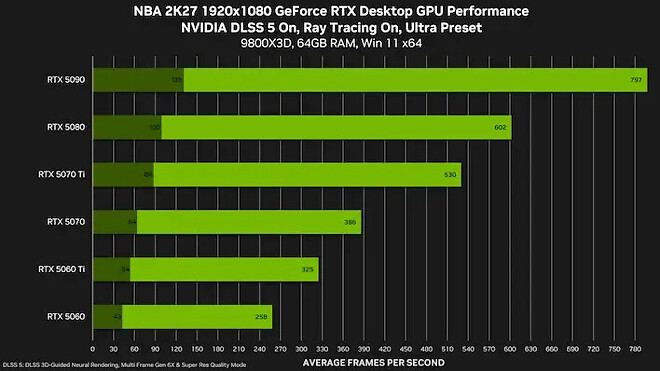
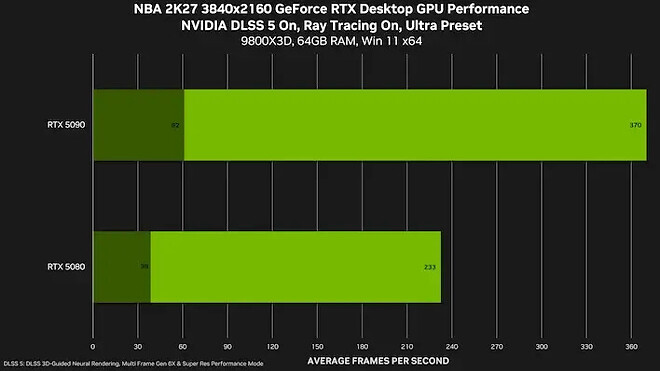
It's still unclear what the minimum requirements for using DLSS 5 are, or where Nvidia will ultimately land when the technology is further optimized. However, Nvidia has provided three sets of its own benchmarks in NBA 2K27. This game is generally a fairly light game. The recommended (not required) hardware for the game includes a Core i5-10600 and a 7-year-old GeForce RTX 2060. However, the large numbers on Nvidia's benchmark chart were generated using 6x Multi-Frame Generation (MFG). To help you see how it performs, we've added the actual MFG-unapplied rendering frame rate to each chart.
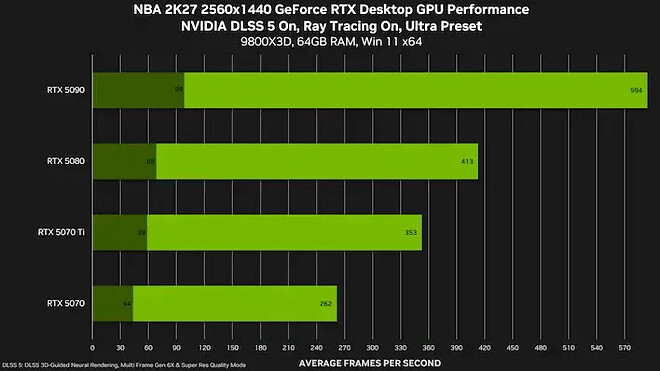
Nvidia is testing the game with ray tracing enabled at the highest settings, which looks impressive. It's still unclear what ray tracing effects the game uses, but regardless, the absolute frame rate generated without frame generation is quite low. Is this because DLSS 5 has a high performance overhead? Partially. The leaked versions that modders are forcing into every game incur a high performance cost, and some commenters speculate that this could be due to it being an unsupported and unoptimized hack.
The Real Question: What Does DLSS 5 Actually Look Like?
To be honest, I haven't had the chance to experience DLSS 5 firsthand yet besides looking at Nvidia's materials. I plan to test it myself later this week. However, Dave Altavilla, the head honcho of HotHardware, saw a live demo of DLSS 5 at GTC and was deeply impressed.
Nvidia's demo certainly looks impressive. Also, if you haven't clicked on the side-by-side leaf demo near the top of this page yet, be sure to check it out. It's taken from Nvidia's specially created Zorah demo to showcase this technology. So, naturally, it's impressive, but what about in actual games? Well, at least judging by these screenshots, it looks pretty good in NBA 2K27 too. I'll be playing the game with DLSS 5 enabled soon and will report back.
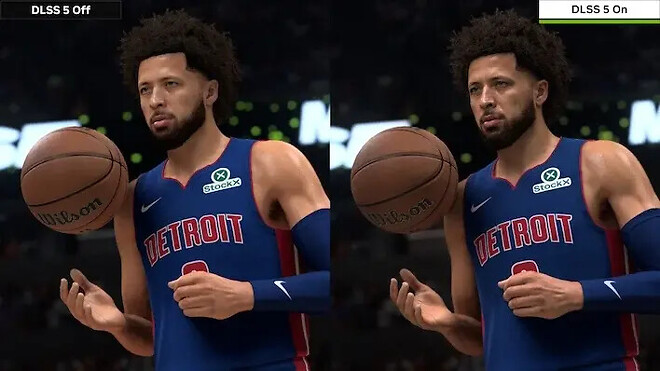
In this comparison featuring Cade Cunningham of the Detroit Pistons, it immediately becomes clear what DLSS 5 is doing for the scene. Almost every part of the image has been improved, from more accurate texturing and shading of the basketball to the wrinkles and skin of Cunningham's face, as well as the material of the sleeves and uniform. His hair appears to need a bit more work, but based on the Grand Theft Auto VI (GTA 6) footage revealed so far, such curly hair appears to be a massive rendering challenge that only Rockstar has managed to solve.
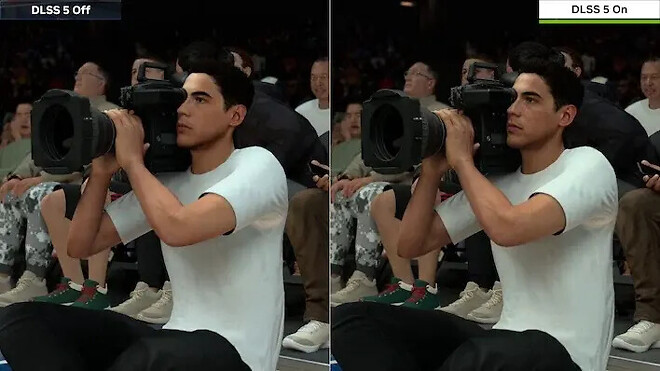
In this comparison showing a video cameraman on the sideline of the arena and some fans in the stands, the improvements are more subtle, but once you start looking, they are equally noticeable. In addition to the face of the young cameraman, the material and shading details of the camera itself have been greatly improved, and subtle details like the shading on the camera operator's hands and the texture of the fans' faces are also evident in the DLSS 5 version. There are other comparisons we could show you, but you've probably gotten the point by now.
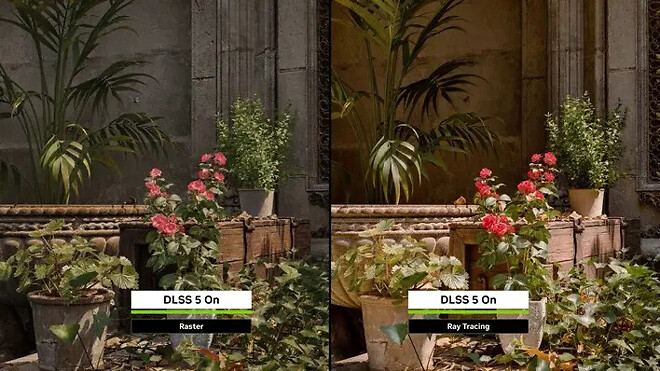
As we pointed out earlier, NVIDIA is testing NBA 2K27 with all graphics features enabled. You might wonder why that is, considering that DLSS 5 will essentially enhance all the game's graphics with its own interpretation. The reason is simple.
Because having a better base rendering provides DLSS 5 with a better foundation to work with. Since there is no ground truth to serve as the standard to match, unlike DLSS upscaling or ray reconstruction, it's important for the game engine to deliver its best results to ensure the most excellent and photorealistic results from DLSS 5.
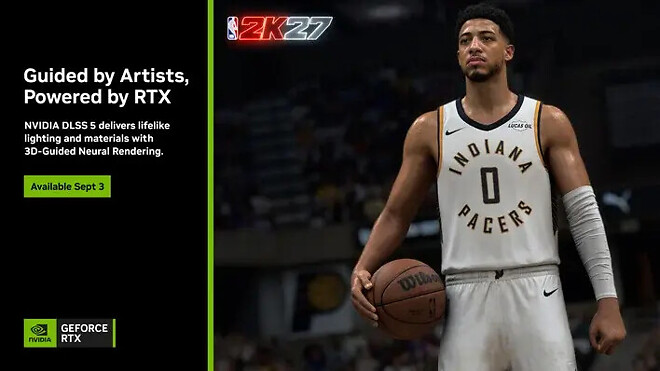
Of course, not all video games aim for a photorealistic appearance. DLSS 5, at least this version, explicitly targets photorealism, so it's not a great fit for games that don't attempt a high level of realism. Nevertheless, this technology is set to be applied to far more games than NBA 2K27.
At GTC, NVIDIA announced that DLSS 5 is set to be applied to Aion 2, Assassin's Creed Shadows, Black State, Cinder City, Delta Force, Hogwarts Legacy, Justice, Naraka: Bladepoint, NTE: Nevernis to Evernis, Phantom Blade Zero, Biohazard Requiem, Sea of Resonance, Starfield, The Elder Scrolls IV: Oblivion Remaster, and "more".
While most of these games actually have a visual style geared toward photorealism, I'm very curious to see how it will look in NTE, an animated gacha game.
Once NBA 2K27 launches with this feature on Thursday, September 3, we'll provide a somewhat more comprehensive report on DLSS 5. For now, what we can tell you is that this technology is real, and it's coming on Blackwell GPUs near you.
There is currently no official support announcement for the Ada Lovelace chip, but since it has the necessary FP8 support, it's possible we may see neural rendering work on previous generation GPUs as well. Unfortunately, those with older chips will likely have no opportunity.
This is because the leaked version puts a heavy load on RTX 30 series GPUs. However, as Nvidia has not explicitly stated this, please continue to watch for further information.
▶ Original source: https://hothardware.com/news/nvidia-dlss-5-neural-rendering-launch-thursday