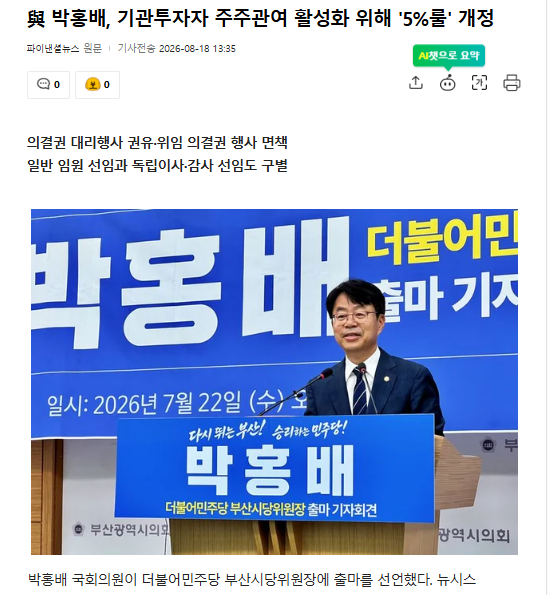
Representative Park Hong-bae of the Democratic Party introduced a Capital Markets Law amendment on the 18th that includes provisions for exception application of the large shareholder reporting system (5% rule) to actively encourage institutional investors' shareholder engagement activities.
The core of the amendment is to apply exceptions to the 5% rule when institutional investors recommend or receive and exercise proxy voting rights in relation to shareholder meeting decision-making.
Under current law, the 5% rule requires that when shares held by oneself and specially related parties exceed 5% of the total, the holding status and holding purpose must be reported to the Financial Services Commission and the Korea Exchange. In particular, those who jointly acquired shares or agreed to jointly dispose of or exercise voting rights are also included as specially related parties and considered co-holders.
As a result, there is room for institutional investors' proxy voting recommendations or exercise of delegated voting rights in shareholder meetings to be interpreted as co-holding. In particular, in the process of proceeding with such procedures, if exceeding 5%, reporting obligations arise for institutional investors, and if the reporting obligation is neglected, legal violations may even occur for institutional investors. Some have pointed out that institutional investors conscious of this are inevitably passive in shareholder engagement activities.
Accordingly, the amendment introduced by Representative Park exempts cases where institutional investors receive and exercise proxy voting rights as a result of recommending proxy voting through disclosed procedures from the 5% rule. This establishes a kind of 'safe harbor (liability exemption)'.
Additionally, the amendment also more specifically clarifies the criteria for reporting changes in holding purpose under the 5% rule from the current 'for the purpose of affecting management rights' to 'for the purpose of actually exercising control over major management matters'. This aims to solve the problem of the difficulty in distinguishing between the act of presenting opinions on company management and the act of exercising substantial control in major decision-making processes.
Furthermore, the amendment distinguishes between the appointment of independent directors, auditors, and audit committee members and the appointment of general executives. This reflects the fact that general executive replacement for securing management and appointment of independent directors and auditors to strengthen corporate monitoring and oversight functions are essentially different in nature. Safe harbor provisions are also applied when public pension funds or entrusted investment management companies exercise shareholder rights related to changes in company bylaws in accordance with principles previously disclosed for improving the governance structure of entire investment target companies.
================================
I'm not sure exactly, but it does seem to have some impact.
▶ Original source: https://news.nate.com/view/20260818n17230?mid=n0203