Hello. This is my first post.
I am not a stock expert.
I have been investing for less than 2 years, and I am a beginner investor who has been doing full-time investing for about a year.
Still, I study and review data daily and am focusing on AI-related stocks from Korea, the US, and China. I continue to monitor market regimes and my portfolio with the help of various materials and AI.
Recently, while lurking on Korean stock communities, I noticed the atmosphere seemed somewhat gloomy, so I thought I'd write down a slightly more optimistic scenario I've been thinking about over the past few days. I'm worried that I might be saying things that deserve criticism since I don't live in Korea and don't fully understand the investment sentiment of those here.
Still, this is a hypothesis a beginner worked hard to study and organize, so please view it kindly. This is a personal hypothesis, so it's not something to refer to for investment decisions. If you think "wow, this beginner is studying hard," I'd appreciate that, and you can also say "this beginner doesn't know how scary the stock market is," but please don't curse me ^^
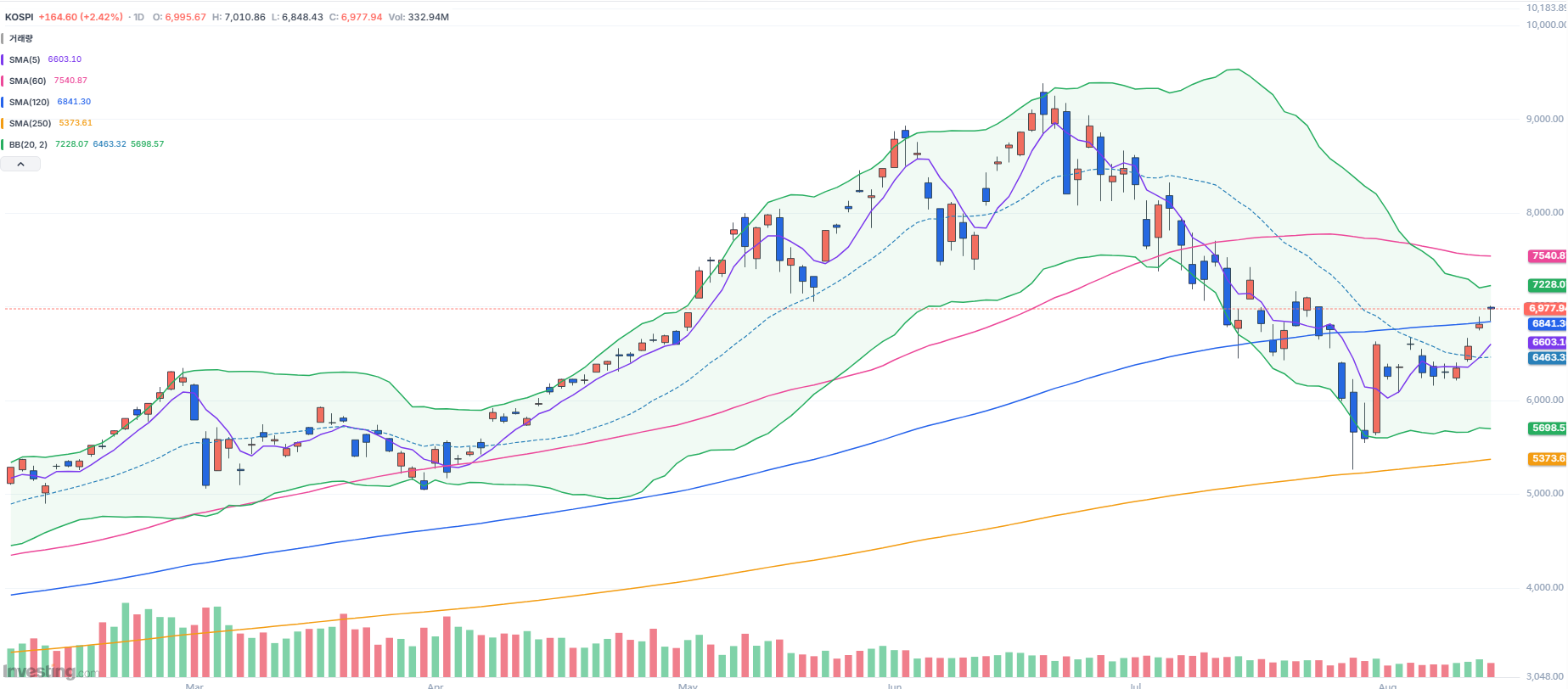
1. I believe the rebound from 5.2K to 7K was relatively easy to explain
I'm roughly dividing the recent buying pressure as follows.
A. Strategic long individual investors / long-term value funds
These are funds that were bought early, enduring fear, in periods when valuations dropped significantly, such as the late 5K to early 6K ranges.
However, such individuals likely used up a considerable amount of cash during the sharp decline, so as the index rises, their capacity for additional purchases may weaken. It seems that some long-term value funds also became increasingly passive about additional purchases as stock prices rose.
B1. Institutions and foreign investors re-entering based on fundamentals
These are funds that re-evaluate memory EPS, valuations, macro environments, etc., and increase their Korean exposure.
B2. Long-term funds that wanted to increase their Korean stock market allocation in the first half but couldn't sufficiently do so because of the too-rapid rise
These are funds that entered only partially or delayed investment entirely, and then entered after deciding prices returned to reasonable levels following the sharp decline.
B3. Funds returning due to volatility normalization
These are cases where funds that mechanically reduced their Korean allocation due to July VKOSPI spikes or VaR/Risk Budget issues are restoring their exposure as volatility declines.
From early 5K to 7K, these funds could relatively easily enter for reasons like undervaluation attractiveness, volatility normalization, and completion of unfinished positions, so I think this was a somewhat natural rebound. (Of course, in the early 5-6K range, it was truly bleak, and even believing in fundamentals, I was anxious.)
2. If 7K breaks through and holds, I think this is where the real test of this rebound begins.
I manage my own target purchase prices for each stock, and now that KOSPI has risen near 7K, quite a few stocks have already begun to exceed their target purchase prices. In other words, the force of simply "buying because it's cheap" like in the 5-6K period will likely weaken.
So I think it's important whether B1-B3 funds can continue to absorb higher prices even after 7K. Still, I think there are increasingly materials supporting that possibility recently.
Recent earnings from major US tech companies have somewhat eased concerns about the profitability of AI CAPEX,
US memory/storage companies' stock prices and long-term demand outlooks are strengthening,
Demand subjects are diversifying not just with CSPs but also with neo-clouds, sovereign AI, and enterprise AIDCs,
AI infrastructure investment is no longer dependent solely on CSPs' own FCF, and diverse financing and funding structures involving governments, financial institutions, and big tech are emerging, further easing concerns about investment sustainability,
A narrative is gradually forming that agentic AI expansion can increase demand across the entire memory hierarchy, not just HBM but also DRAM/NAND,
There is also anticipation for shareholder returns from Samsung Electronics and SK Hynix.
If these materials continue to be confirmed, I think there are reasons for long-term funds to continue making additional purchases of Korea even after 7K.
3. I consider 7.5K an important inflection point
I think breaking through KOSPI 7K itself has quite significant meaning for investment sentiment.
If round numbers like Samsung Electronics' 300,000 won start appearing again here, individuals who have left the market or been on the sidelines may gradually redirect their attention.
But I think the really critical area is the 60-day moving average positioned around KOSPI 7.5K based on current levels.
There will be quite a bit of inventory caught during the sharp decline at this price point,
Individual investors trying to break even,
Some profit-taking from investors who bought at low prices in the 5-6K range,
Institutional rebalancing
could converge and bring significant supply.
Therefore, in the 7K→7.5K range, I think the key is still how much fundamentals and long-term funds absorb that supply.
If 7.5K is properly broken through, the character of the market could change
When KOSPI recovers the 60-day moving average and key stocks like Samsung Electronics and SK Hynix begin to restore their intermediate trends, different funds could enter from that point, I think. Specifically, not "buying funds" because it's cheap, like quant, momentum, and trend-following funds or professional traders, but "buying funds" because the trend is confirmed.
If that happens, I believe that even if there's a thick layer of accumulated sell orders from the past, the behavior of market participants themselves can change. When prices return to break-even, people who were planning to sell might think 'the trend has revived, so let me hold a bit longer,' and at the same time, new trend-following funds can also enter the market.
So I think after properly digesting 7.5K, we could also consider 8K.
To summarize my hypothesis simply,
1) 5.2K~7K — Undervaluation and panic discount resolution zone: A rebound that normalizes undervaluation and excessive fear.
2) 7K~7.5K — The real test of this rebound: It's important whether fundamentals and long-term foreign/institutional investors can continue to absorb existing sell orders.
3) Breaking through and settling at 7.5K — Zone where trend-following funds can enter: With recovery of the 60-day line, quant, momentum, and trend-following funds can begin to take serious interest. However, with substantial sell orders still present, volatility may increase.
4) Around 8K (I really wish it goes just like this) — Zone for re-validation of retail sentiment and fundamentals: A zone where whether retail sentiment recovers becomes important again. From then on, the key is whether AI infrastructure demand, memory EPS, shareholder returns, and macro conditions can actually push the index to higher levels.
Of course, if external variables like the US stock market, geopolitics, inflation, and interest rates worsen again in the meantime, this scenario could easily fall apart. Still, I think the current situation is somewhat different from 2-4 weeks ago, when we were getting beaten down daily and it was difficult to gauge how much further we'd be pushed. It may be a clumsy hypothesis close to wishful thinking, but I'd appreciate it if you could view it lightly as just another way a beginner investor like me sees the market.
July was really tough for me too. I live in Canada, so it's relatively easy to invest in the US market, but I also made a judgment error by investing spare funds in the Korean stock market in June and July ㅠ.ㅠ Still, looking at my account gradually recovering, I'm thinking and studying to learn and turn as many things as the money I lost in this bear market into assets.
Wishing everyone successful investing!!
Thank you for reading this long post