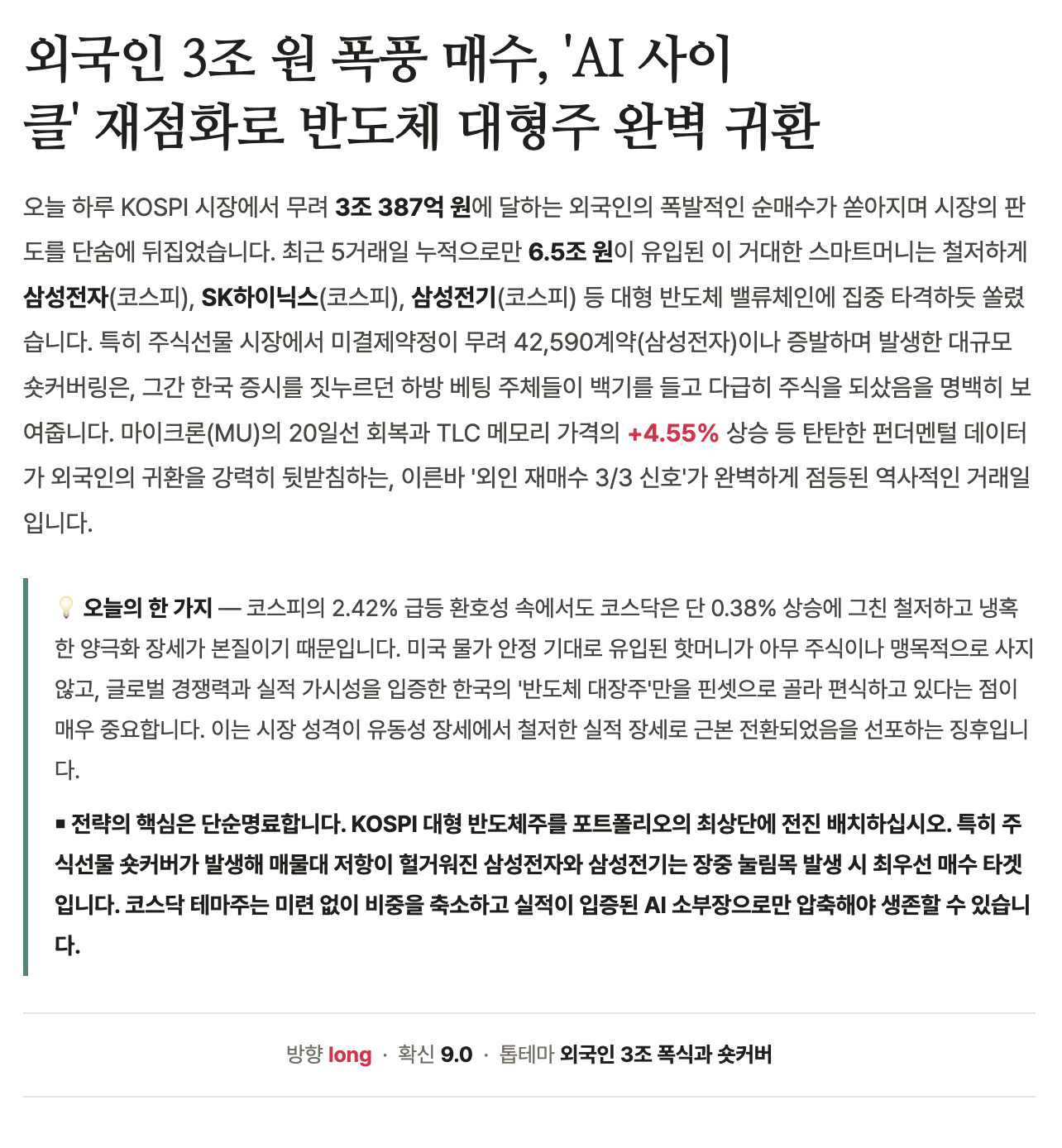
For a full four trading days, foreign investors led the rally.
Of course it is not as fast as the pace of the decline, but simply ending the endlessly falling bear market and, together with the channel shift, creating a different pattern already makes this a good enough market.
Looking back at April, which was a similar situation,
back then too it was clearly hard to buy because things "looked expensive." Then before anyone knew it prices were up 100%, and after doubting and doubting, everyone accepted it as the new normal, and many people began entering late, leaving behind a gap that had already widened as far as it could.
The difference from April is that back then it was a "road traveled for the first time," while now it is a "road already traveled once."
Retail investors have grown cautious and are choosing to trim their positions once prices rise a certain amount.
That also means it was that hard for everyone to hold on through this downturn.
That said, retail investors have bought about 110 trillion won or more this year, and even taking out the money lost to forced liquidations and leverage unwinds, they bought with at least over 80 trillion won, so the current selling can be seen as only a small part of that money coming out.
The majority are still waiting for prices to return to their average cost, which means the road up ahead is rough.
So resistance at the ceiling is heavy and it is hard to climb, while foreigners push prices up, never stop buying, and then sell futures to drive prices down, using retail investors' fear to buy at low prices.
Recently institutions have also been selling the spot shares they picked up at the bottom, yet foreigners kept buying steadily and led the index higher.
Experts see the change in foreign positions as a change of hands, with different foreign players participating rather than the existing ones. Foreigners of a somewhat different character have entered the market and begun buying the domestic market, which is heavily undervalued relative to its value.
The only way to break through this ceiling is ultimately to punch through with a "gap up,"
and quite coincidentally, the US semiconductor market is reviving as well.
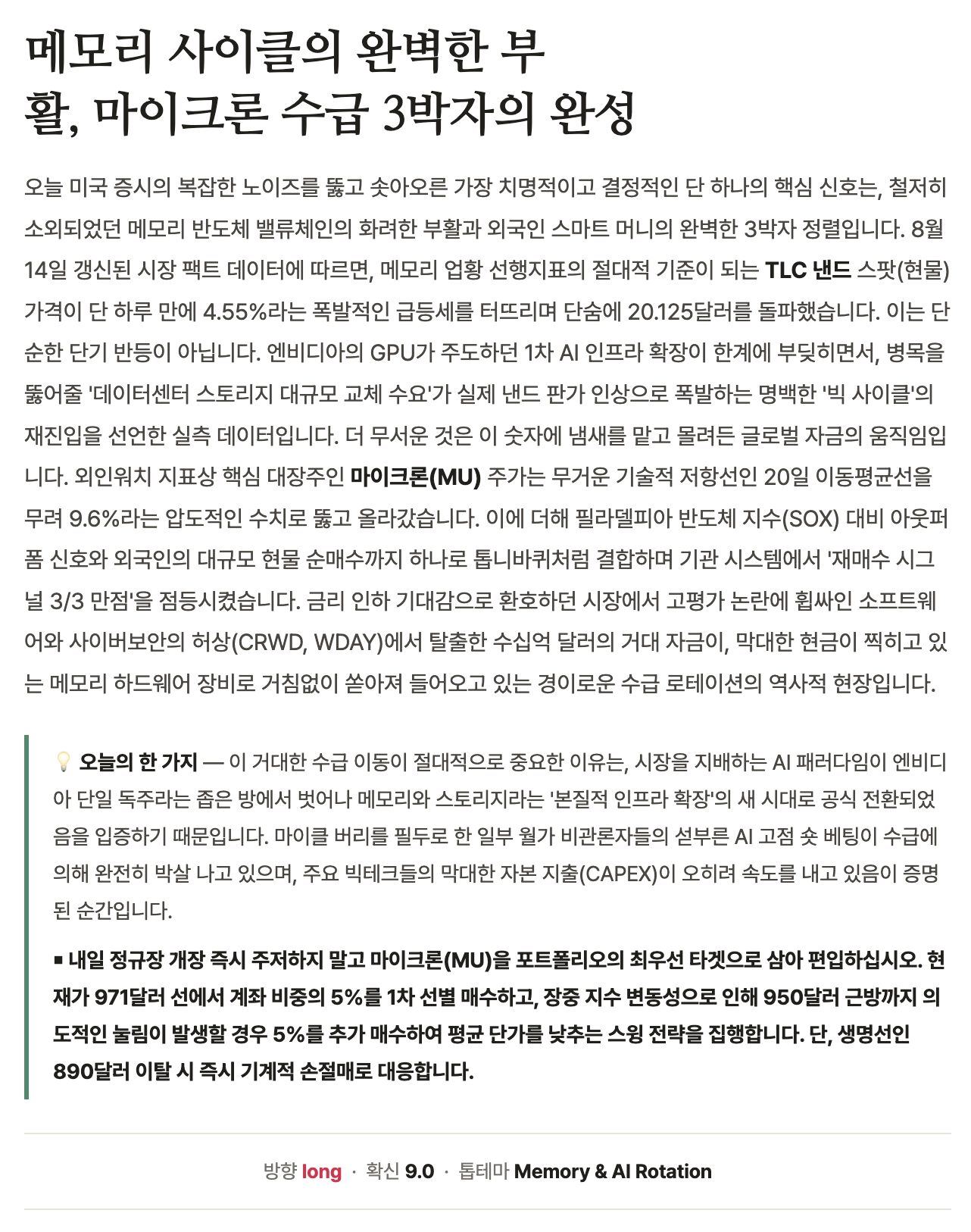
US equity reports show Micron recently taking first or second place in trading value, and the view is that supply and demand has practically returned to what it used to be. Looking at Micron's flows, the put/short side used to press it down whenever it hit the ceiling, but lately it has been breaking through the ceiling to a degree the shorts can hardly bear.
On top of that, after losing the options battle day after day, the call side won twice this week.
This is highly significant: the shorts may gradually come under margin-call pressure. Once a short squeeze comes, it shoots up at some point, and my personal thought is that the 1000$~1050$ range for Micron shares may be the shorts' last line of defense
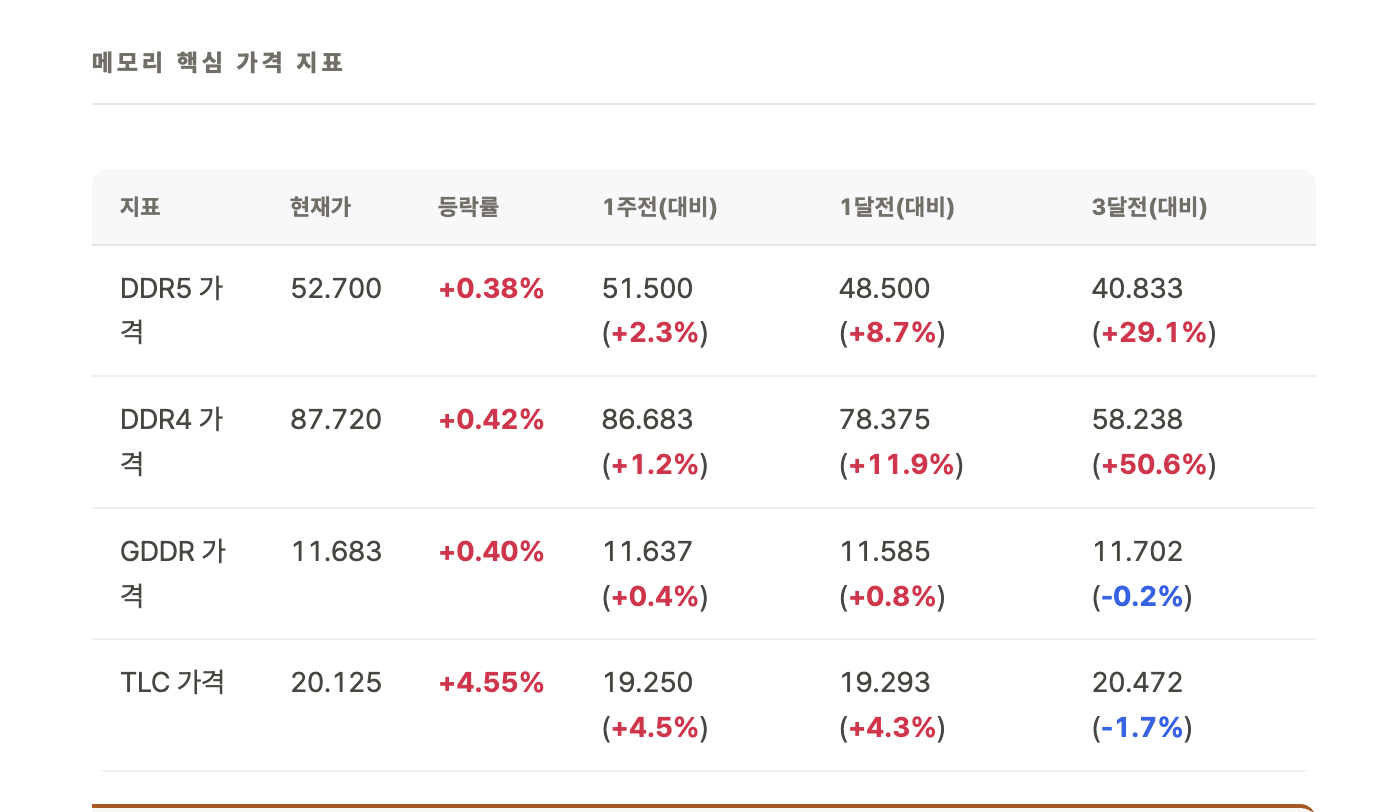
An even more positive point: SSD TLC prices had kept falling, so I had wondered whether the trend had effectively broken,
but recently the bottleneck has accelerated again and the one-day rate of increase has risen enormously.
Thanks to that, SanDisk has regained the same rate of gains as before, though the negative of YMTC ranking third in shipments still remains.
However, most of YMTC's output is for retail, and although its enterprise (corporate) share has risen from last year, retail has low net profit, so its actual revenue stayed in fifth place.
SSD technology is not actually such a remarkable technology, so others can catch up quickly, but enterprise-grade SSDs are a bit different.
Enterprise SSDs need long cell life ( there is a lifespan unit called TBW, and enterprise-grade SSDs with heavy Read and Write have a fundamentally different lifespan ), they need durability against the heat from frequent io, and above all the stability of the SSD controller must be good. They also must not suffer severe performance degradation from problems in some cells due to frequent io.
One reason QLC is avoided for enterprise use is that after a certain time Read performance drops so severely that it becomes hard to use. In any case, verification in this area is extremely tight.
The leaders here are Samsung Electronics and Hynix (Solidigm, which acquired Intel's business), and since disk replacement has to be easy, they must ship legacy-format 2.5-inch nvme SSDs or SAS SSDs, and verification for these is fairly demanding. In data centers the defect rate must be below 0.15%, they must be usable for five years without cell errors, and even when cell errors occur the controller must handle data isolation and redistribution well — on this verification YMTC is still a question mark.
There are plenty of YMTC SSDs on the market and reviews showing stable speeds on nvme4.0 have appeared, but I could not find verification reports from the data center side; presumably export restrictions mean there are no US reports, and domestically there are only retail usage impressions, so such material was hard to find.
So for enterprise use storing important data in countries other than China, verification of YMTC will take considerably more time, and since net profit in this area is large, I think it may take about two more years for them to catch up on revenue.
Around next year, negative news from YMTC may well keep coming, so I think the NAND flash side needs to be watched through the end of this year.
Both domestic and US tech stocks have escaped their downtrend channels, and while it feels like they may be stretching out again,
on the other hand....

I am a bit wary that this might become that meme... but in any case we have escaped the downtrend channel and I think we can now declare that we have entered a new upward pattern.
Holding through the downturn all this time must have been mentally hard — well done to all the investors here in Jusik Handang, and I hope you will be happy with even better returns going forward.