"OECD and EU Announce AI Literacy Framework"
The AI literacy framework was finally announced last June. It's a policy that many have been waiting for, and it was created at the right time through a exemplary process. ^^
Since the draft was released last year, over 2000 people from more than 100 countries, including teachers, students, policymakers, scientists, teacher unions, and NGOs, participated and provided feedback to complete it.
1. International Student Assessment (PISA) to Begin Reflecting AI Literacy from 2029
This framework stands out and holds significant weight because it will be introduced as a new media and AI literacy (MAIL) assessment item in the Programme for International Student Assessment (PISA) starting in 2029.
PISA assesses 15-year-old students in OECD member countries every three years, and its results influence education policies in those countries for years to come. Therefore, it is very important. Starting in 2030, the PISA results will be announced based on this framework, allowing for international comparisons of AI literacy levels among students.
2. Structure of the AI Literacy Framework
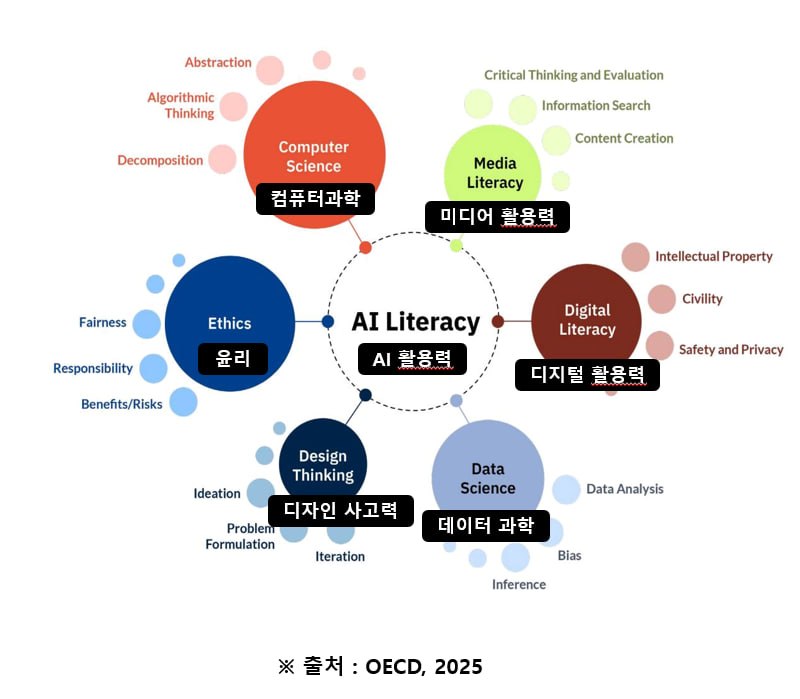
1) Core Competencies: Computer Science, Data Science, Media Use, Digital Use + Ethics, Design Thinking
It clearly defines six areas. Notably, it includes ethics and design thinking, which is important and welcome. Recognizing the importance of establishing and internalizing proper values and the ability to structure and redesign given tasks and situations, this framework acknowledges that these skills are as crucial as direct technical skills.
This indicates that AI literacy should be deeply connected to existing educational systems and academic fields.
2) Definition of AI: Not Human, Cannot Replace Humans, It's Also Important Not to Use It
It clearly reaffirms that 'AI systems are not human and cannot replace human judgment, care, or relationships.'
Learners will develop the ability not only to use AI but also to decide when not to use it. It emphasizes that refusal or limitations on use can sometimes be responsible and ethical choices.
This is a new emphasis added since last year's draft, explicitly stating the viewpoint that "not using AI is also part of AI literacy."
3) Additions to the Final Version in 2026: Enhanced Practicality for Education
- A new 'learner expectations' section was added, explaining developmental stages for basic, intermediate, and advanced levels of AI literacy in elementary and secondary education.
- It also includes 'embedded learning scenarios' and 'exemplary activity examples'.
This allows for the transformation of each competency into real classroom activities across various subjects. It even includes offline, low-tech activities that can teach AI concepts without direct access to AI tools.
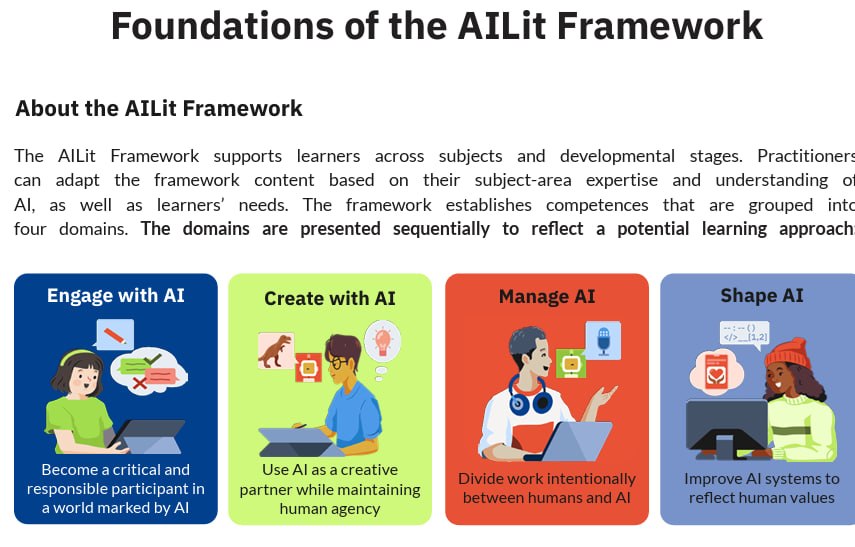
Structured activities and core technology modeling demonstrate how to apply the framework to different subject types.
.
.
Although this framework is not legally binding, it is expected to serve as a benchmark for countries navigating the AI transition and redesigning their AI education policies. Most importantly, it is hoped that it will help control the trend of blindly emphasizing AI skill development, assessment, and testing.
In the future, we need to define true AI talent as individuals who cultivate critical thinking through humanities, social sciences, and philosophy education, enabling them to stand as autonomous human beings.
https://ailiteracyframework.org/
▶ Source: https://ailiteracyframework.org/