Photo description, DeepSeek, amazing the world.
China's new AI sensation, DeepSeek, has hit the tech industry hard.
The chatbot rose to the top of the free app charts in the US, surpassing ChatGPT. At the same time, its founder, billionaire Liang Wenfeng, became a household name in China.
Launched last week, this low-cost chatbot was reportedly developed for far less than its competitors. This sent shockwaves through Wall Street and rivals are scrambling to respond.
Former US President Donald Trump commented on DeepSeek's success, saying it was "a wake-up call that American companies must compete to win."
Photo source,CCTV
Photo description, DeepSeek founder Liang Wenfeng (right) attending a Chinese government meeting.'Eccentric figure'
DeepSeek was founded by Liang Wenfeng in December 2023, and he released his first AI large language model (LLM) the following year.
The 40-year-old was born in Guangdong province, China, and studied electronic information engineering and computer science at Zhejiang University.
While not much is known about him, Chinese tech media outlet 36Kr describes him as "more of an eccentric figure than a CEO" by those who know him.
Rarely appearing in public or giving interviews, he is now attracting international attention. He was recently the only AI company representative invited to a meeting of business leaders with Chinese Premier Li Chang. At the time, business leaders were instructed to "focus on breakthroughs in core technologies."
From finance to AI
Unlike many American AI entrepreneurs from Silicon Valley, Liang Wenfeng also has experience in the financial industry.
He was CEO of Highflyer, an AI-powered quantitative investment hedge fund that used AI technology to analyze financial data and make investment decisions.
In 2019, Highflyer raised over 100 billion yuan (approximately $13 billion), becoming the first quantitative hedge fund in China to do so.
Here, Liang Yuanping used AI and algorithms to analyze stock price patterns and accumulated a vast fortune. His team was skilled at using Nvidia's H800 chip to generate profits from stock trading.
He founded DeepScience in 2023, declaring "We will develop human-level AI."
Cultivating Chinese AI Talent
Liang Yuanping is directly involved in DeepScience's research and is known to offer exceptionally high salaries to top-tier AI talent using profits from his hedge fund.
DeepScience has headquarters in Beijing and Hangzhou, and its research team consists of PhD graduates from prestigious Chinese universities such as Peking University, Tsinghua University, and Beihang University.
It is also considered one of the companies offering the highest salaries to AI engineers in China, alongside ByteDance, the parent company of TikTok.
In an interview with Chinese media last year, Liang Yuanping emphasized, "Our core team consists entirely of local talent. We need to cultivate top talent ourselves."
He also pointed out that China's AI industry "cannot remain a follower forever."
"We often say the gap between Chinese and American AI is 1-2 years. But the real difference lies in 'creativity' and 'imitation'. Unless this changes, China will forever be a follower."
DeepScience's Competitive Advantage
Photo credit,Reuters
DeepScience claims that its AI model R1 was developed using existing technology and open-source software accessible to everyone.
However, WIRED magazine reported that Liang Yuanping's hedge fund, HighFlyer, has been accumulating a large number of GPUs (graphics processing units), which are essential for AI.
According to MIT Technology Review, the number of GPUs he has acquired is estimated to be between 10,000 and 50,000.
These high-performance chips are crucial for building AI models capable of performing a variety of human tasks, from answering basic questions to solving complex mathematical problems.
In September 2022, the United States banned the export of these high-performance chips to China. Liang Yuanping referred to this as "the biggest challenge" in an interview with Chinese media.
Currently, major Western AI models are estimated to use approximately 16,000 high-end chips. DeepScience claims to have trained its AI model R1 using 2,000 high-end chips and thousands of low-specification chips, thereby achieving cost savings.
According to the development team, the chatbot's production cost was only $5.6 million (approximately 7.5 billion won), which is significantly lower than the $5 billion (approximately 6.7 trillion won) invested by OpenAI in developing ChatGPT last year.
However, some are skeptical of this claim.
Elon Musk, a US tech billionaire, pointed out that it is questionable for DeepScience to make such claims without disclosing the actual number of high-end chips used.
Did US Sanctions Boost China's AI Innovation?
Experts analyze that the US chip export ban has presented both a challenge and an opportunity for China's AI industry.
Marina Zhang, associate professor at the University of Sydney, explained, "While these restrictions are challenging, they have forced Chinese companies to innovate more with limited resources."
He added, "Developing creativity and resilience within these limitations aligns with the Chinese government's policy of technological self-reliance."
Indeed, China has made massive investments in cutting-edge technology industries such as batteries, electric vehicles, solar panels, and AI.
President Xi Jinping has long expressed his ambition to make China a technological powerhouse, and there is analysis that the US regulations have served as a catalyst for Beijing's pursuit of technological independence.
Mixed Reactions
Photo credit,EPA
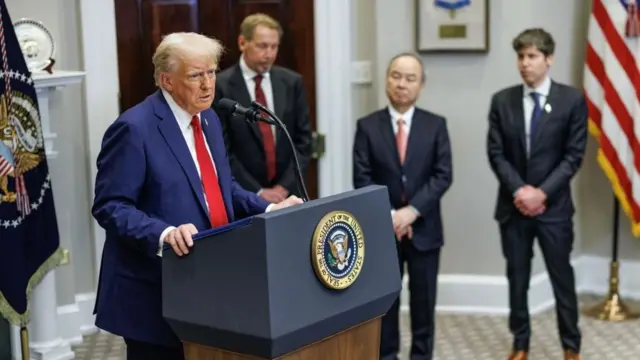
Photo credit,EPA
The emergence of DeepMind has sparked heated reactions in the tech industry, leading to a sharp decline in the share prices of major IT companies.
In particular, Nvidia's stock price plummeted 17% by the close of trading on Monday in New York, wiping out $600 billion in market capitalization. Bloomberg described this as one of the largest single-day drops in US stock market history.
Venture capitalist Marc Andreessen referred to DeepMind R1 as "the Sputnik moment for AI," comparing it to the 1957 launch of Sputnik 1, the world's first artificial satellite by the Soviet Union, which triggered the space race between the US and the USSR.
However, concerns are also being raised about DeepMind's rapid rise.
US analyst Jin Munster expressed skepticism in an interview with BBC, stating, "The truth behind DeepMind's publicly disclosed financial data may still be hidden beneath the surface." He questioned the company's actual funding methods and profitability.
"The chatbot's performance is astonishingly impressive, which makes it even harder to believe," he added.
Australian Science Minister Ed Husic issued a warning about DeepMind's security issues.
"There will be many questions raised regarding the quality of this technology, consumer preferences, data and privacy management, and we need to approach this cautiously," he said.