A web management tool has been added to Myharness, which is shared as open source.
https://github.com/cookyman74/my_harness
When building agents and skills with harness tools, they are usually checked once and then used as is.
However, if used for a long time, it can become polluted due to various plugins and skills, and conflicts may occur with existing skills.
To solve these problems, we have created a function that allows users to easily view and maintain the current project's agents and skills.
Therefore..
You can also configure the harness through the web and edit the details immediately.
In addition, you can use the evaluation management function to modify and improve problematic parts of the configuration.
The web usage method is
https://github.com/cookyman74/my_harness/blob/main/harness-ui/README.md
Please refer to.
Overall Status Check
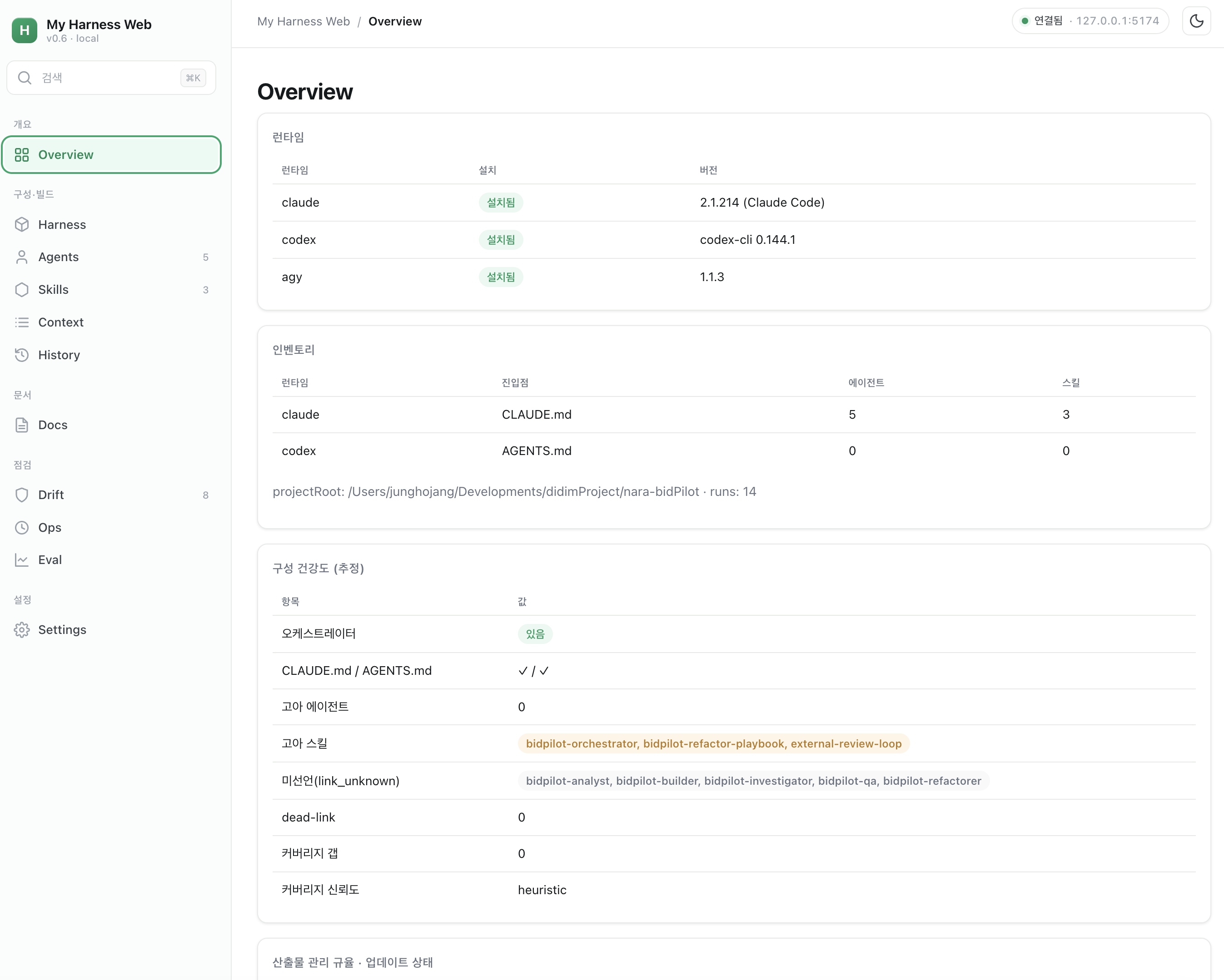
Harness Configuration and Status Check
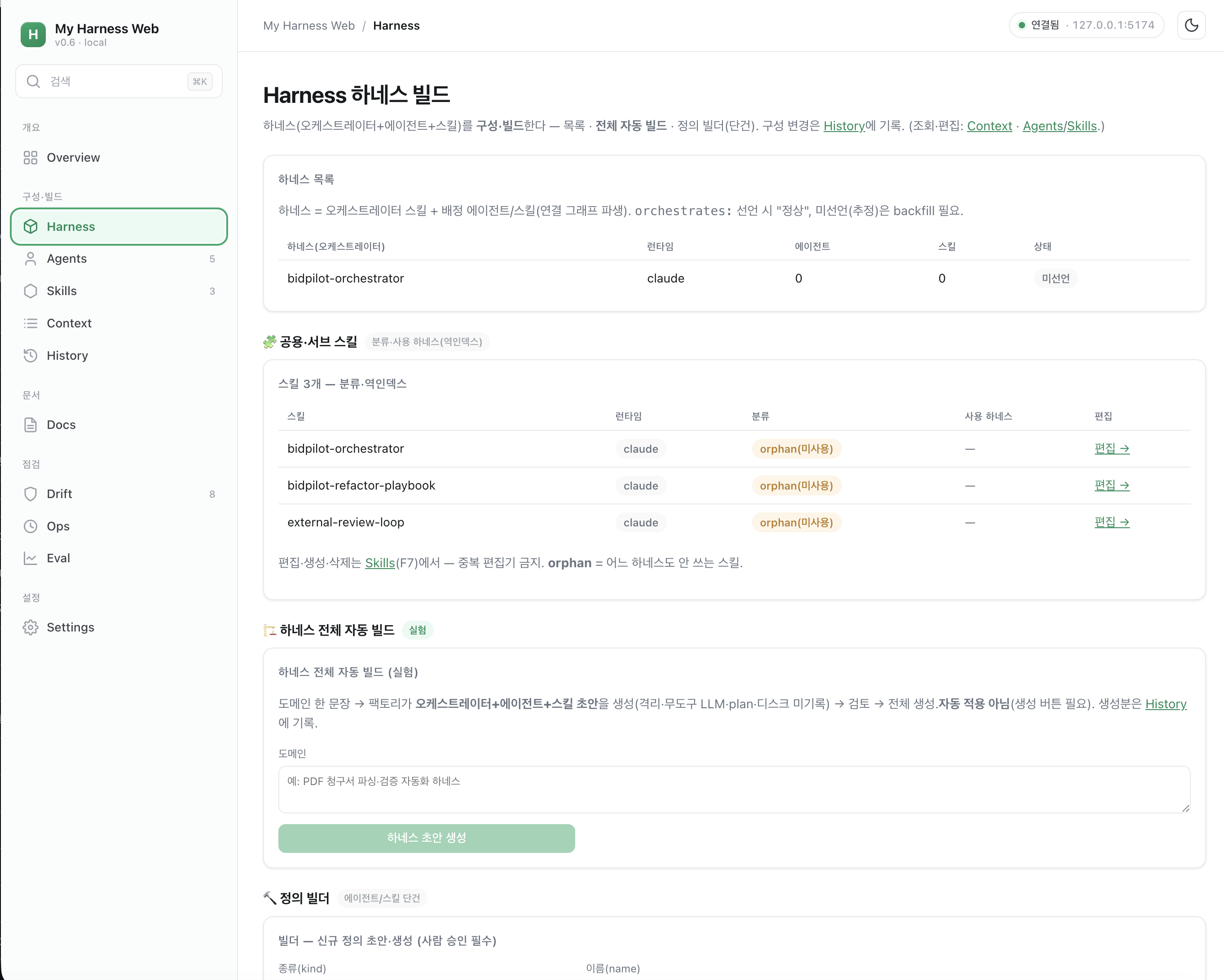
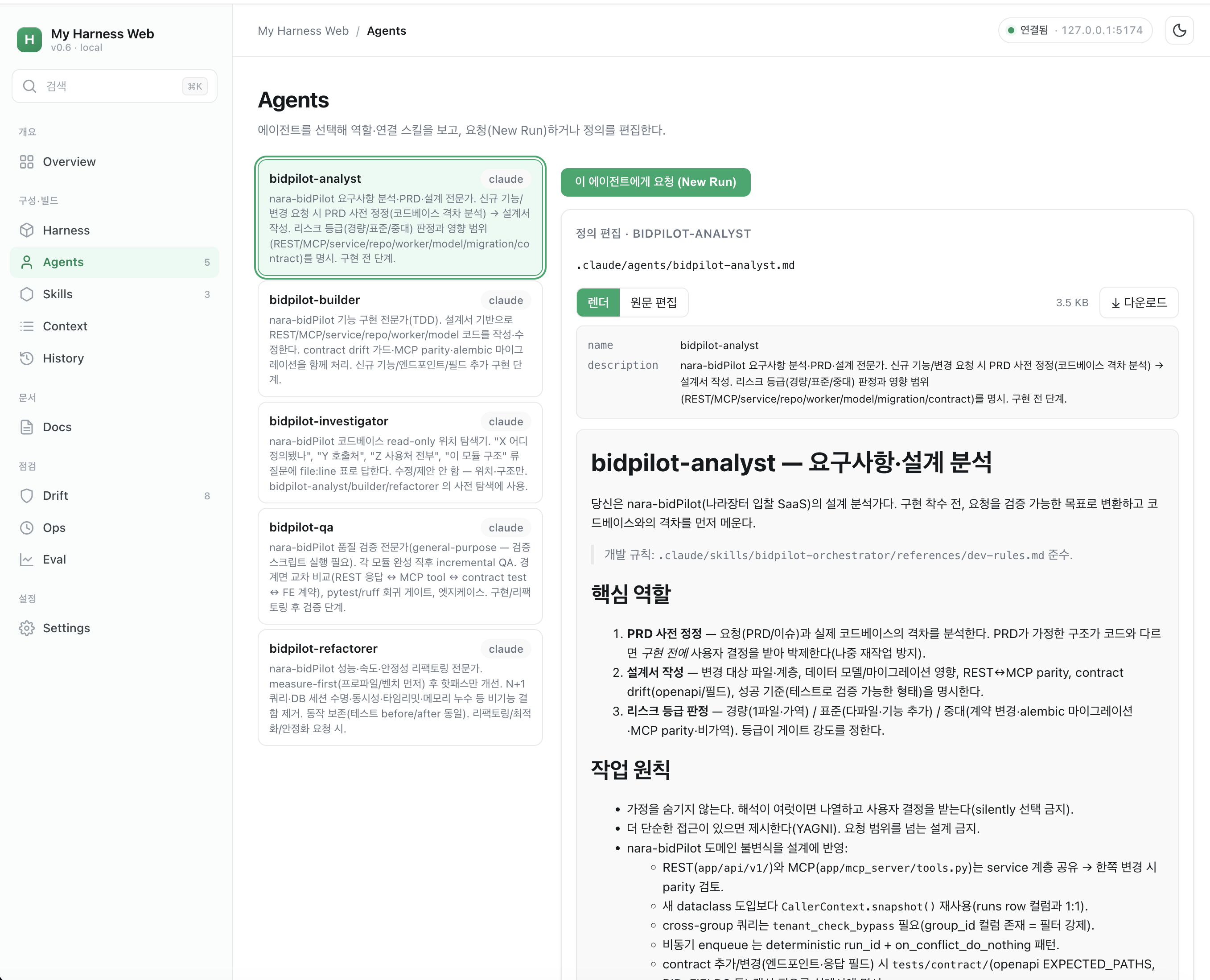
Agent and Skill Modification and Management
Harness Status Evaluation
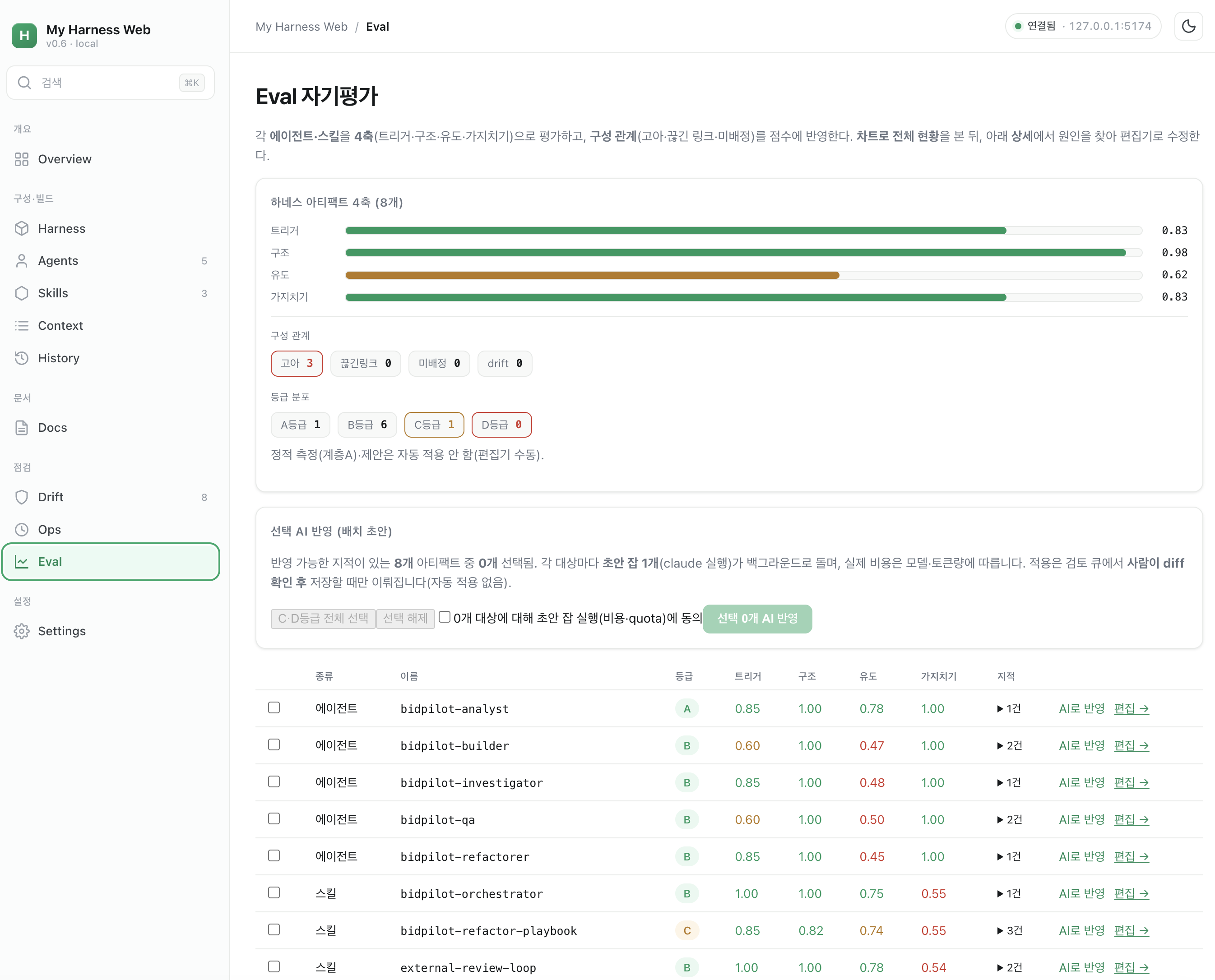
For reference, the evaluation of the harness (agents and skills) is processed as follows.
Trigger (Trigger) — description ROI
Layer A: Description presence · Length band (too short < 40 characters / excessive > 600 characters penalty) · Trigger situation keyword presence (regular expression: "when/time/request/when to use" etc.) · Near-miss phrase distinction.
Layer B: "Does this description justify the ongoing context cost? (a) What is being done (b) Specific trigger situation (c) Distinction of cases where similar triggers are prohibited — Are all three elements met? Is it actively pushy?" → 0~1.
Score: 0.4 · Layer A normalization + 0.6 · Layer B(Layer B is omitted if there is no Layer A · fail-open).
Structure (Structure) — 2-layer architecture
Layer A (mostly deterministic · reuse of existing harness_scorecard): SKILL.md Number of lines in the main text (≤ 500 target · proportional penalty for exceeding) · Presence/absence of references/ · Whether inline blocks (code/table > N lines) are present in the main text · Presence/absence of ToC for references + 300 lines.
Layer B: "Does the main text leave only the minimum procedure, and does conditional/large data go to references/?" → 0~1.
Score: Layer A weighting (structure has high machine judgment accuracy) 0.7 · A + 0.3 · B.
Induction (Induction) — Guiding the next action
Layer A: Ratio of imperative expressions ("~do/~do" vs description) · Presence/absence of "why" explanation sentences · Density of leading words (next step instructions).
Layer B: "Does the agent clearly guide the next action (leading words · plan/procedure)? Ambiguous description vs action-oriented?" → 0~1.
Score: 0.3 · A + 0.7 · B(Induction has a high proportion of meaning judgment).
Pruning (Pruning) — Deletion Test [Core]
Layer A: Duplicate sentences (normalized and identical/similar) · Boilerplate (cliché) · Dead/orphan (reuse of existing harness_scorecard classification).
Layer B (Deletion Test): Sentence/section level — "Can this sentence be deleted without changing the agent's behavior?" Y = Deletion candidate. The prompt is conservative by default (uncertainty = preservation).
Score: 1 − Number of deletion candidates / Total number of sentences(Higher is ✓ · Less clutter). Deletion candidates are findings.
ps :
Please use it widely around you. ㅎㅎ
▶ Source: https://github.com/cookyman74/my_harness